
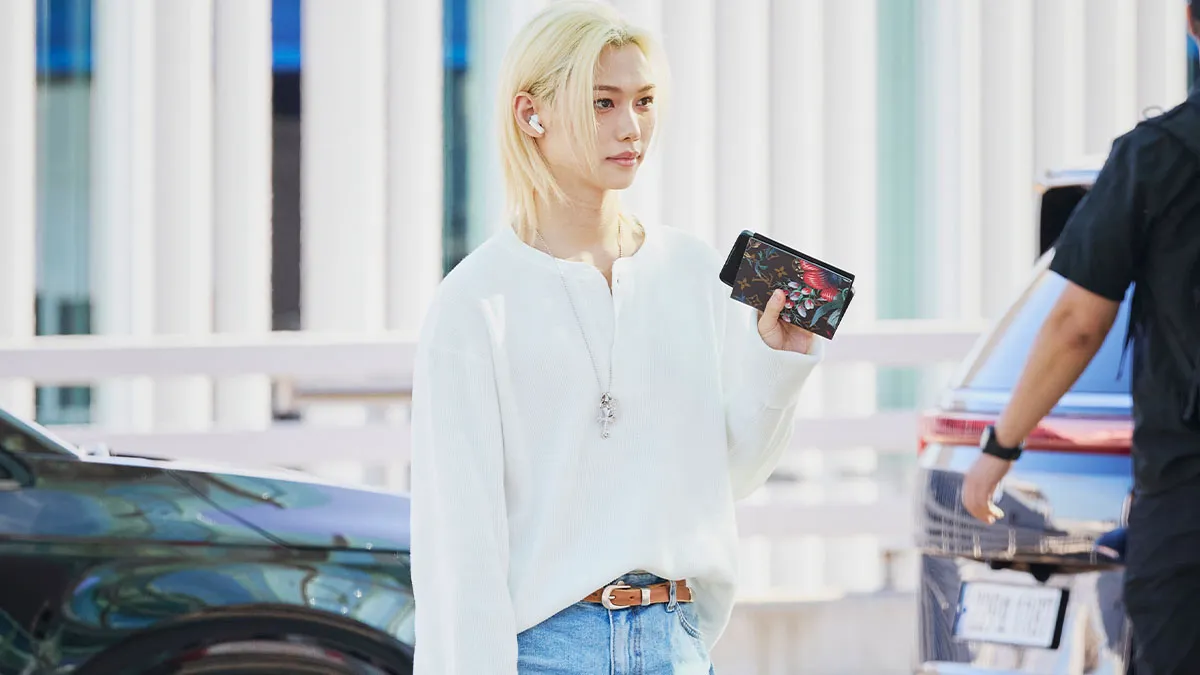
Shin adds that young South Korean shoppers are “more fluid than previous generations. They may wear an expensive watch or bag with a relatively affordable Korean fashion brand, sneakers or an outdoor jacket.”
The shift has been evident at Ami Paris, which has also been opening stores outside Seoul — most recently in Hyundai in Chungcheong, a province southwest of Korea. Accessories have been strong sellers in the country, as well as womenswear, according to Santi-Weil. He says that sneakers, bags and hats have all been growing faster in Asia than in Europe or the US, and that more than 60% of people who visit stores in South Korea are women — outpacing the brand’s global womenswear business, which stands at 20% of sales.
Furthermore, Korean shoppers have been losing interest in logos, Santi-Weil says. Previously, products with the “Ami de Cœur” emblem — a bold, red heart topped with the letter “A” in a capital sans-serif font — would fly off the shelves, he says. Now, customers are more interested in more considered pieces that help them build a complete, versatile wardrobe.
“Shopping is becoming less about following a fixed hierarchy of brands and more about curating a personal world of taste and identity,” says HyperM’s Kim. As a result, “people are spending less on what feels interchangeable and more on what feels meaningful,” he explains — with many no longer simply asking “Can I afford it?”, but “Is it worth it, and does it feel like me?”
The long-term view
Experts are keeping a watchful eye on how long South Korea’s momentum will last. JP Morgan’s Battistini warns that since June 1, South Korea’s stock market, the Kospi Index, has pulled back by about 35%. “Some of the drivers of the Q2 strength might become more volatile into Q3,” she says. Though Battistini is optimistic that South Korea — which boasts one of the highest per capita luxury consumption rates — will remain “a strong contributor to luxury growth, helping to offset the volatility in some other markets” into the rest of 2026 and 2027.
China and Japan may serve as guiding points for brands evaluating the South Korean market. Over the past few years, Japan’s luxury market underwent a major boom, fueled by a weak yen that attracted international shoppers. However, it has since normalized and transitioned from the tourism-driven wave into a stable, high-value market where domestic and jewelry sales continue to climb. Meanwhile, China’s luxury market is yet to fully rebound, as the country grapples with a drawn-out property slowdown that has weighed on consumer confidence. But that hasn’t detracted the growth strategy of several brands, including OTB-owned Maison Margiela, which has been making massive investments in China, including its decision to stage its Fall/Winter 2026 show in China in April, closing out Shanghai Fashion Week.
Still, brands must recognize that South Korea’s luxury market has evolved, and local shoppers no longer simply look to global brands for aspiration. “The global rise of K-pop, K-beauty and Korean brands such as Gentle Monster has created a new level of cultural confidence,” says Kim. “Korean consumers still value heritage, craftsmanship and prestige, but they increasingly expect international houses to engage with Korean culture, rather than simply market to them.”