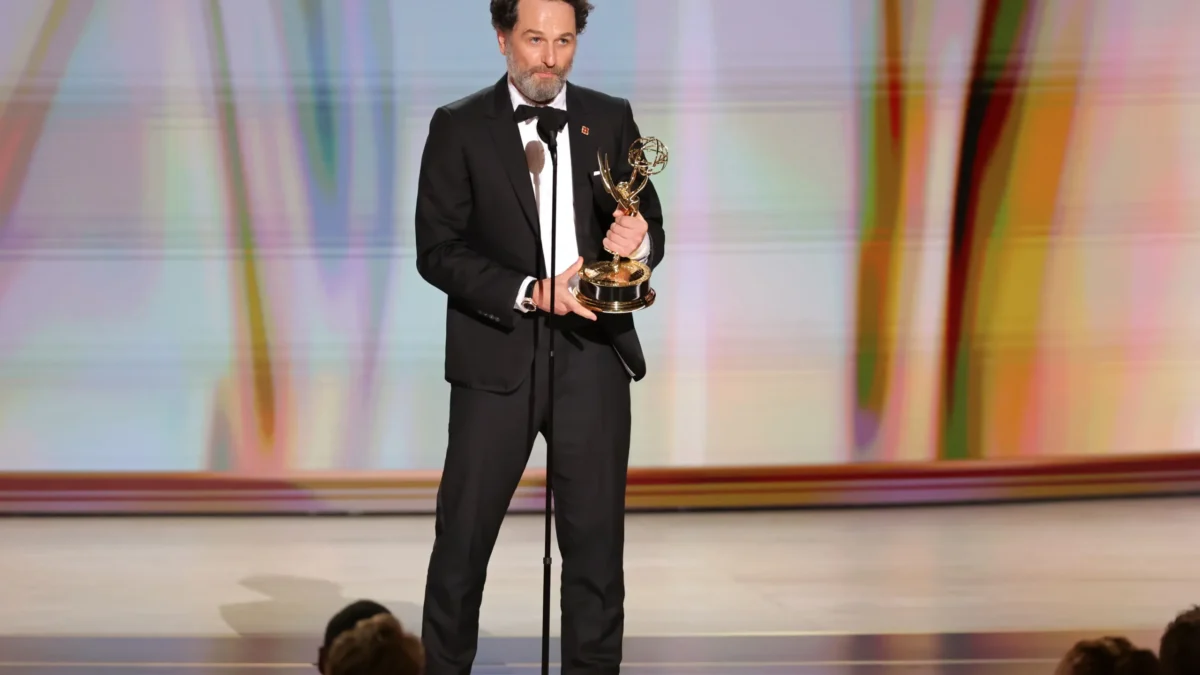
The Television Academy is in advanced talks to move the Emmys to Amazon Prime Video, a potential historic break from broadcast television that would put one of TV’s defining awards shows behind a streaming subscription for the first time.
The shift is not yet final. TV Academy Chair Cris Abrego said only that “conversations are continuing.” But if the deal comes together, it would mark a major turning point for a ceremony that has lived on broadcast television since 1949. Mariska Hargitay closed the 78th Emmys on Monday night from the Peacock Theater, and the next version of the show may look very different.
The larger question for the TV business, however, is whether a new platform actually fixes what has been ailing awards shows. The evidence in the current awards landscape suggests the answer is far more complicated than simply moving from a network to a streamer.
A bigger platform does not guarantee a bigger audience
The Emmys’ most recent eight-year rights deal, struck in 2018, had the networks paying just over $8 million a year to carry the show. That arrangement has become increasingly awkward as streaming companies have become dominant players in the Emmy race. Last year, CBS staged the ceremony while HBO Max, Apple TV and Netflix dominated the evening. CBS won one Emmy, for the now-canceled “The Late Show With Stephen Colbert.”
The 2025 Emmy telecast drew 7.59 million viewers, the ceremony’s best number since 2021. That gives the Television Academy a meaningful audience to protect at the very moment it is considering a move away from the broadest traditional distribution model the Emmys have known.
The SAG-AFTRA ceremony offers a cautionary comparison. The SAG Awards, now rebranded as “The Actor Awards,” moved from TNT and TBS to Netflix in 2024. That first Netflix edition drew 1.8 million views, roughly in line with what the show attracted in its final year on cable. It did not make Netflix’s weekly Top 10 in the U.S., though it did reach the Top 10 in Canada.
In 2025, the ceremony was described as tighter and better reviewed, and Barbra Streisand appeared to receive the Life Achievement Award. Even so, the audience did not meaningfully spike. The decline had already been visible before Netflix entered the picture: SAG drew 2.7 million viewers in 2019, then 2 million, then 1.8 million.
That history underlines the central challenge: streaming can change access, packaging and promotion, but it does not automatically give viewers a new reason to watch an awards show live.
The Emmys have tried exclusivity before
A single long-term partner could give the Emmys stability. A platform that knows it will carry the show year after year has a clearer incentive to invest, promote and experiment. Under the traditional “wheel” model, one network could build momentum for a telecast only to see the ceremony rotate to a rival the next year.
But Emmy history also shows the risk of abandoning a shared broadcast model. From 1966 to 1986, the ceremony rotated among ABC, CBS and NBC. In 1987, Fox outbid the Big Three for exclusive rights. Ratings later cratered, with the show falling from nearly 36 million viewers in 1986 to just over 12 million in 1990. One of those years, 1988, had no host. The Emmys spent much of the following decade moving back toward a shared model.
The current media environment is not the same as the late 1980s, but the lesson remains relevant: a new rights structure does not, by itself, solve audience erosion or format fatigue.
Amazon brings opportunity — and scrutiny
Amazon is not new to awards programming. Prime Video has streamed the ACM Awards since 2022, making that ceremony the first major awards show to move to a streamer. But the Emmys are a more complex proposition because Prime Video is also an active Emmy competitor.
Prime Video received 48 Emmy nominations this year and won 10 awards, including five for the now-canceled superhero series “Spider-Noir.” It also campaigns series such as the postapocalyptic drama “Fallout” and the fantasy epic “Lord of the Rings: The Rings of Power.”
That creates a perception issue the Television Academy would have to manage carefully. The Academy controls the ballot through its third-party partner Ernst & Young, and there is no suggestion that voting has been compromised. Still, perception matters when the company distributing the telecast is also competing for the trophies.
That concern already surfaced in another form this year. During the NBC awards season, Variety heard frustration from publicists and executives at rival studios over a decision to move five categories off the main telecast. Those categories were dominated by streaming series, particularly from HBO Max and Netflix. The complaints did not amount to allegations of impropriety, but they pointed to how closely the industry watches every programming decision around the Emmys.
The Oscars’ coming move to YouTube in 2029 carries a different set of questions. Google does not yet make prestige television, while Prime Video does. The SAG-AFTRA Actor Awards are already on Netflix. If the Emmys join Amazon, a significant portion of the awards ecosystem will have moved further into streaming.
The real test is whether the show changes
A move to Prime Video could free the Emmys from some of the limitations of a traditional broadcast telecast. NBC needs a show that functions as network television, with a broad audience, a strong lead-in and advertising inventory. Amazon can think in terms of Prime subscribers, platform engagement, clips, interviews and social content that extend beyond one night.
That could be the meaningful opportunity. The Television Academy has already been trying to make the main show smaller and faster, as shown by moving five categories out of the telecast. But streaming could also allow the Academy to think bigger, not smaller.
The Creative Arts Emmys are already split across two nights, and the full Emmy operation covers 116 categories. A streaming home could theoretically allow more room for red carpets, live broadcasts, speeches and crafts categories that have long been pushed away from the main spotlight. The source material also raises the possibility of an Emmys weekend running Friday through Sunday, though that remains an idea rather than a confirmed plan.
Distribution is only one piece of the larger Emmy puzzle. The supplied material also calls for a broader review of the awards structure itself, including category definitions, nominee counts, peer-group voting, ballot presentation, eligibility and the growing divide among scripted, unscripted, limited, variety and digital programming.
For now, the next step is whether the Television Academy and Amazon turn advanced talks into a deal. If they do, the Emmys may enter a new era. But the move to Prime Video would be only the beginning of the work, not the solution to everything awards shows are trying to fix.