
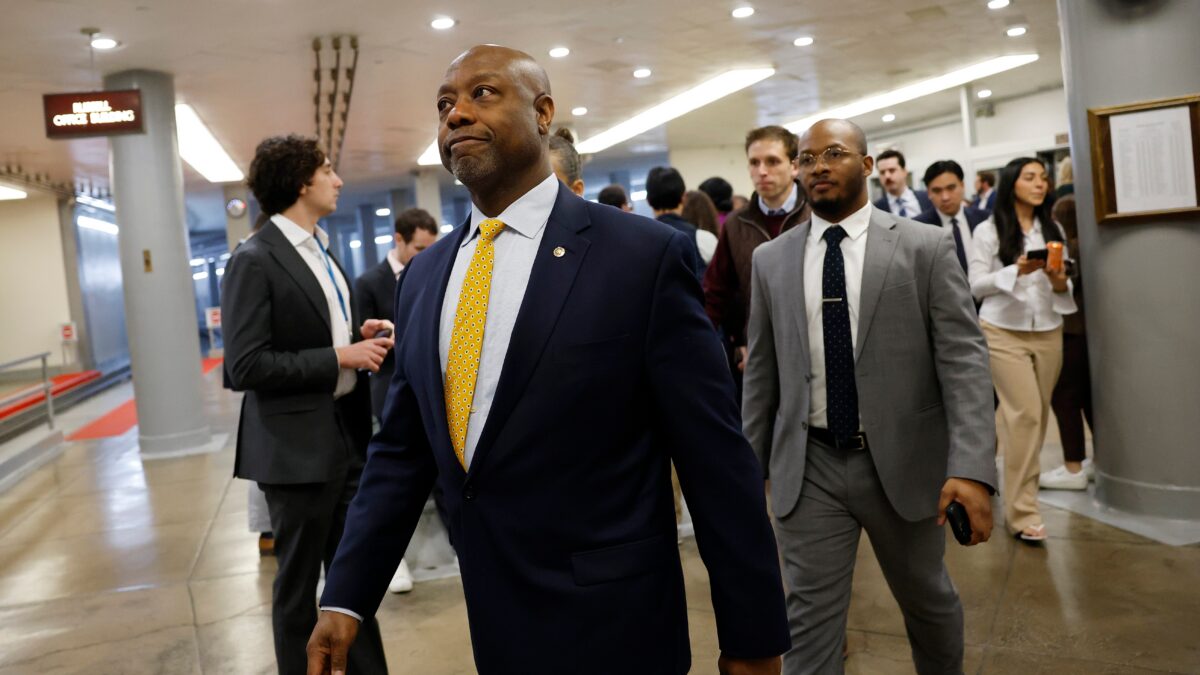
Sen. Tim Scott is making a Hollywood pitch for South Carolina as he works with Sen. Adam Schiff on bipartisan legislation that would create a federal film and television tax incentive.
Scott, a South Carolina Republican, and Schiff, a California Democrat, are co-sponsoring the Senate measure. An identical version has been introduced in the House, but supporters still face the challenge of building enough bipartisan backing to secure floor time.
As currently written, the legislation would establish a 20 percent base credit for labor costs. That federal benefit could be combined with existing state incentives, potentially giving states such as South Carolina more leverage when competing with established production destinations.
South Carolina currently offers a 20 to 25 percent rebate on employee wages and a 25 to 30 percent rebate on supplies. The federal proposal also includes an additional five percent for productions filming in disaster-impacted areas or in designated “opportunity zones,” which are economically challenged areas that can include rural regions.
Scott created the opportunity zones designation as part of the Tax Cuts and Jobs Act of 2017.
Scott argues the proposal is about local jobs
While some conservative critics have characterized the legislation as a benefit for wealthy studio owners, actors and unions, Scott is presenting it as a jobs measure with consequences well beyond performers and executives.
About 7,000 people currently work in production in South Carolina, Scott said, while entertainment affects 17,000 jobs across the state in some way. He argued that the proposed federal credit could help protect those positions and create more employment.
Although the legislation currently includes above-the-line costs, Scott disputed the idea that its primary beneficiaries would be highly paid stars. Actors receive their compensation regardless of where a project films, he said, while crew members and small businesses depend more directly on where production takes place.
Scott also framed domestic film and television production as a way to send American values to audiences. The incentive, he said, could support “multiple voices sharing their perspective on who we are as a country through film.” He noted that some of the Christian movies he watches have been filmed in Georgia.
His support also reflects South Carolina’s long-running effort to compete for entertainment work. Scott said he began trying to attract Hollywood business to the state while serving on the Charleston County Council in the mid-2000s. Later, as a member of the South Carolina House of Representatives, he considered other ways to make the state more competitive.
“We thought we had figured out the magic sauce,” Scott said, before Louisiana and Georgia introduced additional tax credits and drew more productions.
South Carolina is not currently considered a production powerhouse, though it has hosted the recently concluded series Outer Banks and The Righteous Gemstones.
A movie connection that goes back decades
Scott has described his interest in the film business as personal. During high school and college, he worked at a North Charleston movie theater that screened titles including Rocky III, Return of the Jedi and An Officer and a Gentleman.
On breaks from the theater, Scott visited a local Chick-fil-A, where he met business mentor and restaurant operator John Moniz.
Scott said he still visits movie theaters most weekends and takes notes during screenings, sitting high in the auditorium with a small light. He cited Schindler’s List as an example of a movie profound enough to warrant writing down thoughts while watching.
He also pointed to the 2003 sports drama Radio as an example of what South Carolina can bring to the screen. Filmed in Walterboro and Anderson, the movie stars Cuba Gooding Jr. as a Black man with an intellectual disability in the 1970s who becomes an assistant to a local football team’s white coach.
Scott said the film “will bring tears to your eyes” and can help viewers understand the importance of not bullying others. He praised its message of recognizing that everyone has “dignity and value,” before emphasizing that the production took place entirely in South Carolina.
The state has also recently promoted its screen history with a three-day “Discover South Carolina” installation inside Vanderbilt Hall at New York City’s Grand Central Terminal. Timed to coincide with the United Nations General Assembly meeting, the display included a fake canoe, faux swans and a neon quotation from 2004’s The Notebook: “If you’re a bird, I’m a bird.”
A placard described the state as “Hollywood’s Backlot” and highlighted The Notebook, Forrest Gump, The Big Chill, Sleeping With the Enemy and Dear John.
What Happens Next?
Scott acknowledged that affection for movies alone will not move the legislation through Congress. After the November elections, supporters will need to assemble a sizable coalition in both chambers and across party lines.
“The truth of the matter is unless we have strong numbers, bicameral numbers, bipartisan numbers, this will not hit the level of prioritization that’s necessary for it to get floor time,” he said.
His case for expanding that coalition is straightforward: “The good news is people love movies, to be honest with you.”