
Why This Matters
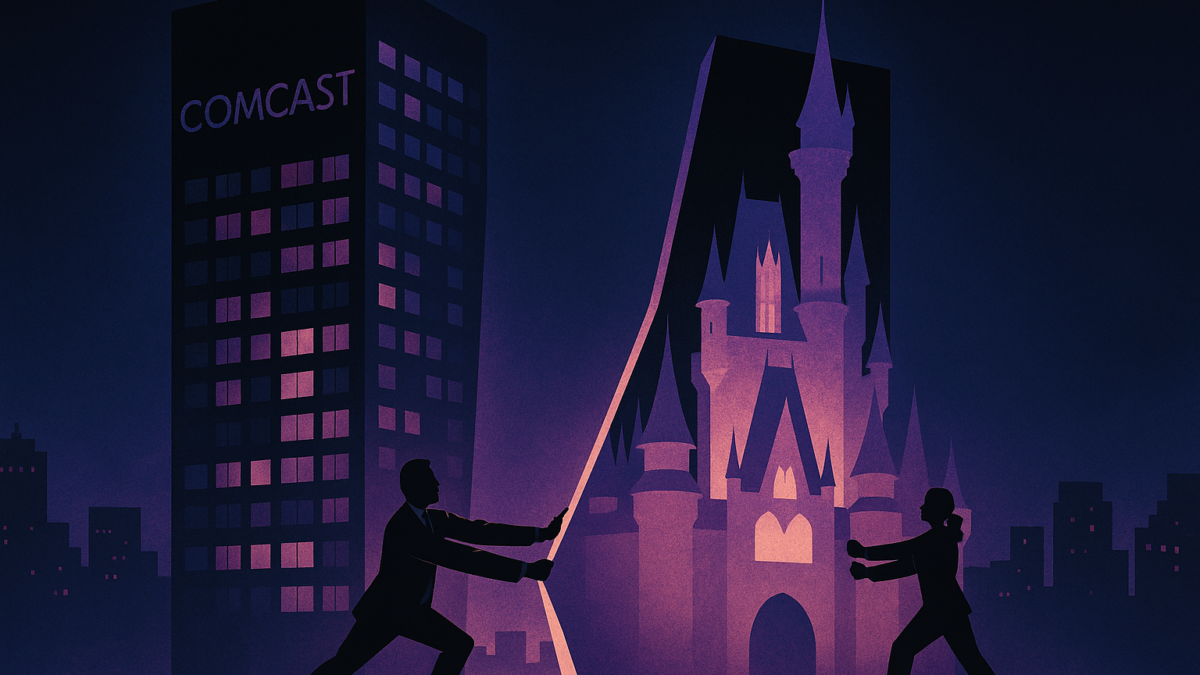
Comcast’s decision to separate NBCUniversal and Sky from its cable and wireless operations is more than a corporate housekeeping move. It is an attempt to redraw how Wall Street evaluates one of the last fully integrated giants in media and telecommunications, at a moment when investors have grown skeptical of sprawling conglomerates with mixed growth profiles.
For years, Comcast has been valued primarily through the lens of its broadband business: reliable, cash-generative, but increasingly mature as cord-cutting, wireless competition and slower household formation weigh on growth. Inside that same corporate structure, NBCUniversal’s studio, television, news, sports, streaming and theme park assets have often been treated as part of a larger telecom story rather than as an entertainment company with its own strategic trajectory.
The logic behind the split is clear: Comcast wants the market to look at the media assets differently. A stand-alone NBCUniversal and Sky would be easier to compare with Disney, Warner Bros. Discovery, Paramount and Netflix than with cable operators. The hope is that investors will assign a higher multiple to an entertainment company with global brands, premium sports rights, studio output, parks exposure and a streaming platform than they currently do to those assets buried inside a broadband-led parent.
That aspiration is particularly important because Disney has become the valuation benchmark for traditional media companies that still have scale, intellectual property, sports and parks. Comcast has long owned assets that resemble parts of Disney’s portfolio: a major film studio, television networks, a broadcast network, streaming ambitions, global distribution and theme parks anchored by major franchises. But because Comcast also owns a massive connectivity business, its stock has often traded more like an infrastructure-and-cash-flow company than an entertainment growth story.
Separating the businesses could give both sides a cleaner identity. The cable and wireless company would be able to emphasize broadband, mobile bundling, network investment and cash returns. The media company would be free to pitch itself around content, sports, international reach and direct-to-consumer expansion. In an era when investors punish complexity, simplicity has become a strategy.
Industry Context
The move arrives as the entertainment industry is still searching for a stable post-cable model. Linear television remains profitable but declining, streaming is growing but expensive, and consolidation pressure continues to build across Hollywood. Companies that spent years chasing subscribers are now focused on profitability, pricing power, advertising technology and strategic partnerships.
Comcast’s ownership of NBCUniversal has always been one of the defining examples of vertical integration: distribution pipes on one side, premium content on the other. That model once promised enormous strategic advantages. Cable systems could benefit from exclusive programming relationships, while media assets could gain leverage through a powerful distributor. But the streaming era has weakened the old logic. Consumers no longer experience entertainment primarily through cable bundles, and regulators have become increasingly sensitive to companies that control both access and content.
Sky adds another layer to the calculation. Comcast’s acquisition of the European pay-TV giant was a bold international bet, giving the company a major footprint across the U.K., Germany, Italy and other markets. But Sky’s growth has been challenged by the same forces reshaping U.S. television: streaming migration, sports-rights inflation and pressure on traditional subscription packages. Folded into a new media structure, Sky could either become a global distribution engine for NBCUniversal content or a candidate for further restructuring, partnerships or asset sales.
The entertainment sector has been moving toward sharper corporate definitions. Disney has spent the past several years reorganizing around streaming, parks and ESPN. Warner Bros. Discovery has been paying down debt while trying to prove that HBO, Warner Bros. and Discovery’s unscripted library can support a durable global streaming business. Paramount has been the subject of ongoing deal speculation as it navigates heavy streaming losses, a challenged linear portfolio and questions about scale.
Against that backdrop, Comcast’s split appears designed to preserve optionality. A separately traded NBCUniversal-Sky entity could pursue mergers, joint ventures or asset swaps more easily than it could inside Comcast’s current structure. It could also become a more transparent target or partner for another media company seeking scale in streaming, sports or international distribution.
Sports will be central to how investors judge the new company. NBC has major rights across the Olympics, NFL, Premier League, college sports and other premium events, all of which remain among the most resilient assets in television. Live sports continue to command advertising dollars, support subscription bundles and create appointment viewing that streamers badly want. If the company can show that sports rights drive Peacock engagement and broader monetization, it strengthens the case for a richer entertainment valuation.
Theme parks also matter. Universal’s parks business has been one of NBCUniversal’s strongest assets, with high margins, strong consumer demand and franchise-driven growth. The opening of new attractions and the continued expansion of intellectual property-based experiences give the company a tangible earnings engine outside the volatility of television advertising and film performance. That parks exposure is one of the clearest reasons Comcast may believe its media assets deserve to be viewed closer to Disney than to a conventional TV network group.
What Happens Next?
The immediate challenge will be execution. Investors will want details on capital structure, debt allocation, leadership, rights agreements, technology arrangements and whether the media company will retain enough financial flexibility to compete in streaming. A spin-off can clarify a story, but it can also expose weaknesses that were previously cushioned by a larger parent company.
Leadership will need to articulate a convincing plan for Peacock, which has gained traction but still operates in a crowded field dominated by Netflix, Disney, Amazon and YouTube. The market will not reward another streaming service simply for existing. It will look for evidence of pricing discipline, subscriber quality, advertising growth, churn control and a content strategy that balances expensive originals with sports, news and library programming.
Deal speculation is almost certain to intensify. Once NBCUniversal and Sky are separated from Comcast’s connectivity operations, bankers and rivals will begin gaming out combinations that were once harder to imagine. That could include partnerships around streaming technology, sports rights, international distribution or even broader mergers if regulators and balance sheets allow.
For Comcast, the bet is that two focused companies will be worth more than one diversified giant. For Hollywood, the move signals that the next phase of media consolidation may not begin with a splashy acquisition, but with companies first breaking themselves apart to become easier to understand, value and combine. If the separation succeeds, it could become a template for other legacy players trying to convince Wall Street that their best assets have been hiding in plain sight.