
“Like any great love, “ Taylor Swift once sang about New York, “it keeps you guessing. … But you know you wouldn’t change anything.”
Well, at least she wouldn’t. New Yorkers have long had what might be called an indifferent relationship with Swift, if not an overtly skeptical one.
When the pop star and Travis Kelce get married at the city’s second-most famous building of Madison Square Garden Friday night, it will cement, at least one gets the sense in her mind, the romance she has for the city. Saying “I do” right there on 34th Street in the heart of it all (if behind so many curtains one can’t really be sure) gives her the fairy-tale ending she has long imagined. One also gets the sense that in her mind it also gives us the fairy tale we have long imagined — “Taylor Swift! Married right here! At our most cherished landmark!”
Swift has been knocking on Gotham’s door evermore, seeking to join our pantheon of storied musicians associated with the city, our Lou Reeds and Lady Gagas and every third jazz great. But despite first buying a place here a dozen years ago and releasing that ode to the five boroughs, “Welcome to New York,” later that same year, matters have not gone as smoothly as she might have hoped.
At first New Yorkers (and I speak not for nine million people but a vibe) were amused, even endeared, that she came here from Nashville. When Swift went on David Letterman — himself an easily naturalized New Yorker — in 2014 and told us that she had recently gotten an “apartment in Tribeca” after “obsessing over” moving here for a year, we smiled. “It’s like, ‘You don’t understand, you have to go there now! You have to go to New York! Just drop what you’re doing! You have to go there, it’s amazing, it’s the greatest place ever,’” she told Letterman she’d been telling everyone, relatably. Who was this tall blond enigma, long established as a country star and newishly minted as a pop star, who also wanted to be a part of it? We were open. The city had a history of assimilating such yearners, most notably Madonna, Swift’s forerunner and her own Middle American transplant success story. (That Madonna released a new record, complete with Times Square pop-up, on the same day as Swift’s wedding underscores the point.)
Of course, Madonna came as a teenager with nothing but a scrappy dream. Swift was already well established upon her arrival — that “apartment in Tribeca” was two adjacent penthouses that cost $20 million. Her crowing about New York could veer from cute to clueless, and sometimes became a little like the infamous celebrity who gets pregnant, “expounding on things everyone already knows as if they were the first to discover them,” as Daily Show co-creator and New York stalwart Lizz Winstead notably said about one of our other landmarks, the New York Times. When Swift took to TikTok to explain our actual most cherished building — “You can get almost anything in a bodega; bodegas are our friends” — it became cringily clear that this relationship was in for its bumps.
In the years since, the concerns we had intensified. Swift made her fair share of appearances out in New York, but usually only at trendy West Village restaurants or Meatpacking clubs, more Leo DiCaprio than Leo Durocher. Swift is someone we became a lot more likely to see at The Corner Store (a two-week-wait Soho place that denies entry to anyone not in “Smart Elegant attire”) than a, you know, corner store.
Yes, there’s an argument that this is what the city itself has become, a place for the wealthy and the $15 latte, a pit stop for the downtown influencers and the midtown tourists from whom money can be extracted before the trip back to Barcelona (a belief confirmed by one look at the World Cup bewildered currently wandering through). But despite the disappearing of a certain kind of New Yorker from Manhattan and brownstone Brooklyn, they still exist everywhere else — and, at any rate, even the gentrified carry the bullshit detector.
In truth, plenty of New Yorkers are both privileged and come from elsewhere, but still fall into the rhythm and the patois that has long defined the city. The most recent example lies with none other than New York’s current leader, Zohran Mamdani, who arrived as an elementary-schooler and grew up wealthy on Riverside Drive but understands innately how to talk Knicks and the right bodega order.
The answers to the question of what makes a true New Yorker are many. (It certainly is NOT, as JLo’s recent assessment had it, that you have to be born here.) But it does come with a kind of authenticity, an easy folding into the city’s rhythms, especially after you’ve stayed a few years.
And Swift has never done that, unlike so many of our beloved celebrities both born and naturalized, our Spike Lees and Julianne Moores and Timothée Chalamets, our Robert De Niros and Sarah Jessica Parkers and Jerry Seinfelds. Those people might be on the street or at the next table or just do things that suggest someone who had taken to the very close-quarter casual vibe that presumably is why someone would want to live here in the first place. Swift never seemed a part of that fabric.
Sure, the paparazzi and stalkarazzi constrain her; we can’t pretend that’s not real. But Swift never gives someone who would do normal-person things even if she could. And besides, it’s not like De Niro and Chalamet don’t have photographers who want a pic.
The truth is, in the 12 years since Swift moved here, we mostly have forgotten about her — not that she existed, but that she really wanted to be here or even was here, more than any mega-rich globe-skipping icon who is anywhere. New York is, of course, different than L.A. because it’s not so vast and not so car-bound; if you’re here, we’ll see you. But we don’t see Swift. What drugstore does she go to? Does she walk on the street? Does she even leave her house in the daytime? Has she endorsed or voted here?
These are all things we can imagine about our most iconic celebrities because we’ve seen them do it; heck, Paul Rudd stands on election lines and hands out cookies. All of that seems foreign for Taylor Swift, and her evident belief that she can join the pantheon without these basic rituals seems like just one more example of her not getting it.
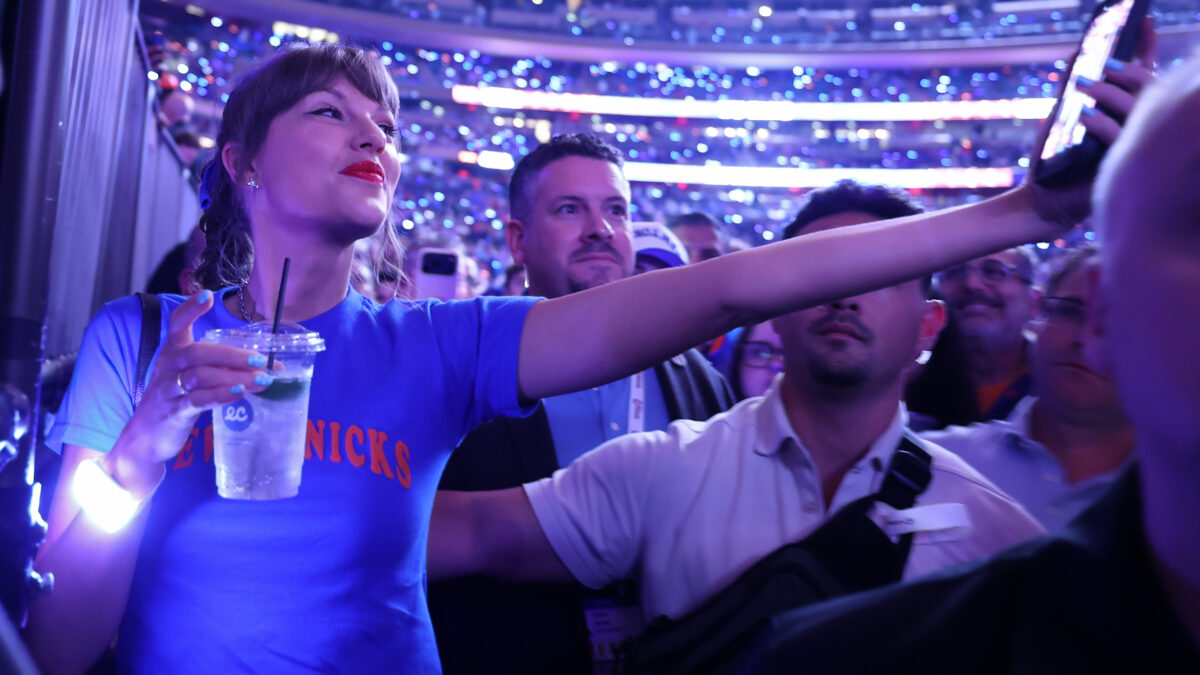
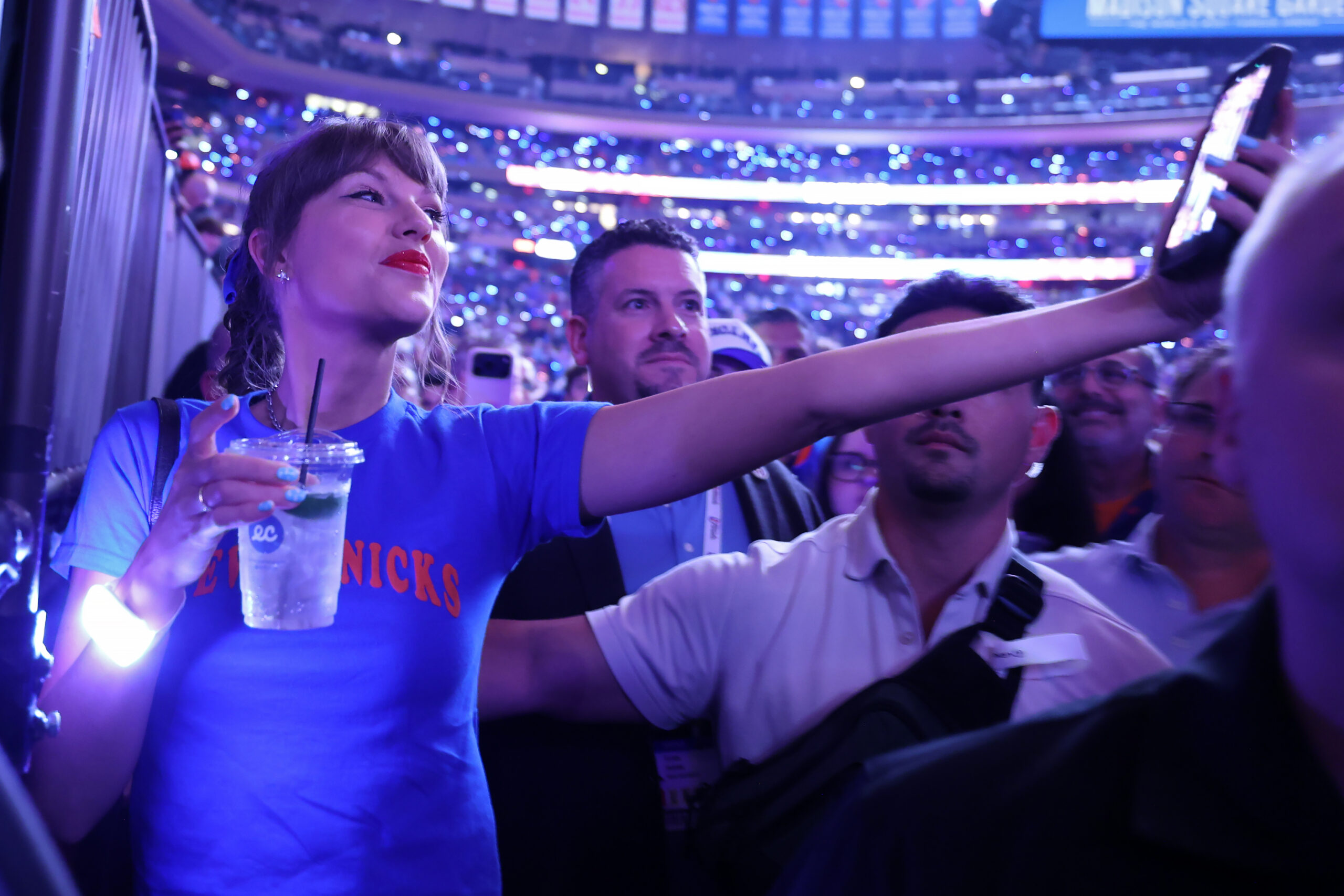
That’s why Swift’s appearance jumping up and down courtside at Game 4 felt so jarring. To her it was just what a New York celebrity does — goes to a Knicks game. But to us she wasn’t a New York celebrity, which is why at sports bars showing the game people stopped cheering to offer loud boos went the cameras cut to her enthusiasms. It was almost poignant, her so badly wanting to be one of us and so many of us saying you’re not, saying the love was unrequited. It was almost like … a Taylor Swift song.
And now, the wedding at MSG. As you may have gleaned from all the eyebrow-raising and decoy talk over the past month, New Yorkers remain unsold on the Garden. Despite its decades-long ubiquity in our lives and our iCals, the building has just as often stirred negative feelings. Sure, it has the Knicks, and Billy Joel, and the Big East, and the Islanders when they play the Rangers, but it also has been a neighborhood bully, the longtime subject of eyesore and enshittifying renovations and a James Dolan who has used the place as his own very expensive grievance-settling weapon. That Swift didn’t seem to understand this sentiment is further proof of the misalignment between the New York she badly hopes will embrace her and the many residents for whom the jury is still out.
Because the truth is we don’t always throw rocks at things that shine. But we do like to see them at the bodega once in a while.