
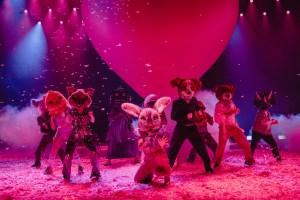
Broadway’s Winter Garden Theatre has become a confetti-covered dance floor in Jamie Lloyd’s new revival of Much Ado About Nothing, with Tom Hiddleston and Hayley Atwell leading Shakespeare’s romantic comedy through pop hits, elaborate partywear and an irrepressible burst of club energy.
Hiddleston plays Benedick opposite Atwell’s Beatrice, the sparring pair whose plotting and verbal combat form the center of the story. Their romance begins as a “merry war,” with neither character initially willing to acknowledge the feelings beneath their schemes.
The production’s signature image is a nightly storm of pink confetti, which accumulates across the stage in deep drifts. But Lloyd’s revival does not rely on that spectacle alone: Fabian Aloise’s choreography gives the straight play the momentum of a musical, while the cast moves and sings through a soundtrack of dance and pop favorites.
Among the songs featured are Taylor Dayne’s “Tell It to My Heart,” C & C Music Factory’s “Gonna Make You Sweat (Everybody Dance Now),” Deee-Lite’s “Groove Is in the Heart” and All-4-One’s “I Swear.” Hiddleston’s Benedick and his crew also make an entrance to the Beastie Boys’ “Fight for Your Right (To Party).”
Shakespeare Meets a 1990s Dance Club
Lloyd frames the comedy as a 1990s-era club experience, applying his typically stark theatrical style to a far more celebratory effect than in his productions of A Doll’s House, starring Jessica Chastain, and Betrayal, which also teamed the director with Hiddleston.
At one point, the company wears oversized mascot-style heads, including a chick, octopus, dog and robot. Elsewhere, a giant inflatable heart, modern costumes and the ever-present confetti turn the stage into a brightly colored party space.
Soutra Gilmour designed both the scenery and costumes, while Jon Clark supplied the lighting. Ben and Max Ringham’s sound design keeps the music forceful during the dance sequences, then lowers it to a background thrum when Shakespeare’s dialogue needs to take over.
The club concept provides a contemporary frame for a plot driven by disguised identities, overheard conversations, romantic interference and carefully constructed deceptions. The title itself carries an old double meaning: Shakespeare’s “nothing” could also suggest “noting,” or gossip.
Hiddleston and Atwell Lean Into Their Marvel Connection
Hiddleston brings physical comedy, dance moves and direct audience engagement to Benedick, using knowing glances and quick acknowledgments of the crowd’s enthusiasm to make theatergoers feel included in the character’s plotting. One understated comic moment finds him deadpan as he blows away a stray piece of confetti.
Atwell meets that energy with a Beatrice defined by sharp intelligence and fiery resolve. The production also openly recognizes the stars’ Marvel associations: standees depicting Hiddleston as Loki and Atwell as Agent Carter briefly appear, drawing a major response at the reviewed performance.
Mason Alexander Park makes another strong impression as the sharp-tongued Margaret, taking a microphone for a performance of “Tell It to My Heart” that places dance-pop showmanship inside the Shakespearean setting.
The wider company includes James Phoon as Claudio, Tim Steed as Don John, Gerald Kyd as Don Pedro and Mara Huf as Hero. Phoon moves Claudio between romantic appeal and infuriating behavior, while Steed supplies the production with its villain. Kyd’s Don Pedro begins as a garrulous host before turning against the slandered Hero.
The complete listed cast also features Mika Onyx Johnson, Forbes Masson and Phillip Olagoke. The production runs two hours and 20 minutes, including an intermission.
ShowBiz Take
The real trick of this Much Ado About Nothing is that its party concept does more than decorate the play. The dance soundtrack, choreography, soundscape and audience interaction amplify the romantic games already built into Shakespeare’s comedy.
That makes the revival notable not simply for pairing Hiddleston and Atwell, but for turning a familiar theatrical text into something that can feel like a Broadway musical without ceasing to be a play. Its most memorable effects are deliberately tangible: performers dancing together, a giant heart filling the space and enough pink confetti to nearly swallow its leading man.
Under Lloyd’s direction, the Winter Garden becomes both a stage and a celebration, with Hiddleston, Atwell, Park and the ensemble committing fully to the production’s invitation to groove.