
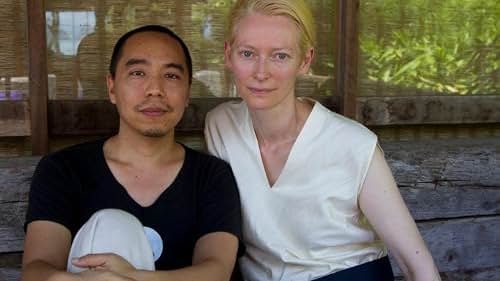
Mexican production and distribution company Piano has joined Apichatpong Weerasethakul’s “Jengira’s Magnificent Dream,” producer Julio Chavezmontes has confirmed. Tilda Swinton is attached to the film, which continues an established creative connection between the filmmaker, the actor and the company.
Piano previously produced Weerasethakul’s 2021 film “Memory,” alongside Colombia’s Burning and other partners. That project also starred Swinton and premiered in competition at the Cannes Film Festival, where it shared the Jury Prize.
“Jengira’s Magnificent Dream” follows Jengira, a Thai widow who goes to the ancient rock forest of Sigiriya in central Sri Lanka to scatter her husband’s ashes. Her experience is disrupted by visions that alter her perception of time and space, pulling her through different eras.
With science and empathy as her guides, Jengira becomes a living connection between the past, future and spirit. The project will combine a 1970s science-fiction aesthetic with a timeless setting in which cell phones provide the only signals that time has shifted, moving across memory, history and the supernatural.
Swinton will be joined by Thailand’s Jenjira Pongpas, whose credits include “Cemetery of Splendor,” and Sakda Kaewbuadee, who appeared in “Tropical Malady.” Canadian actor Connor Jessup, known for “Falling Skies,” is also in the cast.
A New International Collaboration for Piano
The project aligns with Piano’s record of working across borders on films driven by distinctive creative approaches. Its most internationally visible production to date is Ruben Östlund’s 2022 dark comedy “Triangle of Sadness,” which Piano co-produced. The film won the Palme d’Or at Cannes and received multiple Oscar nominations.
Piano’s path to that collaboration developed over several projects. Chavezmontes wrote and produced Sebastián Hofmann’s “Time Share,” which competed at the Sundance Film Festival in 2018. A jury presided over by Östlund awarded the movie best screenplay.
After additional connections with Östlund’s longtime producing partner Erik Hemmendorff and producer Philippe Bober, Piano was invited to co-produce “Triangle of Sadness.” The company had previously distributed Östlund’s “The Square.” Chavezmontes recalled that accepting the “Triangle of Sadness” opportunity was “an immediate yes.”
In an interview with Variety, Chavezmontes said Piano’s choices are led by creative potential rather than a fixed genre, format or mainstream formula. “If something strikes us as potentially incredible, then the format is absolutely secondary,” he said.
Chavezmontes founded Piano to make his own films, beginning with “Halley,” which he wrote and Hofmann directed. The company then expanded into productions from other filmmakers, developing relationships through distribution, festivals and international co-production.
Its credits span projects including Mia Hansen-Løve’s “Bergman Island,” Abel Ferrara’s “Siberia,” Leos Carax’s “Annette,” Luis Ortega’s “The Jockey” and Lucrecia Martel’s documentary “Our Land.” Piano’s filmography also includes work that has premiered in competition or other sections at Cannes, Venice, Berlin, Sundance, Toronto and Rotterdam.
Chavezmontes described the company as “quite chameleonic” in the kinds of films it supports. His central test for a potential project is whether it connects with him as a viewer and whether Piano can meaningfully help realize it, both creatively and through the practical work of production.
That approach extends to co-productions, which Chavezmontes views as more than financing arrangements. “Ultimately, what really defines a co-production is the people who come together to collaborate,” he said, pointing to the creative and technical teams that make the films possible.
Piano’s Wider Slate
Piano is also participating in this year’s Morelia Film Festival with Manuela Martelli’s “The Meltdown,” Chile’s submission to the Oscars and a film the company co-produced. It is distributing five other titles at the festival: Poh Si Teng’s debut documentary feature “American Doctor,” “Mickey,” “The Lost Mariachis,” “Shana” and “Beauty Salon.” The company is also holding a major anniversary party there.
At the upcoming Ventana Sur, Piano will take part in the Proyecta Co-Production Forum with “The Absence,” the debut feature from Mexican filmmaker Jorge Sistos Moreno. His short “The Darkness” debuted at Cannes’ Critics’ Week.
Beyond Piano’s slate, Chavezmontes has called for a broader long-term audiovisual policy in Mexico. He welcomed the country’s new 30% tax incentive for domestic and international productions, as well as state-level incentives in Jalisco and Morelos, but argued for a comprehensive support system comparable to those in Spain, Brazil and Colombia.
ShowBiz Take
Piano joining “Jengira’s Magnificent Dream” matters because it reunites collaborators already connected through “Memory” while placing Weerasethakul’s new project within a company built around international partnerships. The film’s mix of grief, shifting time, science-fiction imagery and the supernatural also fits Piano’s stated preference for work that resists easy categorization.
For Chavezmontes, that identity is not tied to any single success, including “Triangle of Sadness.” “We make films we genuinely believe in,” he said. With Swinton and an international cast attached, “Jengira’s Magnificent Dream” now becomes the latest expression of that independent, collaboration-first strategy.