
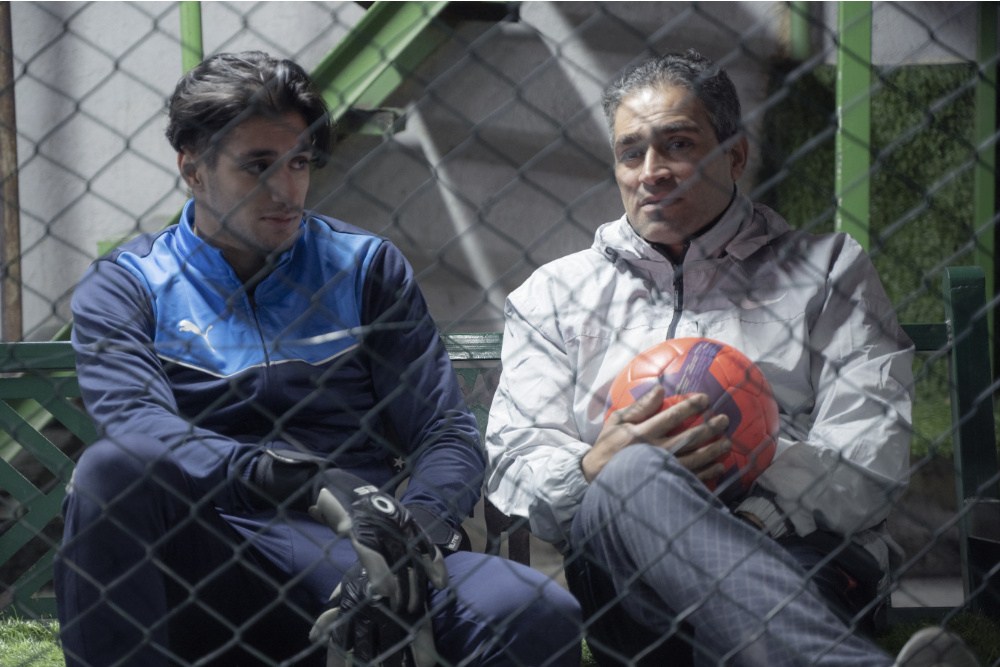
Farzad Khoshdast’s documentary “Third Land” follows an Iranian refugee family caught between official recognition and legal uncertainty in Turkey, where delays, precarious employment and the threat of police attention shape everyday life.
Screening in the Czech Joy section of the Ji.hlava Documentary Film Festival, the film centers on engineer Hamid, his wife, Hananeh, and their son. International aid organizations have recognized the family’s refugee status, but they do not have legal residence in the country — the condition that gives the documentary its title.
The resulting contradiction runs through the family’s story. While facing prolonged delays in securing work permits, Hamid and Hananeh must find employment under the table. Hananeh worked in Alanya, while Hamid found work in an industrial town near Istanbul. Ankara served as the production’s main location.
Khoshdast, himself an Iranian émigré, said he first met Hamid and his family while traveling in Turkey with his wife about four years ago. After the director spoke about his own life and the harm he said he had suffered at the hands of the Islamic Revolutionary Guard Corps, Hamid asked whether he would record his story.
“I replied, ‘As it happens, I’m a documentary filmmaker, and I’d like to make a film about you,’” Khoshdast recalled. The family later welcomed the couple into their home, allowing the project to begin taking shape.
Trust Built Across Three Periods
That access was not immediate. Khoshdast said earning the family’s trust took around two years, spread across three separate periods. By then, he had become familiar with the repetitive pattern of their days and used that understanding to shape the documentary’s opening.
Footage from those three periods was assembled into the film’s first three episodes, creating the sense that events were unfolding within one or two days and had been captured by multiple crews at the same time. Khoshdast described the merging of those different periods as one of the documentary’s central structural choices.
The closeness between filmmaker and subjects also influenced how he worked on set. Khoshdast said he always used a cinematographer so that he could remain physically and emotionally present with the family rather than standing behind the camera.
“Sometimes they cried in my arms,” he said. “I would hold them, comfort them, and then guide them in front of the camera, making sure they neither saw the cinematographer nor felt his presence.”
The director said he developed that approach while making his previous documentary, “Narrow Red Line,” about incarcerated young people. On that film, he worked with cinematographer Morteza Poursamadi, whom Khoshdast called “the greatest cinematographer in the history of Iranian documentary cinema.”
A Production Marked by Fear
Making “Third Land” carried its own risks. Khoshdast said he and the production were detained two or three times, with the most serious incident occurring in Ankara sometime after a terrorist attack. Following the filming of an elevator scene, officers arrived at Hamid’s home intending to detain the director. Friends intervened and assured authorities that he would report to a police station the following day.
In another incident, Khoshdast said a Turkish citizen falsely accused the crew of filming President Erdoğan’s home. The director recalled fearing that he would have a heart attack when detained, despite previously filming inside Iranian prisons and being arrested in Iran.
As concerns grew that the family might be under surveillance, the documentary’s portrait of instability became even more complicated. Khoshdast said their experience may reflect circumstances affecting as many as half a million Iranians forced to leave their country, while emphasizing that the suffering of a single family was enough to demand attention.
According to the director, some Iranians in Turkey eventually return home with nothing, but Hamid and his son cannot go back. He said depression and homesickness can become especially severe for people who have left Iran without being able to establish a new life elsewhere.
Hamid’s professional history adds another dimension to the film. Khoshdast said the engineer abandoned a promising career in Iran after realizing his technical abilities were being used as part of the country’s missile system. The director contrasted Hamid’s skills with his present circumstances, describing a precarious, nomadic existence without institutional support. Khoshdast said Hamid recently told him he was not even allowed to hold a bank account.
“What kind of world allows such talent to go to waste while everyone simply watches?” Khoshdast asked.
ShowBiz Take
“Third Land” matters because its form is tied directly to its subject: separate stretches of time are brought together to evoke a life in which the same pressures repeat without resolution. The family’s refugee status is recognized, yet legal residence remains out of reach; they need work, yet permits are delayed; they have left Iran, yet cannot fully begin again.
The director’s connection to that uncertainty also became personal. Khoshdast said he and his wife spent all their savings on the production and filming. By the time the documentary was completed, they had no money left, and the security situation in Iran prevented him from returning. In that respect, he now shares a version of the displaced status experienced by the family onscreen.
What Happens Next?
“Third Land” is screening in the Czech Joy section of the Ji.hlava Documentary Film Festival, which runs through Nov. 1.