
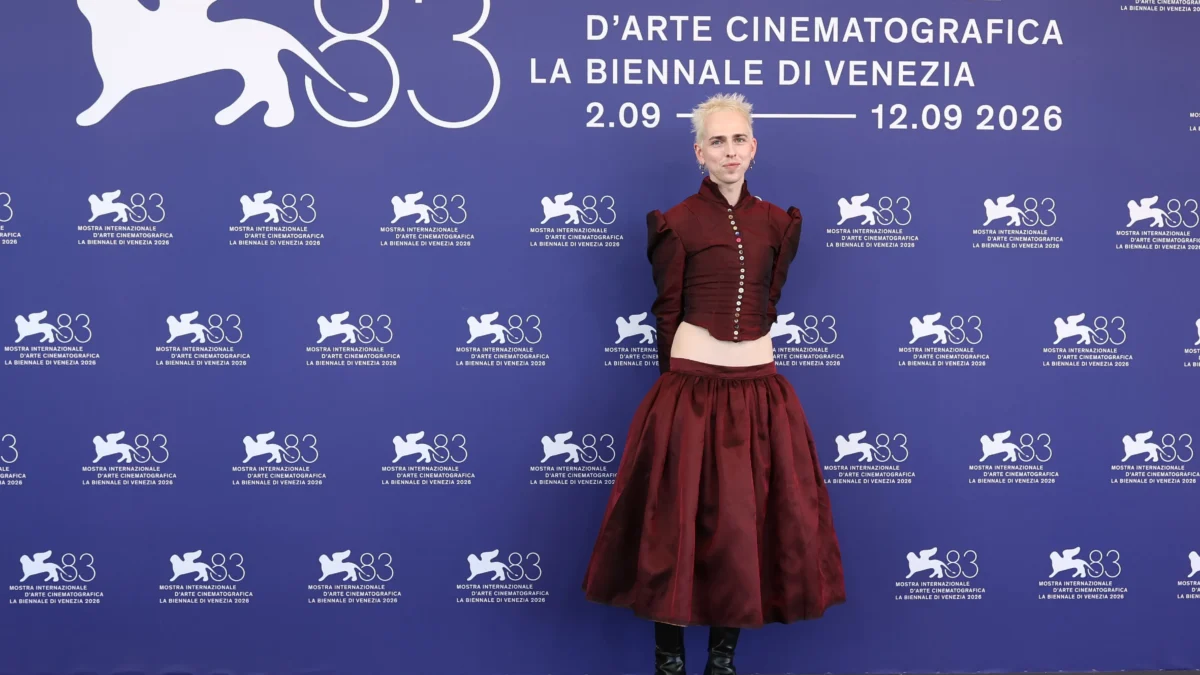
In 1991, British filmmaker Derek Jarman screened Edward II, his political and wildly inventive adaptation of Christopher Marlowe’s classic play, at the Venice Film Festival. The film was a hit with critics, and Tilda Swinton, who starred alongside Steven Waddington and Andrew Tiernan, won the festival’s Best Actress award. This week, exactly 35 years later, Edward II returns to the Lido in the form of a brilliant behind-the-scenes documentary about the film’s eventful production from first-time filmmaker Theo Rollason.
The documentary is titled Queer Edward II and screens this afternoon in an Out Of Competition slot on the Lido.
An assortment of former Jarman acolytes, such as Swinton and Sandy Powell, are Executive Producers on the project alongside other interesting names like Christine Vachon and Russell Tovey. Seamus McGarvey, the Irish DoP behind titles like Joe Wright’s Atonement, Tom Ford’s Nocturnal Animals, and Lynne Ramsay’s We Need to Talk About Kevin, is credited as the cinematographer. The film has been pieced together using footage that a young McGarvey, then fresh into his career behind a camera, shot on the Edward II set.
Watch on Deadline
“It was all just sitting in a cupboard for 35 years,” Rollason says of the footage, which he stumbled upon after a tip from a friend. Alongside editor Nicole Hálová, Rollason began the lengthy process of combing through the hours of footage, and he has carved out an illuminating portrait not only of Jarman’s unique artistic practice but also of his much-less-talked-about leadership in the gay rights movement in the UK.
Producers on the title are Ben Fowlie, Sebastien Rabas, and Michael Sherman. Simon Fisher Turner composed the score, and Dora Ash Sakula and Neo Michael were the archival producers. After Venice, Queer Edward II will screen at the London Film Festival.
Below, Rollason speaks with Deadline in depth about the miraculous story behind his discovery of McGarvey’s footage, starting the project completely independently with no funding, and how he hopes the film can “form a little companion piece” to Jarman’s Edward II.
Venice runs until September 12.
DEADLINE: Theo, how did you find this footage?
THEO ROLLASON: It’s an odd story. So Derek was making Edward II, and Sarah Swords, who’d worked on The Garden with Derek, wanted to make a behind-the-scenes film about Edward II. She hired Seamus McGarvey, who’d also worked on The Garden, and sent him on his way with a camera. At the end of production, as often happens with these kinds of indie productions, Seamus turned up and said, “Here’s the footage,” and they said, “We don’t have any money.” So the footage ended up with Ahmad Ahmadzadeh, who runs the camera company that hired out the camera to Seamus. And it was all just sitting in a cupboard for 35 years. I’ve known Ahmad for years, and he got in touch with me because I’ve worked as an archivist previously and said, “Can you give me your opinion on this material?” He knew I liked Derek Jarman’s films, and watching it was incredible. It was a real look behind the production and who Derek was. The final step in realizing this could be a feature film was that the politics of the time were really thoroughly explored on the set. I spent a while convincing Ahmad that there was a feature film here, and not just the typical behind-the-scenes featurette.
DEADLINE: How much footage was there? Was it reels?
ROLLASON: 30 hours of Betacam SP. There could have been a watchable 15-hour film in the footage. All credit to Seamus. He was in his early to mid-20s when he shot this. He wasn’t strictly a documentary filmmaker, but he’s just so intuitive with a camera. He’s constantly finding the right expressions to cut away to. It’s really the easiest job in the world watching his rushes because it’s basically been edited in camera.
DEADLINE: What did Seamus say when you first contacted him with the idea?
ROLLASON: He was surprised. No one knew that the footage still existed. Everyone had forgotten about it or assumed it was gone. So when we originally got in touch with him and asked whether he would be okay with us making this film, he was just delighted. For him, it was emotional to see one of the very first projects he worked on, which he had thought had come to nothing, being brought back to life.
DEADLINE: Watching this film and seeing Derek at length, you realize how English he was. I’d never really thought of him in that context.
ROLLASON: Yes, and that was one of the other appeals of the material: it couldn’t be more British and specifically English. Just the way he speaks, but also all the stuff he’s interested in talking about. The first scene we put in the film shows Derek talking about Marks and Spencer’s underwear, and that sets the tone. It’s an amazing document of the UK at that time.
DEADLINE: So much gets lost when a person dies, and there’s all this mythmaking about who they were. In Derek’s case, I feel like people don’t really consider how involved he was in the gay rights movement.
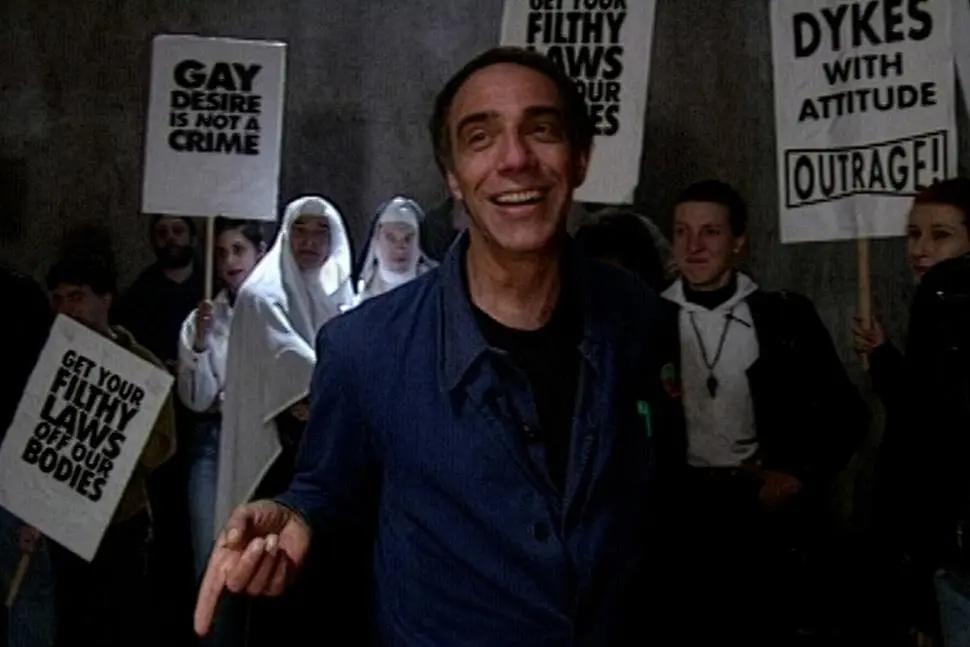
ROLLASON: Yeah, that was the breakthrough for me. There are obviously a few films about Derek Jarman. There’s Isaac Julien’s film, which does a great job of telling his life story. And within that, his involvement with the gay rights protest group OutRage. I knew Derek’s films very well, but I wasn’t as aware of just how directly politically involved he was. It’s fairly obvious from Edward II where his politics lie, but that doesn’t really give you the sense that he was on the streets with OutRage. He wasn’t watching from afar and making these comments. He was really doing it from the inside. And basically, all the archive footage in the film that isn’t on the set of Edward II is there to give that context.
DEADLINE: Filmmaking is always hard. But this is a unique project. Was it tough to raise funds and get people on board?
ROLLASON: It was incredibly easy to get people emotionally on board. The goodwill around Derek’s legacy is unbelievable. I don’t think many subjects could garner the kind of response Derek gets from people. Financing, obviously, is a different thing, and we did it probably the most insane way we could have, which was starting production without any financing, which was a huge leap of faith, especially as a first-time filmmaker. I’m not sure I’d ever do it again. I’ve made shorts before, but I haven’t made documentaries. I didn’t really have anything to prove myself, so there was an element of, if I just start making this film and we have something to show people, then, you know, fingers crossed, the money will follow. And it took a while, but it eventually did.
DEADLINE: What’s your background? How did you start making films?
ROLLASON: I’ve worked as a film critic for years. I love writing about film. And everything I’ve learned about film has been from watching an obscene amount of films. I didn’t go to film school or anything like that. I’ve always wanted to make films, but didn’t have the confidence. Over the last few years, I taught myself how to edit at a job I had producing video content. I did some video essay stuff. I put out a short film, which was very loosely narrative or experimental. I also worked as an archivist for the estate of the artist Paula Rego, and got very interested in large film and photo archives.
DEADLINE: Is that footage at the end of the film where Derek is at a screening from Venice?
ROLLASON: It is. He was there showing Blue at the Biennale a couple of months before he died. That footage is amazing. He’s so obviously very unwell by that point, but he writes about it so warmly in his diaries, and it felt like a really lovely glimpse into the future. I was a bit concerned that, in trying to make a film set on the Edward II set, I would give the impression that it was Derek’s last film. That’s why I wanted to have this flash-forward, to show that that wasn’t the case, but also to hit home that this was quite close to his death.
DEADLINE: How does it feel to now be showing your film at Venice?
ROLLASON: It’s crazy. The reason we started the film with no funding was that we looked at the submission dates for Venice. It’s 35 years ago this week that Edward II played Venice, and we just thought, that’s a really neat little thing; should we go for it? If I’m honest, I didn’t think there was any chance that this film would be here. It’s completely surreal.
DEADLINE: How would you like this film to be viewed? I couldn’t help but think of the many possibilities to distribute it. It could go along with a retrospective of Derek’s many works, for example.
ROLLASON: I would love for it to be shown with Edward II as much as possible. If this film is a chance for Derek’s films to be seen more widely, that’s always great. But Edward II, especially, is such a special film, and it hasn’t been seen as widely, certainly in the UK, in the last decade. I hope this can form a little companion piece to Edward II. Beyond that, I’m excited to see how it lands with a British audience. It is a very British film, and there are some very British characters, shall we say, who appear in it.