
Thiti “Tongte” Srinuan gave audiences at Taiwan Creative Content Fest in Taipei an unexpectedly graphic look at his acting past, displaying a photo of himself genuinely defecating on camera during his years as a supporting performer for Taibaan Studio.
Srinuan, who later wrote and directed the Thai blockbuster “The Undertaker” and its sequel, explained that the moment came while he was playing an unstable character who relieved himself wherever he wanted. Instead of using a prop, the production asked Srinuan to do it for real.
“Forty or 50 people were sitting there watching me, and I felt like I couldn’t go,” he recalled.
The image also caught festival organizers off guard. Moderator Mr. Knee, senior public relations manager at Vieshow Cinemas and founding chair of the Taiwan Film Critics Society, said they had only seen the photo that morning.
From Supporting Roles to a Thai Box-Office Hit
For Srinuan, the story illustrated Taibaan Studio’s commitment to realism. He said that approach makes the studio’s fictional universe adaptable: Because its characters feel like residents of the same village, any one of them can move into the spotlight for a romance, ghost story or another kind of film.
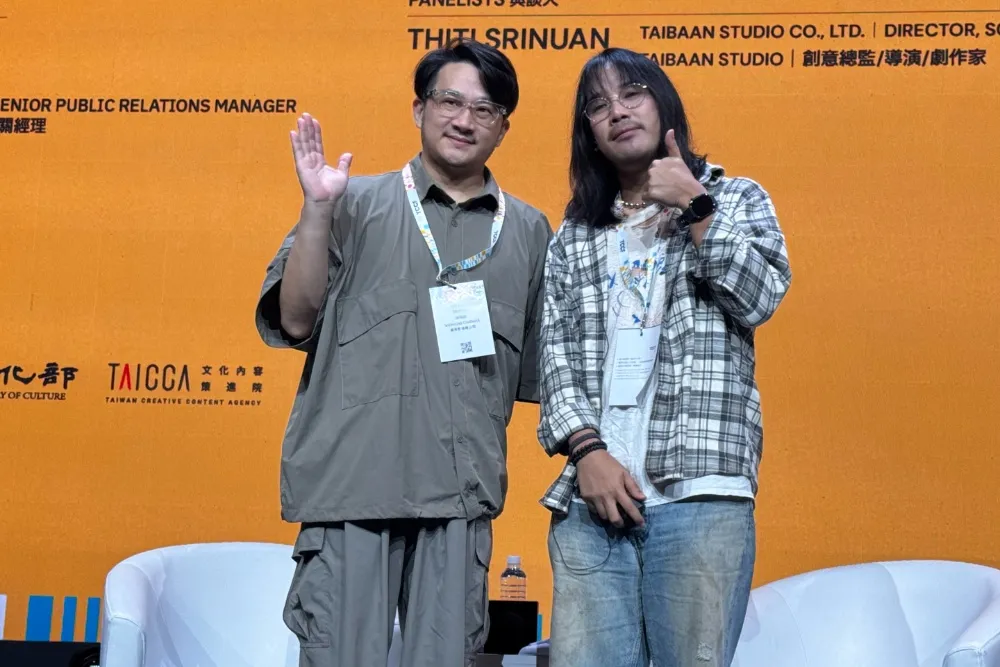
Srinuan appeared alone on the TCCF panel, which examined how user-generated content can become a path to theatrical filmmaking. His own journey began as an extra and supporting actor in Taibaan productions. Working with a small rural Thai crew that had little formal training, he volunteered to write scripts and later assist with directing, taking those responsibilities on five films.
Those movies played almost entirely to audiences in Thailand’s northeastern Isan region, Srinuan said. His outlook changed after a music video he directed went viral nationwide, convincing him that a regionally rooted film could reach viewers across the country. When nobody else agreed to direct his script, he took the job himself.
That film, “The Undertaker,” ultimately grossed more than THB700 million ($20.8 million) in Thailand. Released in 2023 as the sixth feature in the Taibaan universe, it became the country’s highest-grossing Thai film in nine years. Its sequel arrived this year.
The production remained notably lean. “The Undertaker” carried a THB10 million ($297,000) budget, although Srinuan said only THB8 million ($238,000) was spent; the remaining THB2 million made the budget a round number. By comparison, he said a typical Thai feature costs at least THB30 million ($891,000).
The first Taibaan film raised THB2 million ($59,000), or THB4 million ($119,000) with marketing included, and earned THB35 million ($1 million). Even so, financing another installment proved difficult. The team instead developed its online audience, using music-video revenue to fund the second, third and fourth films.
How Music Videos Shaped “The Undertaker”
Srinuan said his music videos have accumulated more than 4 billion combined views. Rather than accepting flat payments from clients, he negotiated a portion of view revenue. That meant earning nothing when a video failed, an arrangement that pushed him to study marketing. He later brought a similar model to features, requesting compensation from ticket sales instead of a fixed fee.
The format also influenced his screenwriting. Srinuan constructs movies from four- or five-minute sections—the approximate length of a music video—then joins those pieces until the film reaches two hours. He believes that structure works for viewers accustomed to short-form and vertical content, even if some audiences find the emotional changes abrupt.
“You’re laughing, then you’re made to cry, then you’re laughing again,” he said of the criticism. “But to me, life is like that. You laugh sometimes, you cry sometimes. So I like it this way.”
Audience comments, he added, carry more weight for the studio than likes or shares. A trailer is expected to generate about 20,000 shares and 2 million views without paid advertising. If commenters become particularly interested in an unexpected character, the studio adjusts its marketing to emphasize that figure.
“The Undertaker” began with its title. Srinuan selected the profession because he believed nobody would encounter more ghosts, but early drafts concentrated on spirits while barely addressing the job itself. He then drew from his rural childhood, when he was paid to be ordained as a novice monk for funerals because he had no money and was able to observe undertakers closely.
The project evolved from horror into drama, though it was still promoted in Thailand as a ghost film because that genre sells. Srinuan also studied Charlie Chaplin and prioritized visual storytelling over dialogue, hoping to make the Isan-rooted story more accessible. He said the comedy connected overseas, while the local culture often did not.
Its release strategy began with cinemas in Isan and the franchise’s established fans. Word of mouth then carried the film into theaters elsewhere in Thailand. After completing the original “Undertaker,” Srinuan—who had already worked across writing, directing, acting, editing and sound—also took marketing classes.
ShowBiz Take
The startling behind-the-scenes photo may have delivered the panel’s most memorable moment, but Srinuan’s larger story shows why his career is relevant to the industry conversation at TCCF. Taibaan’s route from regional productions and viral music videos to a THB700 million theatrical hit was built through lean budgets, revenue sharing, direct audience feedback and an insistence on creating work without waiting for conventional financing.
Srinuan nevertheless warned that a large online following does not guarantee movie attendance. As he put it, one disappointed viewer can influence the rest of a creator’s audience. His conclusion was more demanding than celebratory: “If you don’t create work, miracles won’t happen.”