
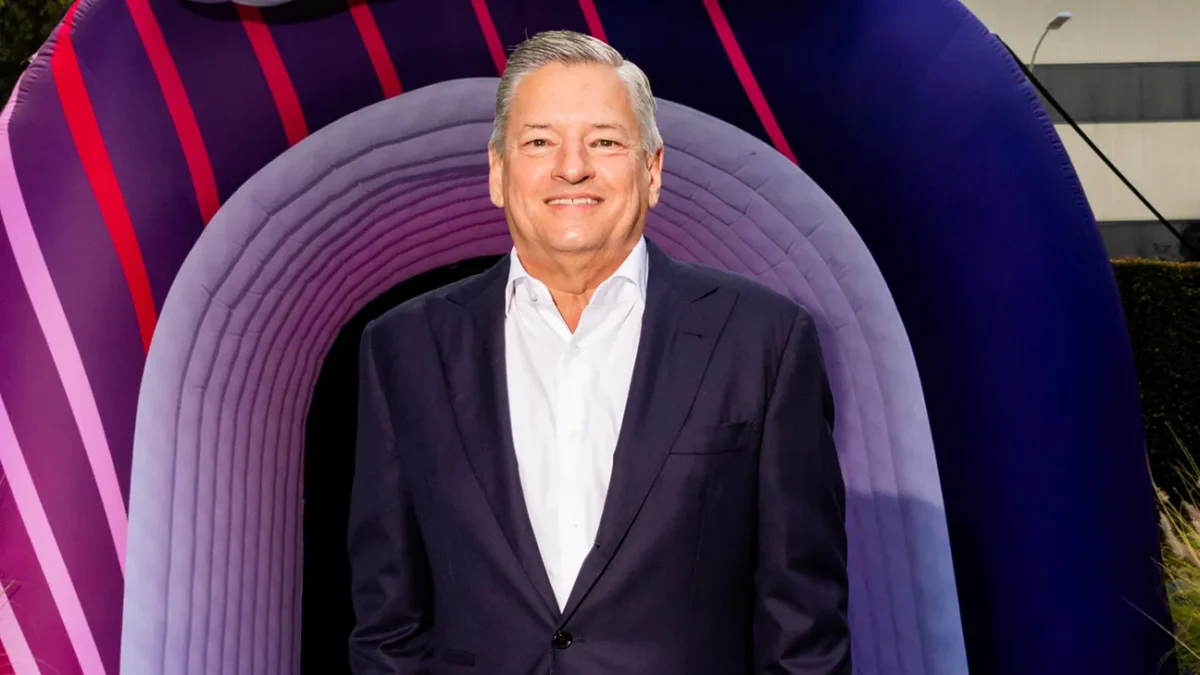
Netflix co-CEO Ted Sarandos has acknowledged that the streaming service’s engagement is not increasing at the pace he wants, after viewership rose just 2 percent during the first half of 2026.
“Overall, we’re not growing as fast as I want us to, and we’re working on making that move faster,” Sarandos said Wednesday at Bloomberg’s 2026 Screentime event.
He later emphasized that Netflix’s wider operation remains healthy, saying, “The business is great and growing fine.” Still, his comments put a spotlight on the company’s efforts to drive more viewing while balancing spending, subscriber growth and advertising.
Netflix’s live-programming equation
Live programming is one route Netflix is using to attract audiences. Its recent push has included several high-profile NFL games, though Sarandos’ figures show that live content currently accounts for a larger share of spending than viewing.
Netflix invests approximately $20 billion in content each year, with about 5 percent of that total going toward live programming. Those broadcasts generate roughly 1 percent of overall viewership, Sarandos said.
However, he argued that live programming offers advantages beyond the amount of time subscribers spend watching it. Live events produce “a lot of signups,” he said, while also helping Netflix reduce subscriber churn. Advertisers are also particularly enthusiastic about the format.
That combination means Netflix is assessing live programming not only through its direct share of viewership, but also through its ability to bring in subscribers, retain them and appeal to advertising clients.
Sarandos stands by Warner Bros. bid
Sarandos also addressed the pending $111 billion combination of Paramount Skydance and Warner Bros. Discovery, a deal that was given the go-ahead by a judge earlier Wednesday.
Netflix previously had an agreement in place and, for a brief period, held the winning bid for Warner Bros. without the Discovery portion. David Ellison, who had recently combined Paramount Global and Skydance, later entered with financial backing from his billionaire father, Oracle founder Larry Ellison.
Asked whether he regretted Netflix’s approach, Sarandos defended both the proposal and the limit the company placed on its offer.
“I think the plan was solid,” he said. “We won the deal at some point, so we think we priced it right — at our scale. That was the top price point where I thought we could return value to our shareholders with that asset. Any more than that, I thought we’d be taking it into negative territory — even with our scale.”
Whether the merged Paramount Skydance and Warner Bros. Discovery will become a substantially greater streaming competitor remains uncertain, according to Sarandos. He said simply combining the two companies does not make the eventual market-share result predictable.
“It looks on paper — so far it’s one and one,” he said. “So I don’t know if one and one is two, or one and one is one and a half, or one and one is three.”
No plan to become a user-generated platform
Netflix’s engagement strategy is also bringing it into business with creators known for their work on YouTube, but Sarandos rejected the idea that those agreements represent a major change in direction.
“We’re definitely… not in the UGC [user-generated content] business,” he told interviewer Lucas Shaw. “We’re in the professionally produced content business.”
Sarandos said some people working on existing platforms are already producing programming that comes close to professional standards. Netflix could pursue agreements when it believes it can monetize that work more effectively, but it is not attempting to recruit the full creator community.
Netflix’s potential monetization advantage comes partly from having multiple revenue streams to divide, while YouTube is funded almost entirely by advertising.
The creator deals echo an earlier moment in Netflix’s competitive history. In 2012, when he was the company’s chief content officer, Sarandos said Netflix was racing to become Warner Bros.’ HBO before HBO could become Netflix. Even as Netflix increasingly enters YouTube’s creator pool, he maintains that the service remains focused on professionally made programming rather than opening itself broadly to user submissions.
What Happens Next?
Netflix does not plan to introduce a free, entirely advertising-supported tier anytime soon. Sarandos said no FAST — or free, ad-supported television — model would justify “cannibalizing the core product.”
The company will instead continue working to accelerate engagement within its existing model, while using live events for signups, subscriber retention and advertiser interest. At the same time, Netflix will be watching how the newly approved Paramount-Warner Bros. Discovery combination translates from a massive corporate deal into actual streaming-market share.