
Why This Matters
Taylor Swift’s unannounced stop at Alan Jackson’s Nashville farewell concert turned a sentimental country sendoff into a revealing snapshot of where modern music fandom stands: deeply loyal, highly emotional and not always united. The moment was designed as a tribute to Jackson, one of country music’s defining voices, but the audience reaction quickly became part of the story.
Swift appeared to honor Jackson’s influence and thank him for the way he has championed younger artists over the course of his career. For many in the room, her presence served as a full-circle reminder that Swift’s own path began in Nashville, where she was first introduced as a teenage country songwriter before becoming one of the biggest pop stars in the world.
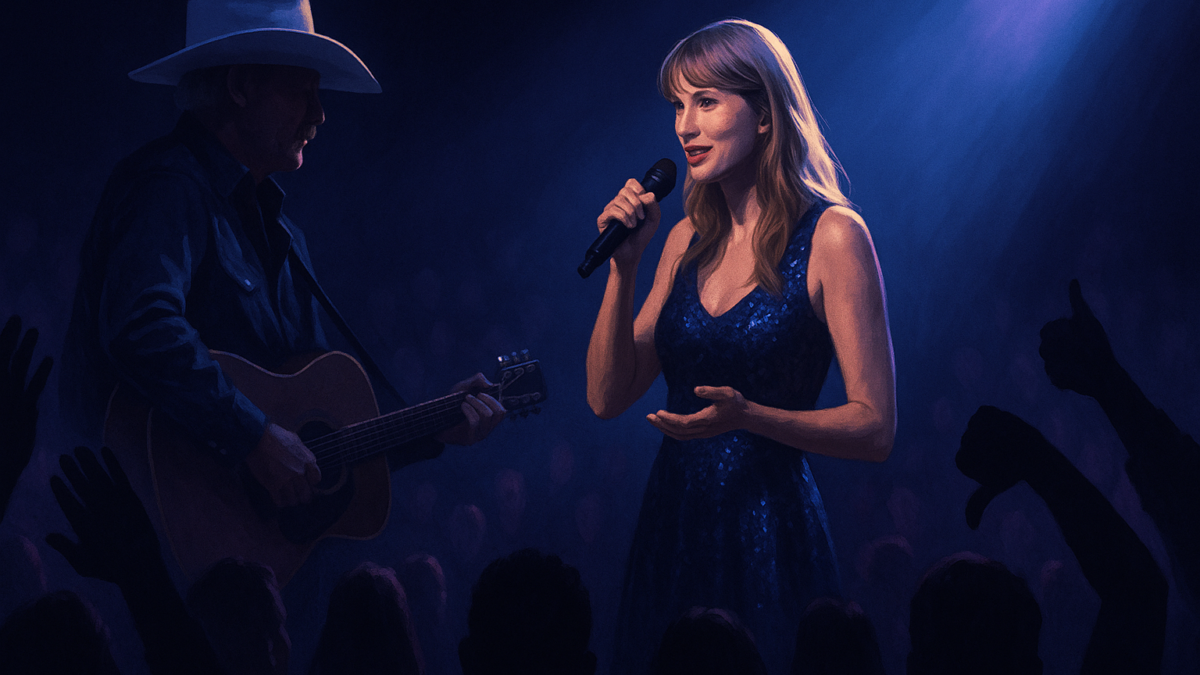
But the response was not uniformly celebratory. Cheers greeted Swift as she stepped into the spotlight, while audible boos from some sections of the crowd reflected the complicated relationship she still has with portions of the country audience. That tension is what made the appearance more than a routine celebrity cameo.
In entertainment terms, the mixed reaction matters because it illustrates how Swift remains both a unifying and polarizing figure, even at an event centered on another artist. Her fan base is massive and intensely engaged, yet in traditional country spaces, some listeners continue to view her evolution away from the genre as a departure rather than a career expansion.
For Jackson’s farewell concert, the moment also underscored the generational bridge he represents. Jackson’s catalog is rooted in traditional country storytelling, while Swift’s career has stretched from Nashville songwriting rooms to stadium-scale pop spectacle. Putting those two narratives on the same stage created a powerful image, even if the crowd did not respond with one voice.
Industry Context
Country music has always placed a premium on authenticity, loyalty and lineage. Artists are often judged not only by their songs, but by how closely they are perceived to remain connected to the genre’s traditions. Swift’s early albums helped introduce a younger audience to country music, but her subsequent move into pop shifted the way some country fans assess her place in that history.
That makes her appearance at a Jackson farewell especially notable. Jackson built his career on plainspoken lyrics, neotraditional arrangements and a public identity closely tied to the values of classic country. He became a standard-bearer for a sound that resisted over-polishing, even as Nashville’s commercial center moved through various waves of crossover ambition.
Swift, by contrast, became one of the industry’s most successful crossover stories. Her move from country radio to pop dominance was not gradual background noise; it was a defining business and cultural shift. She proved that a Nashville-developed songwriter could become a global touring and recording force without remaining confined to one format.
That trajectory helped reshape the expectations for young artists coming out of country music. Today, genre boundaries are more fluid than ever, with country acts collaborating across pop, hip-hop, rock and Americana. Yet the reaction in Nashville shows that the emotional boundaries for fans can be far less flexible than the commercial ones.
Swift’s presence also arrived at a time when legacy concerts have become major cultural events. Farewell tours and final hometown appearances are no longer merely nostalgia plays; they are opportunities for an artist’s career to be reframed in real time. Guest appearances often function as public endorsements, signaling who belongs in the story of an artist’s influence.
In that sense, Swift thanking Jackson for supporting young artists was an important gesture. It placed the focus on mentorship and continuity rather than genre politics. Still, the moment carried unavoidable subtext. A superstar who has spent years expanding beyond Nashville returned to a deeply country setting to salute a figure who never had to leave the genre to become iconic.
The boos, while not defining the entire response, are likely to generate conversation because Swift’s public appearances are rarely neutral events. Even a brief cameo can become a flashpoint, particularly when it intersects with questions about roots, ownership, audience identity and the changing sound of country music.
What Happens Next?
The immediate aftermath will likely play out across social media, where fan-shot clips and audience reactions can quickly shape the public narrative. Supporters will frame the appearance as a gracious tribute from one Nashville success story to another. Critics may use the crowd response as evidence that Swift’s standing with traditional country audiences remains complicated.
For Jackson, the focus is expected to remain on the farewell itself and the legacy of a career that helped define several decades of country music. His ability to draw surprise guests of Swift’s stature only reinforces the breadth of his influence across generations of artists.
For Swift, the moment adds another chapter to her long and sometimes uneasy relationship with the genre that launched her. Whether she chooses to address the reaction directly or let the appearance stand on its own, her tribute to Jackson served as a reminder that country music remains part of her origin story, even if her career now operates on a much larger global stage.
Industry observers will be watching to see whether the moment prompts broader discussion inside Nashville about how the genre treats artists who cross over and come back, even briefly, to pay respect. Country music’s future is increasingly expansive, but its past still carries enormous emotional weight.
The most likely outcome is that the mixed reaction becomes a short-lived controversy attached to a larger, more enduring image: a farewell concert for a country legend, interrupted by a surprise appearance from one of music’s biggest stars, and a crowd reaction that revealed just how personal these histories remain.