
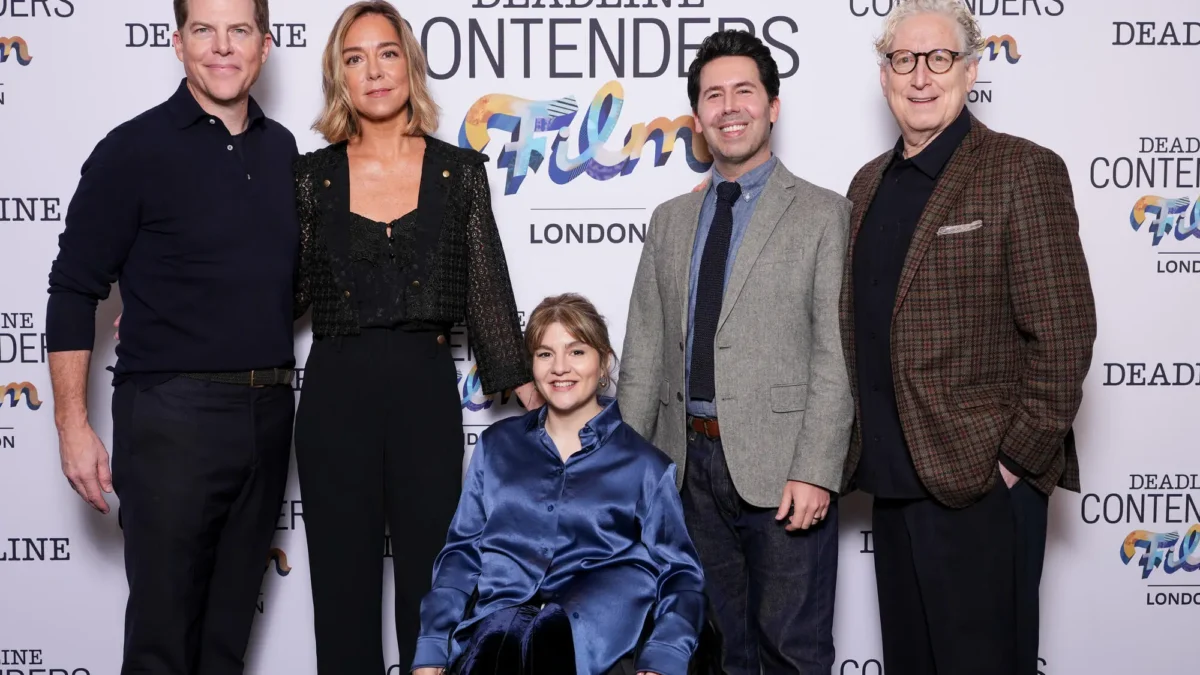
Being Heumann producer Kevin Walsh says the team behind the Apple Original Films drama achieved something significant beyond the movie itself: creating an accessible production environment for a cast that included 10 disabled leads.
Speaking alongside director Siân Heder during a Q&A at Deadline’s Contenders London, Walsh said the work required to make the set accessible was a point of particular pride.
“I think we created history,” Walsh said. “We are as proud of that as we are of the movie.”
The production adapted trailers and other facilities around the needs of its performers. Walsh said the team constructed accessible ramps and retrofitted hair and makeup trailers so disabled actors could use them.
“We really approached this film with the same kind of relentlessness that Judy approached her life,” he said. “We had 10 disabled leads. It took a lot of detail to make it accessible.”
Walsh also credited Apple with backing those efforts, adding: “It took a company like Apple to really support us.”
The story behind Being Heumann
Ruth Madeley, an alum of Doctor Who, stars as disability-rights advocate Judy Heumann in the feature, which is based on Heumann’s memoir.
The film focuses on 1977, when Heumann led more than 100 disabled people in a takeover of the San Francisco Federal Building. The resulting sit-in lasted 28 days, making it the longest occupation of a federal building in U.S. history.
At the heart of the story is a group of protesters who build a close community and refuse to leave until the government enforces Section 504 of the Rehabilitation Act. The provision required all federal spaces to become accessible.
For Heder, the path to the project began with a message from a friend who worked as an accessibility coordinator for the documentary Crip Camp at Sundance. The documentary featured the late Heumann.
“A friend of mine was the accessibility coordinator for Crip Camp at Sundance, and she sent me a text message and said, I’m hanging out with this woman, Judy Heumann. She’s the coolest woman on the planet, and someone should make a movie about her,” Heder recalled.
Heder later watched Crip Camp and read Heumann’s memoir, where she encountered the history of the Section 504 protests. She said her experience making Coda had already sharpened her awareness of how many stories from disabled communities remained unrepresented.
“I’d had a very profound experience on Coda, entering the deaf community and really understanding how many of these stories aren’t told,” Heder said. “There are so many of these incredible stories within the disability community, and they are just never represented.”
Heumann’s personality also drew the filmmaker in. Heder described her as funny, self-possessed and firmly in command, recalling her distinctive Brooklyn accent and the authority she carried with those around her.
ShowBiz Take
The importance of Being Heumann extends beyond its depiction of a landmark protest. Walsh and Heder’s comments show how the production attempted to apply accessibility to the practical realities of filmmaking, from casting 10 disabled leads to modifying trailers and constructing suitable ramps.
That connection between subject and set is what gives Walsh’s “created history” assessment its weight. The movie recounts a campaign demanding accessibility in federal spaces, while its own production addressed the access requirements of disabled performers in concrete, day-to-day ways. Walsh’s remarks also underscore that those measures required extensive planning, detail and studio support rather than functioning as an afterthought.
What Happens Next?
Being Heumann debuted at the Toronto International Film Festival last month and is screening this week as one of the London Film Festival’s headline galas.
The film will open in select theaters on November 6, followed by its Apple TV debut on November 13.