
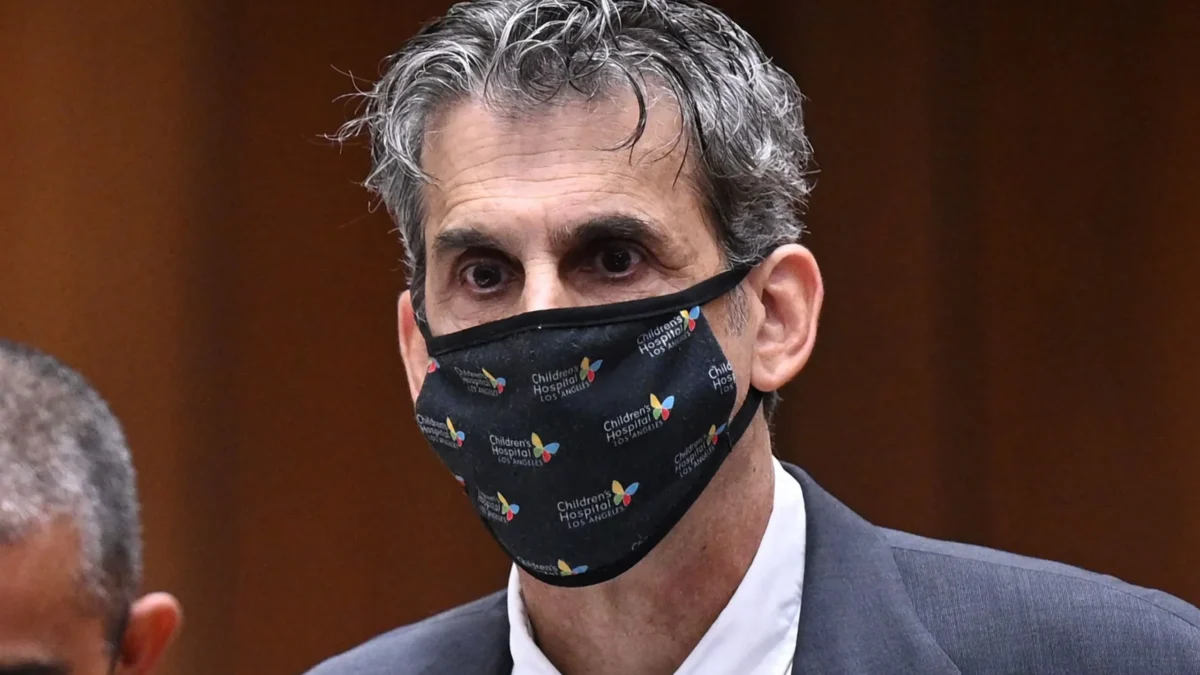
TV writer and producer Eric Weinberg has gone on trial on 23 counts of rape and sexual assault, with prosecutors alleging that he presented himself as an amateur photographer to bring seven women to his Los Feliz home before attacking them.
Weinberg, 66, worked on “Scrubs,” “Californication” and other television shows. He has remained in jail since 2022 while awaiting trial over the allegations, which concern incidents prosecutors say occurred between 2014 and 2019.
During opening statements Thursday, prosecutor Ariel Anson told jurors that Weinberg cultivated a reassuring public persona that caused the women to trust him.
“The defendant had carefully created an image of himself,” Anson said. “These women believed the defendant was this successful, kind family man. They believed he would uphold their boundaries … In reality the women were never safe.”
Anson described Weinberg as someone who could appear “very charming and friendly and charismatic,” arguing that he repeatedly used that image as part of a calculated pattern.
Explicit photos shown to jurors
Both the prosecution and defense displayed explicit photographs Weinberg had taken of the accusers. In a couple of those images, his hand could be seen gripping the women by the throat.
Anson argued that the images captured alleged assaults while they were underway. After the photo shoots, Weinberg provided the women with the pictures, according to the opening statements. Some later asked him to delete the images.
One woman considered deleting the photographs herself but decided against doing so because she believed they might eventually serve as evidence for police.
Defense attorney Philip Cohen offered a sharply different interpretation of the material. He acknowledged that some jurors might already regard Weinberg as a “creep,” but maintained that such a judgment would not satisfy the legal standard required for conviction.
“When you take away the bias, the sympathy, the creep factor, and you look at what the law requires, they have a problem in this case,” Cohen said. “Is he a criminal? That is the question.”
Cohen argued that a sexual-assault conviction would require jurors to determine that Weinberg knew the women were afraid. He said the photographs reflected Weinberg’s perspective at the time and noted that some showed the women smiling.
“What was Weinberg thinking?” Cohen asked. “There is not one indication that Weinberg knew of anybody’s fear and took advantage of it.”
Defense challenges the women’s accounts
The defense also contended that the women’s descriptions of the alleged encounters became more incriminating than their initial statements to police.
Cohen told jurors that Weinberg’s ex-wife had contacted some of the women and persuaded them to submit court declarations supporting her in a custody dispute. He alleged that the ex-wife wanted to “put Eric away” and assist the women in obtaining civil payouts.
“They strategize about how to do this,” Cohen said.
Prosecutors, meanwhile, are expected to address why the women may not have responded to the alleged assaults in ways some jurors might anticipate. The prosecution plans to call forensic psychologist Barbara Ziv, who frequently appears in sexual-assault cases to explain what were described in court as “rape myths.”
Anson said Ziv’s testimony would help jurors understand why the women sometimes appeared to placate Weinberg or minimize what they said had happened.
“They didn’t fight or kick or scream,” Anson said. “What they were trying to do was make sure they got out safely.”
What Happens Next?
The trial is expected to continue for six to eight weeks. The seven women connected to the charges are due to testify and are being identified in court only by their first names. They are expected to have dogs with them for emotional support while on the witness stand.
An eighth woman is also scheduled to testify, although her allegations are not among the charges Weinberg is currently facing.