
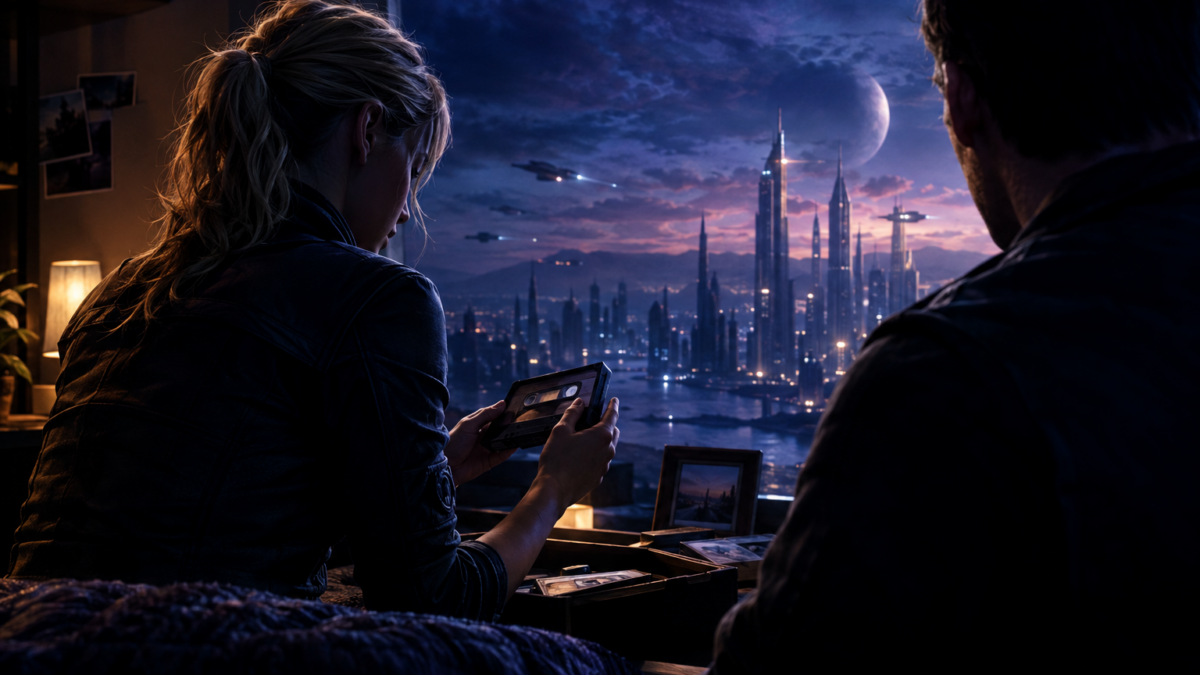
A quiet Starbuck sequence in “Battlestar Galactica” became an unlikely point of contention behind the scenes, with creator Ronald D. Moore revealing that Syfy executives objected to the scene’s deliberate lack of action.
The moment appears in the Season 2 episode “Valley of Darkness,” when Starbuck, played by Katee Sackhoff, and Helo, played by Tahmoh Penikett, visit Starbuck’s former apartment on Caprica. There, Starbuck plays a tape of her father performing piano music. The recording heard in the episode is actually a song by Philip Glass.
As the music plays, Starbuck reflects on what separates her from the other people fighting around her. While others are struggling to return home, she says she is fighting because fighting is all she knows.
The scene moves slowly and allows several seconds to pass without dialogue — an approach that did not win over the cable channel.
During an appearance on Sackhoff’s podcast, Moore said the network hated the sequence “because it was slow, and they’re not doing anything — shouldn’t there be more action?”
Instead of shortening the material in response to those concerns, Moore pushed further in the opposite direction. The network’s objections inspired him to make the scene even longer than he had originally planned.
A deliberate approach to pacing
Sackhoff pointed to the apartment sequence as an example of the show’s “intentional” pacing. She said “Battlestar Galactica” moved much more slowly than earlier projects on which she had worked.
Moore, meanwhile, recalled repeatedly having to defend that measured rhythm. His goal was to leave room for small, recognizable pieces of behavior that could make the characters seem like people rather than larger-than-life figures defined only by an intergalactic war.
That priority also shaped “33,” the first episode of the series. Moore cited a phone conversation between Laura Roslin, played by Mary McDonnell, and Commander Adama, played by Edward James Olmos.
During the exchange, Adama falls silent for several beats. Roslin then asks whether he is still on the line. Moore said he fought to preserve the pause because it reflected the sort of natural moment that happens regularly in real conversations but can disappear when performers are simply moving through scripted dialogue.
“I was always looking for those little pieces that made them more people, that made them more human beings that we could relate to,” Moore told Sackhoff.
Those details were also the kind of material that could draw executive resistance. According to Moore, executives tended to favor scenes that placed a greater emphasis on action.
Humanity amid the larger conflict
Glen Larson created the original “Battlestar Galactica,” but Moore’s version became the defining interpretation of the story. Its approach placed character development at the center of the larger conflict, grounding the intergalactic war in the personal experiences of its characters.
The Starbuck apartment scene captures that balance particularly clearly. Its Caprica setting and the wider fight remain important, but the sequence pauses to focus on music, silence and Starbuck’s understanding of herself.
That character-led approach has remained central to the show’s reputation. TVLine ranked “Battlestar Galactica” as the best Syfy series of all time, citing a version of the story in which the characters feel like real people rather than outsized heroes.
ShowBiz Take
Moore’s recollection reveals how one of the show’s defining strengths was also a recurring source of behind-the-scenes friction. Syfy’s concern centered on momentum and action, while Moore saw silence and stillness as essential tools for making the characters relatable.
The result in “Valley of Darkness” is not simply a break from the action. Starbuck’s return to her apartment gives the episode room to connect its large-scale war with a private admission about why she continues to fight.
By extending the scene rather than cutting it back, Moore reinforced the creative principle he also defended in “33”: sometimes the pauses, hesitations and seemingly uneventful beats are where “Battlestar Galactica” finds its most revealing human moments.