
Why This Matters
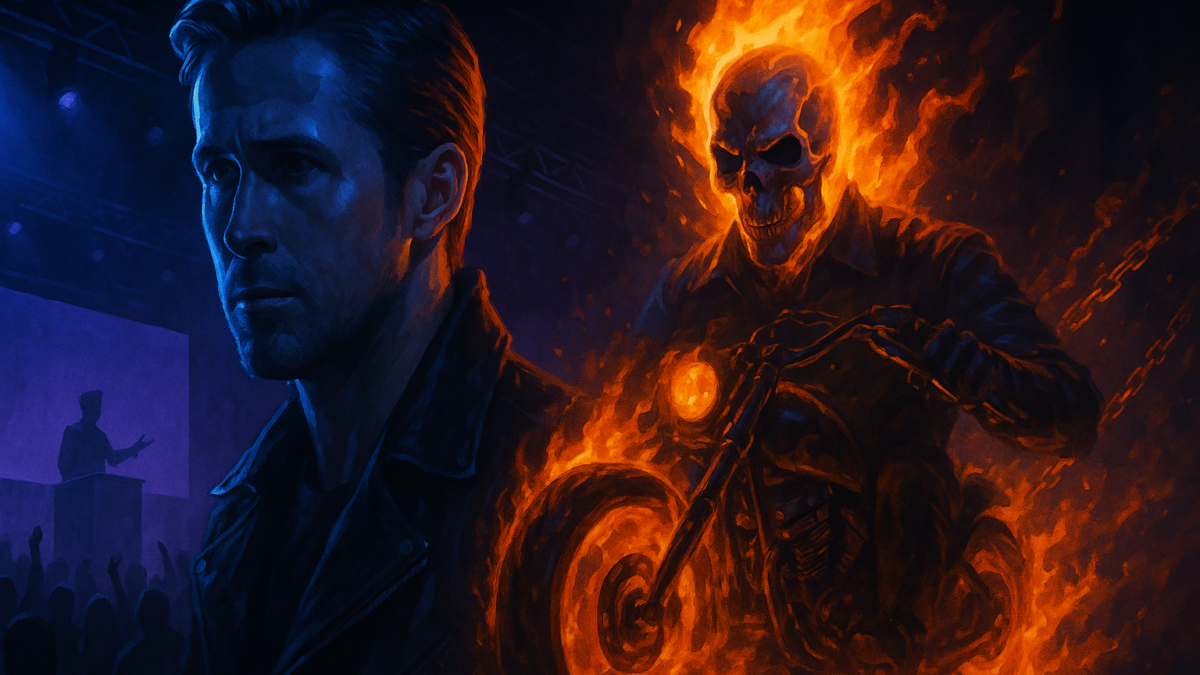
Ryan Gosling’s long-rumored arrival in the Marvel Cinematic Universe is no longer a fan-casting fantasy. Marvel Studios chief Kevin Feige used the San Diego Comic-Con stage to confirm that the actor will lead a new standalone feature centered on Ghost Rider, one of the company’s most visually distinctive and tonally flexible antiheroes.
The casting instantly gives Marvel a major movie star at a moment when the studio is working to reassert its big-screen dominance. Gosling, coming off the cultural phenomenon of “Barbie” and with the high-profile sci-fi film “Project Hail Mary” on the way, brings a rare combination of awards credibility, action experience and mainstream audience goodwill. For a character who has always lived at the intersection of horror, western, superhero spectacle and outlaw cool, that mix matters.
Ghost Rider is not a traditional cape-and-mask figure. The character is a cursed agent of vengeance, most famously embodied by motorcycle stuntman Johnny Blaze, who becomes bonded to a demonic force and transforms into a flaming-skulled rider. That mythology gives Marvel the chance to push into darker, more supernatural territory without abandoning the large-scale set pieces expected from its theatrical releases.
The announcement also signals a renewed commitment to star-driven Marvel projects. In the earlier phases of the MCU, casting was often about transforming actors into franchise icons. Now, as comic book movies face a more skeptical marketplace, attaching a performer with Gosling’s profile can help cut through audience fatigue. His involvement immediately turns a risky genre swing into an event movie.
For longtime fans, the news carries an added charge because Ghost Rider has remained one of Marvel’s most recognizable characters without receiving a definitive modern film adaptation. Nicolas Cage played Johnny Blaze in two Sony-produced movies, released in 2007 and 2011, which leaned heavily into the character’s pulpy extremes. Those films developed a cult following, but they never fully settled the question of what a prestige-level Ghost Rider movie could be.
Industry Context
Marvel’s decision to put Ghost Rider back in theaters comes during a period of recalibration for the studio. After years of near-automatic box office dominance, the MCU has been forced to contend with uneven returns, a crowded streaming strategy and increased pressure to make each new title feel essential. A standalone Ghost Rider film offers a clear genre hook: a supernatural action thriller with horror iconography and marquee casting.
That direction fits a broader shift inside the superhero space. Audiences have become more selective, rewarding comic book films that feel distinct rather than merely interconnected. “Joker,” “The Batman,” “Deadpool” and “Guardians of the Galaxy” each succeeded by leaning into a specific tone. Ghost Rider allows Marvel to build something more nocturnal and dangerous than its standard save-the-world template.
The character’s screen history is complicated but valuable. Cage’s version arrived before Marvel Studios had established the MCU as a unified brand, and those movies were made under Sony’s banner. Since then, Ghost Rider has continued to circulate in fan conversations, helped by the character’s instantly recognizable design and by a later television incarnation in “Agents of S.H.I.E.L.D.,” where Gabriel Luna played Robbie Reyes. Marvel now has an opportunity to consolidate that legacy for a new theatrical era.
Gosling’s casting also reflects Hollywood’s renewed appetite for pairing major actors with genre properties that can be reshaped around their screen persona. He has proven unusually elastic as a performer, moving from romantic drama and musical performance to noir comedy, action and self-aware blockbuster comedy. A Ghost Rider film could tap into his quiet intensity, physical precision and dry humor while giving him a darker canvas than his recent studio work.
For Marvel, the move may help solve two problems at once. First, it gives the studio a bankable adult-skewing character who can appeal beyond the core superhero demographic. Second, it adds momentum to the MCU’s supernatural wing, an area Marvel has teased through projects such as “Doctor Strange,” “Werewolf by Night,” “Moon Knight” and the long-gestating “Blade” reboot. Ghost Rider could become the connective tissue for that side of the universe.
The Comic-Con reveal also underscores the continued importance of Hall H as a franchise-launching platform. Even in an era when studios can dominate social media with a single post, a surprise casting confirmation in front of thousands of fans still creates the kind of instant mythology that marketing departments cannot easily manufacture. Marvel needed a buzzy moment, and Gosling on a flaming motorcycle is exactly the kind of image that travels.
What Happens Next?
Marvel has not yet disclosed a release date, director or full creative team for the film, making those announcements the next key pieces to watch. The choice of filmmaker will be especially telling. A glossy action specialist would point toward a high-speed blockbuster, while a director with horror or neo-western instincts could indicate a more daring interpretation of the material.
The studio will also need to clarify which version of Ghost Rider Gosling will play. Johnny Blaze remains the best-known incarnation on the big screen, but Marvel has several options from the comics, including Danny Ketch and Robbie Reyes. Each character opens different story avenues, from carnival tragedy to urban vengeance to broader supernatural mythology.
Another major question is how closely the film will connect to the larger MCU. Marvel could treat Ghost Rider as a self-contained origin story, allowing the character to develop outside the burden of multiverse exposition. Alternatively, the movie could serve as a doorway into a more horror-driven corner of the franchise, potentially intersecting with Blade, Doctor Strange or other occult Marvel figures down the line.
Production timing will likely depend on Gosling’s schedule and Marvel’s evolving release calendar. With the studio being more selective about what it dates and when, Ghost Rider may be positioned as a premium theatrical event rather than one more installment in an overstuffed pipeline. That would align with Marvel’s recent emphasis on slowing down and making individual projects feel bigger.
For now, the announcement gives Marvel something it has needed: a clean, exciting headline that combines a beloved character with an actor audiences are eager to see take a swing inside the MCU. If the studio can match the casting with a bold creative approach, Ghost Rider could become more than a revival. It could be the start of Marvel’s next great tonal reinvention.