
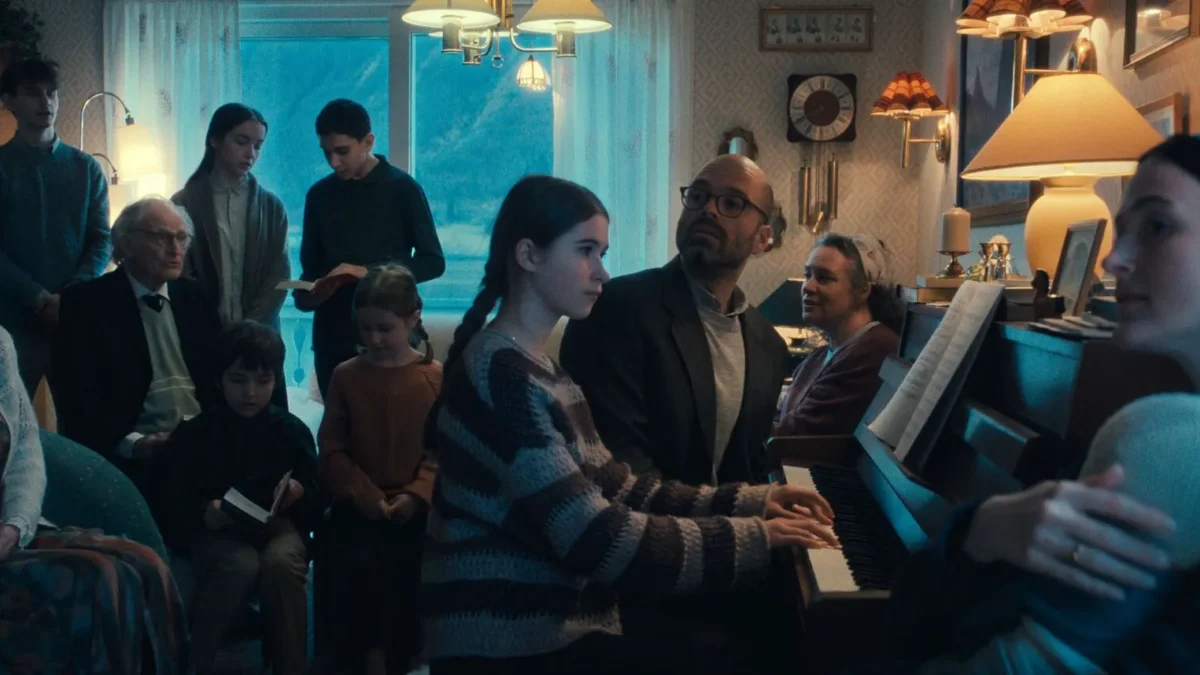
Renate Reinsve has added another major Cannes chapter to her career with Cristian Mungiu’s Fjord, which won the Palme d’Or — the Romanian filmmaker’s second — and has now been selected by Romania as its contender in the Best International Feature Film Oscar race.
Reinsve stars opposite Sebastian Stan as Lisbet, a Norwegian mother of five whose Romanian educator husband has moved the family to her hometown. Local disapproval of the couple’s Romanian Christian evangelism escalates into accusations that they are harming their children, prompting state authorities to take the five children into care.
The role required Reinsve to move away from the tools she had previously relied upon. Lisbet is presented without vanity, wearing long, subdued skirts and black coats with no makeup. Her physical bearing reflects the exhaustion of a parent under immense strain.
A Performance Built on Restraint
During her early discussions with Mungiu, Reinsve learned that his camera would remain “really far away” and that he wanted to avoid guiding viewers toward a particular emotion or judgment. That meant stripping away many of the expressive choices she might otherwise have used to help audiences connect with Lisbet.
The approach initially frightened her. Reinsve, a classically trained actor who has worked in theater for two decades, was accustomed to revealing enough to establish an emotional connection while still leaving space for interpretation. In Fjord, she was asked to leave that space much wider.
She found a reference point in the way people can understand the severity of a roadside accident from a distance simply by observing how those involved move and hold themselves. That image helped her trust that Lisbet’s experience could register through precise physical details rather than overt emotional signaling.
Mungiu’s method also involved numerous takes as he gradually constructed the movement and rhythm within the frame. Reinsve’s first day included a 12-minute scene in which Lisbet is told her children will be removed. She had received the script only a week earlier and gave everything to the first three takes, only for filming to continue through 17 as Mungiu refined the scene.
She eventually learned to recognize when the director was ready for her strongest emotional push: “When he’s happy, he rubs his hands, and then I know now I can give it my all.”
Reinsve described the process of learning an unfamiliar technique as “always a little bit humiliating,” but said it also created an opportunity to transform. Once she understood Mungiu’s method, she began adding small, specific elements without attempting to manipulate the audience.
Why Reinsve Chose Lisbet
Mungiu initially asked Reinsve to read for Mia, a liberal-minded neighbor he believed might be the more obvious fit. He also let her audition for Lisbet, and Reinsve felt an “overwhelming” connection to the mother, particularly because she is a parent herself. The prospect of Lisbet losing her children was devastating to her, and she was relieved when Mungiu ultimately gave her the part.
Preparing for the role sent Reinsve into an extensive study of theology and Pentecostal Church practices. She spent time with congregations, observing their singing, food-sharing, greetings, clothing and worship gestures. Research and filming together took six months, though she still felt she had not learned enough.
The work also forced her to inhabit values and opinions different from her own. She said the challenge was to find compassion for Lisbet’s beliefs and understand how they had developed, rather than judging the character. That same balance extended to Lisbet’s marriage: although Reinsve was initially provoked by the husband speaking for his wife, she came to see substantial trust between them.
Her existing friendship with Stan helped establish that connection onscreen. The actors had worked together three years earlier on A Different Man, and Reinsve said their familiarity meant they did not need to warm up to each other. She felt that comfort gave the couple a warmer relationship than their restrained physical behavior might otherwise suggest.
A Remote Shoot — With Alleged Ghostly Company
Fjord was filmed in a remote Norwegian village with a population of 25. Feeding the cast and crew became a production challenge, while avalanches sometimes blocked roads and forced the team, its gear and performers to travel by boat.
Reinsve also claimed the hotel where the production stayed was haunted. She said cast and crew members heard knocks on their doors at night and reported other unexplained experiences. On some nights, she said knocking at her own door continued for around two hours from 1:30 a.m., but nobody was there when she checked. The experience left her sleeping poorly for two months, although the production also found time for food, singing, dancing and parties.
The film has already generated the kind of discussion Reinsve believes Mungiu wanted. Neon released Fjord in the U.S. earlier in October, where she said it prompted heated debate. She has also spoken with Norwegian child-services workers who saw the film and welcomed it as a starting point for conversation. Reinsve described Norway’s child-services system as mainly a good, well-functioning institution while acknowledging stories of serious mistakes, misunderstandings and clashes of values.
ShowBiz Take
Fjord matters as both another Cannes milestone for Reinsve and a deliberate artistic reset. She won Cannes’ best actress prize in 2021 for Joachim Trier’s The Worst Person in the World, her first leading role, and later reunited with Trier for Sentimental Value, which brought her an Oscar nomination for Best Supporting Actress. With Mungiu, however, she was asked to discard familiar habits and rebuild her performance around distance, rhythm and restraint.
That risk has arrived with significant recognition: a Palme d’Or, Romania’s international Oscar submission and active debate around the film’s central conflict. For an actor who says she enjoys different directing styles and challenging characters, Lisbet represents precisely the kind of unfamiliar territory she was seeking.
What Happens Next?
Reinsve filmed Alexander Payne’s Somewhere Out There during the previous awards season and is set to portray feminist and author Mary Wollstonecraft in Mia Hansen-Løve’s If Love Should Die. The film will move across 12 years of Wollstonecraft’s life in England, Revolutionary France and elsewhere in Europe, with production spanning six countries. Reinsve has already researched the role in locations including London and Paris as she prepares for another dramatic transformation.