
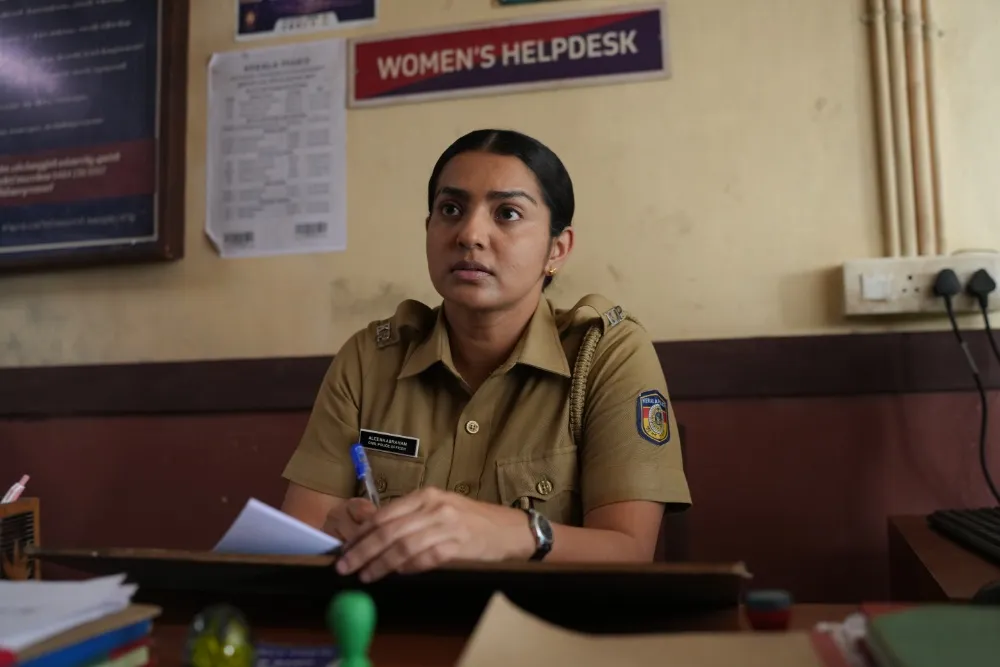
Parvathy Thiruvothu is stepping into a Malayalam-film police uniform for the first time in “Pradhama Drishtiya Kuttakkar” (“Prima Facie Guilty”), a theatrical thriller that places her inside the kind of troubled institution her characters have often challenged from the outside.
Directed by Shahad Nilambur and produced by Arjun Selva under 11 Icons Film Productions, the film stars Thiruvothu as Aleena Abraham. After the death of her constable husband, Aleena joins the police through a compassionate appointment. An unexpected criminal case soon disrupts the local station where she works alongside officers Divya, Dasan and Sreenath, forcing questions about duty, justice and how quickly guilt is assigned when the evidence remains incomplete.
“I loved it,” Thiruvothu said of portraying someone working within a state institution. “I’ll tell you why, because most of the time people don’t understand what it is like to stay within a rotten structure and try to change it.”
Building Aleena From the Inside Out
Written by P. S. Subramanian and Vijesh Thottungal, “Pradhama Drishtiya Kuttakkar” does not hold back its central crime for a conventional final reveal. According to Thiruvothu, the film discloses what happened within its first 10 to 15 minutes. The suspense instead comes from whether the officers involved will be discovered.
She credits Subramanian with shaping the procedural mechanics and Thottungal with supplying the emotional center. She characterized the storytelling as “two steps forward, one step back,” with each apparent answer opening another complication.
Preparing to play Aleena involved learning police procedure while making sure the character did not appear too polished. Thiruvothu trained to perform a proper salute, then intentionally held back some of that precision on camera because Aleena is not supposed to be thoroughly versed in protocol.
She also spent time with real policewomen who worked as extras on their days off. Separately, she has previously held extensive discussions about police procedure with Indian Police Service officer Ajeetha Begum.
Although this is Thiruvothu’s first uniformed police role in a Malayalam film, it is not her first law-enforcement character. She played plainclothes deputy commissioner Kranthi Shenoy in Prime Video’s “Dhootha” and dubbed the Malayalam version of Kareena Kapoor Khan’s police officer in “Daayra.” Her other credits include “Bangalore Days,” “Take Off,” “Uyare” and “Virus.”
Thiruvothu has not yet seen Sandhya Suri’s Cannes-debuting “Santosh,” in which Shahana Goswami plays another policewoman who assumes her late husband’s position through a compassionate appointment. She said she may contact Goswami about watching the film, which was blocked from release in India by the country’s censor board. “That in itself says enough about the movie as to why it’s important,” she said.
Scrutiny, Activism and Staying in the Industry
The themes surrounding Aleena also connect with Thiruvothu’s own experience of remaining within an industry she has publicly challenged. She spoke out about misogyny in Malayalam cinema in 2017 and has remained active with the Women in Cinema Collective and following the Justice Hema Committee report.
The Kerala government created the committee in 2017 to examine sexual harassment and gender discrimination in the Malayalam film industry. It submitted its findings in 2019, but the report became public only in August 2024 after a Kerala High Court order. Its findings detailed systemic harassment, wage discrimination and the blacklisting of women who spoke out.
Thiruvothu said public judgment has become a constant, with criticism directed both at what she says and at issues she does not address. “Anything I say or don’t say, there is always a verdict placed on me,” she said, dating that experience to around 2016, when she called out misogyny in cinema.
She identified the introduction of Internal Complaints Committees on film sets as one tangible gain. The committees are mandated under India’s sexual harassment law but faced years of resistance from industry unions. Calling their implementation “a big win” for workplace safety, Thiruvothu added that Malayalam productions still trail Hindi film sets in the number of women employed as department heads, cinematographers and editors.
She also questioned institutions that tell women to wait for justice, saying police were unable to provide her with an example proving that justice had been served when she defended her decision not to pursue legal cases of her own.
Thiruvothu argued that Malayalam actresses receive fewer opportunities than male actors to rebound after a box-office failure, even as Mamitha Baiju, Anna Ben and Anaswara Rajan have delivered hits. “The same choice levels or the number of choices that are given to anyone who is male in this industry has to be given to women and other minorities,” she said.
What Happens Next?
Thiruvothu is currently juggling four projects, including Prime Video’s “Storm,” from Hrithik Roshan’s HRX banner, and the second season of “Dhootha.” She is also attached to two unannounced Hindi projects and “Homo Sapiens,” a Malayalam-language ensemble film she described as lighter than her recent work.
Comedy, however, remains an ambition. Pointing to Mike Leigh’s “Happy-Go-Lucky” and Anne Fletcher’s “The Proposal,” she said she wants opportunities in romantic comedies and comedies but has not even been offered the chance to audition for them.
For now, continuing to work is itself part of her resistance. Thiruvothu said remaining in an industry that has at times tried to push her out may be among her bravest choices. She only recognized the parallel with Aleena after seeing the completed film: both refuse to run, even while protecting themselves.
“I enjoy watching patriarchy fall apart,” Thiruvothu said. “I enjoy it, so I would rather stay in.”