
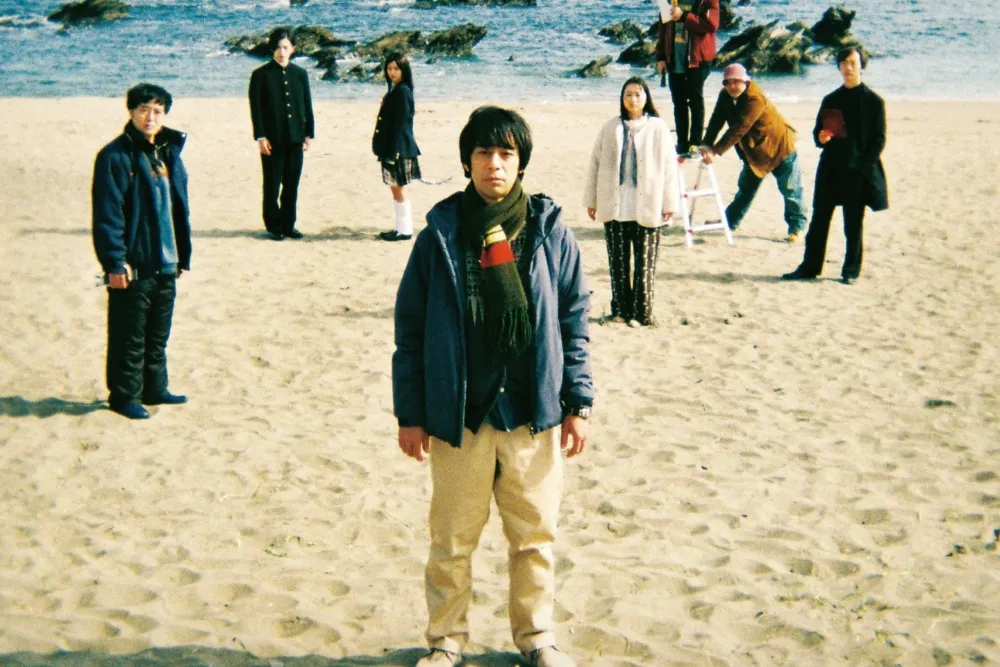
Ueda Shinichiro has transformed “Earthlings in Love” from a 30-part social media microdrama into a 111-minute feature film, expanding the vertically shot project with restored material, additional filming and a new theatrical rhythm.
The film is showing in the Nippon Cinema Now section of the 39th Tokyo International Film Festival. Its move to feature length followed what Ueda described as an enthusiastic online response to the original series, whose episodes were only a few minutes each.
“Earthlings in Love” centers on Shinpei, a director who learns that he has young-onset dementia. As he sets out to preserve his memories, Shinpei decides to complete a movie he began shooting with friends during his teenage years.
That story continues Ueda’s interest in filmmaking as both a subject and a storytelling device. His cult zombie film “One Cut of the Dead” shifted from a single-take horror-comedy into an examination of making a movie and the disorder of life on a film set.
From a Vertical Series to a Feature Film
Ueda conceived “Earthlings in Love” for vertical viewing before developing its screenplay. Although the project was not initially planned as a feature, the director told Variety that his own creative instincts may be better suited to feature films, the format in which he has been working.
The social media version totaled 76 minutes across its 30 episodes. Re-editing and expanding the material brought the theatrical cut to 111 minutes.
That 35-minute increase did not come simply from putting the episodes together. Ueda reinstated shots and dialogue that had been left out of the online release and conducted additional filming. At the same time, he removed some of the social media edition’s cliffhanger scenes, which had originally been designed to encourage audiences to return for the next episode.
The change in platform also altered the pacing. Ueda said social media creators must constantly consider the possibility that viewers will swipe away if a story moves too slowly. A theater, by contrast, gives a filmmaker more time to develop the direction and foreground the performances once an audience has taken its seats.
Despite that recalibration, Ueda said his fundamental production approach remained close to the one he used on the features “One Cut of the Dead” and “Special Actors.” Beyond the vertical frame, he did not make a major distinction between the formats. He also noted that the “Earthlings in Love” performers had feature-film experience and delivered performances at that level rather than adopting the larger acting style he associates with some short-form vertical dramas.
How Memory Shaped the Story
Part of the film’s premise emerged from Ueda’s own experience returning to his hometown and meeting former schoolmates. While discussing their shared past, the group discovered that they remembered some events differently and had completely forgotten others.
Those conversations led Ueda toward a story examining the gap between memory and recorded images. In “Earthlings in Love,” that idea is embedded not only in Shinpei’s attempt to document his life, but also in the visual limitations of the vertical frame.
Ueda considers the format particularly well suited to an individual person’s proportions, although he found group compositions more restrictive because of the reduced horizontal space. He also used those boundaries deliberately, withholding information outside the frame before revealing it from another angle.
According to the director, those unseen areas leave space for viewers’ imaginations. He further connected the restricted view to the story’s subject, explaining that some dementia symptoms can limit vision.
Instant Reactions Versus the Theatrical Ritual
Having previously released other microdramas, Ueda identified the speed of audience response as one of the most consequential differences between social media and theatrical work. Comments can begin appearing immediately after an online release.
He offered an extreme example of how quickly that process can unfold: an idea might be developed in the morning, filmed during the day and released that evening. Ueda compared that immediacy to posting a comment or a tweet. A feature film, he said, requires advance planning and takes at least 12 months to reach theaters.
Ueda nevertheless expects both forms to endure. He believes the vertical-shorts market will continue growing while movie theaters remain important. In Japan, he said, theaters are now the only spaces where people turn off their phones, sit together for two hours and collectively watch or listen to something.
Borrowing an observation from a senior director friend, Ueda compared that communal experience to a church or sacred place: audiences gather in darkness for a shared ritual that cannot be replicated in the same way elsewhere.
ShowBiz Take
“Earthlings in Love” matters because its expansion is more than a change in running time. Ueda reshaped the same project around two sharply different modes of attention: the rapid, cliffhanger-driven environment of social media and the sustained focus he expects from a theatrical audience.
The film’s form also serves its subject. A story concerned with unreliable memories, forgotten experiences and the difference between recollection and recorded evidence is presented through a frame that intentionally excludes parts of the visual world. By restoring footage, adding new material and slowing the pace for theaters, Ueda has turned the project’s journey between formats into another layer of its exploration of filmmaking itself.