
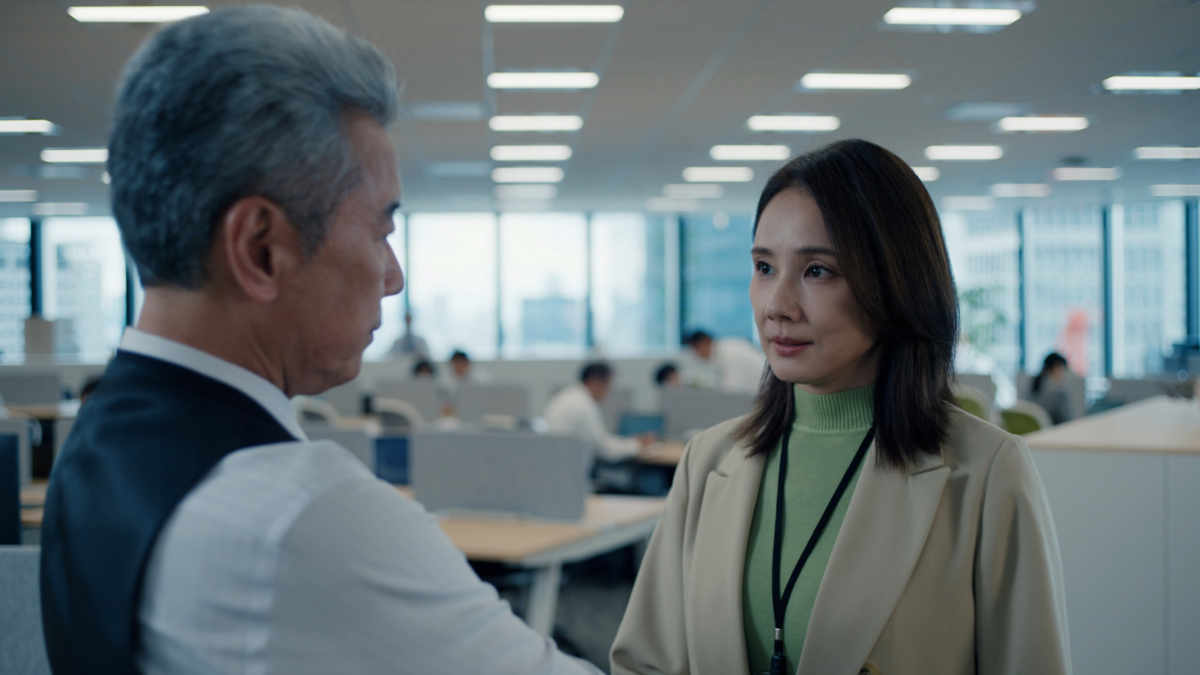
NHK drama The Employee is prompting discussion in Japan about the conflicting expectations placed on ambitious women in the workplace, according to senior producer Akiko Ueda.
The series, which launched two weeks before Ueda’s comments to Deadline, stars Yoh Yoshida and Sara Minami. Its story centers on Eriko, a 50-year-old executive hopeful who has spent her career trying to advance in a male-dominated corporate environment.
Eriko appears to be approaching a defining professional victory as she leads a major project expected to secure her a place on the board. But shortly before its launch, an anonymous threatening letter arrives, destabilizing both her career and the organization to which she has devoted herself.
For Ueda, the drama grew from a broader question about whether employees can escape the institutional values they have absorbed.
“We were deeply fascinated by the question: ‘Can a person who has internalized the values of an organization ever truly become free from them?’” Ueda said.
She described a “double bind” that women can encounter in Japanese workplaces: They may have significant ability and ambition while simultaneously facing expectations not to display those qualities too forcefully. That tension, she said, can lead people to connect their self-worth to their organization’s assessment of them and intensify their need for approval.
Ueda called that dynamic a “restrictive and unreasonable situation.” The writers responded by building the series around a woman whose value has been determined by her workplace and who ultimately challenges that system in an effort to regain control of her identity.
Characters Beyond Heroes and Villains
The production took on harassment, workplace gender dynamics and questions surrounding perpetrators and victims — subjects Ueda said presented a “major challenge” for the team.
Yoshida plays Eriko as someone caught between what Ueda characterized as corporate righteousness and human righteousness. The producer praised Yoshida’s “earnestness” in handling that conflict.
Minami’s character, Ruri, brings shifting pressures to Eriko’s circumstances while carrying what Ueda described as an “underlying vulnerability.” Ueda said the two leads helped establish an approach followed by the wider cast, with the characters portrayed as complicated people who cannot be classified simply as good or bad.
That moral complexity is central to a drama examining not only individual behavior but also the systems and power structures shaping it.
From a Mothers’ Community to the Corporate World
The Employee began in a dramatically different form. Its earliest version was a three-line logline set among a community of mothers connected through their children, rather than inside a company.
NHK nevertheless identified promise in the underlying idea of women with different values and life experiences encountering and changing one another. Moving the action into an office allowed the creative team to expand the premise beyond personal relationships and examine organizational structures and power dynamics.
The finished project was selected during the second year of NHK’s Writers’ Development Room, known as WDR, after competing against eight other scripts shortlisted last summer.
It is the second Japanese series to come from the initiative. The first was the thriller 30,000,000 Yen, which Ueda said was widely praised for the speed and unpredictability of its plot.
WDR program director Keita Hosaka previously said the writers-room program was created amid concern that leading young Japanese drama writers were moving toward manga, video games and comedy instead.
The Employee was written by Tomomi Naka, Shu Matsui, Tomoe Asaka and Sou Tateya. Hosaka directed alongside Keisuke Oshima and Yuki Nishio. Ueda produced the series with Shouta Ishimura.
ShowBiz Take
The significance of The Employee lies in how its workplace thriller framework supports a direct examination of recognition, ambition and institutional power. Eriko’s professional crisis is not presented only as a threat to one project or promotion; it tests the identity she has built around the organization’s judgment of her.
The series’ evolution also shows how a change of setting can widen a drama’s scope. What began as a story about women meeting through their children became an opportunity to explore hierarchy, workplace behavior and the pressures that can shape how employees understand their own worth.
By refusing to divide its characters neatly into heroes and villains, the production is also positioned to address harassment, victimhood and responsibility through competing human and corporate loyalties rather than simple labels.
What Happens Next?
NHK hopes to continue the Writers’ Development Room with a third edition, although no timing has been announced. For now, The Employee serves as the program’s second produced drama and its latest attempt to turn a developing script into a series built around a major social question.