California remains the country’s biggest movie and television production hub, but New York has dramatically narrowed the gap.
California recorded $1.76 billion in production spending during the latest quarter, according to industry tracker ProdPro’s quarterly snapshot released Thursday. New York reached $1.61 billion after an 87 percent surge, far outpacing California’s 17 percent increase.
ProdPro co-founder and CEO Alex LoVerde told The Hollywood Reporter that New York appeared capable of taking the top spot as the third-quarter figures were compiled. California ultimately retained its lead by just $147 million, he said, making the fourth quarter and 2027 critical periods to watch.
New York’s production engine accelerates
New York’s rise is being supported by expanded soundstage infrastructure, a large union crew base and access to nearby Tri-State locations. CBRE reported in June that the state’s soundstage inventory has increased 43 percent since 2020 amid growth in purpose-built facilities.
That infrastructure has helped New York attract both feature films and the kind of scripted television productions that can remain on the same stages across multiple seasons. This season’s roster includes CBS shows CIA, FBI and Elsbeth, along with NBC’s The Fall and Rise of Reggie Dinkins, Law & Order and Law & Order: SVU.
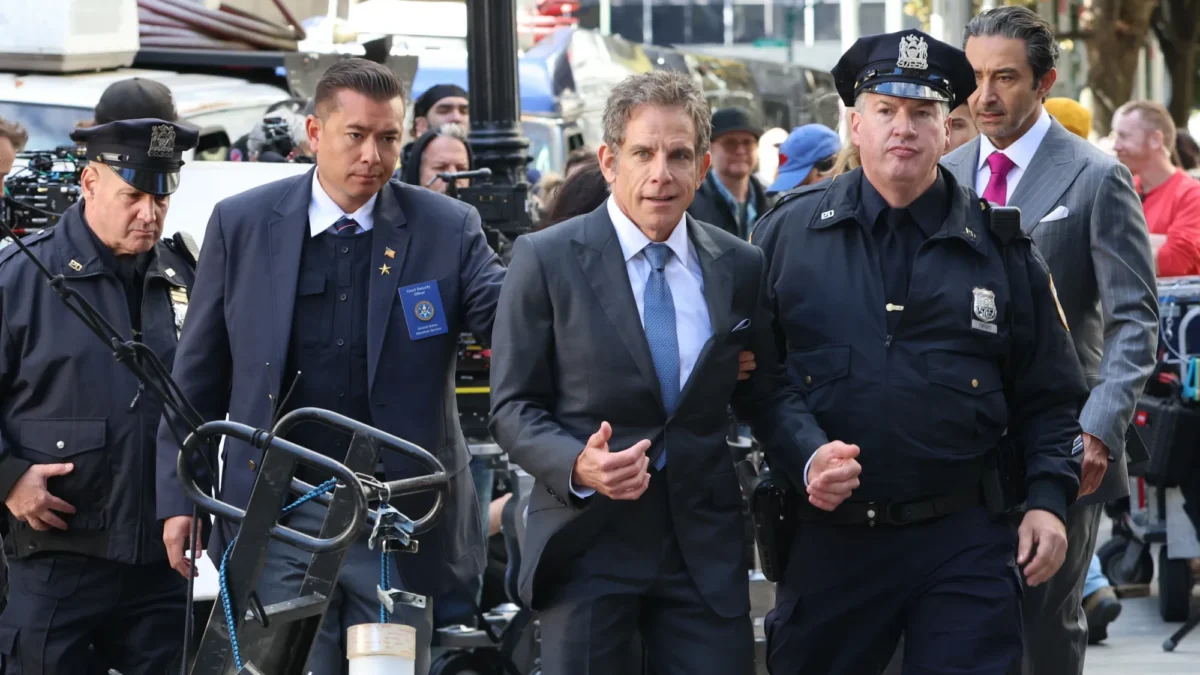
October alone brought crews for Apple TV’s Ben Stiller-led comedy Protective Custody, A24 romantic drama Deep Cuts and PREPPY, a true-crime film featuring Kit Connor.
Universal Pictures’ Miami Vice: 85 illustrates how productions can use the wider region. The neo-noir action film starring Michael B. Jordan and Austin Butler has filmed in New York, Wayne, New Jersey, and its namesake Florida locations.
California is fighting to retain production
California’s 17 percent spending increase still represents a meaningful recovery. ProdPro counted approximately 80 live-action film and television projects shooting in the state during the quarter.
Gov. Gavin Newsom’s office and state and local officials in Los Angeles have pledged to reduce red tape, limit production flight and keep studios operating in Burbank and Hollywood.
The state also recently resolved tensions involving David Ellison, who had threatened to move Paramount to locations including Tennessee or Texas while California pursued him in court over his successful bid to acquire Warner Bros. That dispute has been smoothed over, and the $111 billion deal has closed.
Ellison can now turn his attention to existing Los Angeles studio lots and his pledge to make 30 movies annually, although not all or even most of those productions will film in California. His combined operation produces more than 100 series at any one time.
Georgia and New Jersey build momentum
New York is not California’s only challenger. Georgia posted a 32 percent quarterly increase in production spending after being hurt by Marvel superhero projects moving to the United Kingdom.
James Gunn’s DC sequel Superman: Man of Tomorrow has been shooting on location in Georgia. Benny Safdie’s Lizard Music and Netflix’s Scooby-Doo origin series also filmed there during the quarter. American Idol is additionally preparing to move production from Los Angeles to Atlanta, giving Georgia another long-running franchise capable of establishing a production base.
New Jersey, meanwhile, has become another major East Coast growth center. Netflix’s Kevin Hart and Henry Cavill action project Spy Duo and Adam Sandler’s Grown Ups 3 have recently filmed in Monmouth County. CBS series Cupertino and Dan Levy’s Netflix show Big Mistakes also shot in the state.
Although New Jersey’s filming count fell 24 percent year over year during the quarter, former state film commission director Jon Crowley argued that the decline reflected soundstages reaching capacity. Netflix is building a base at the former Fort Monmouth site, Paramount has signed a 10-year lease at the developing 1888 Studios in Bayonne, and Lionsgate is an anchor tenant at Great Point Studios in Newark. All three projects remain under construction.
Crowley suggested that limited available stage space allowed New York to capture additional work. He was removed as film commission director days later, with no reason given. A New Jersey Economic Development Authority representative supported his assessment while confirming that the state is seeking someone to fill the role.
A mixed picture in other production markets
Illinois increased its number of live-action film and television shoots by 15 percent, even as quarterly spending declined. LoVerde noted that the comparable quarter last year included season two of Apple TV’s Dark Matter. Current activity includes the Chicago franchise — Chicago Med, Chicago Fire and Chicago P.D. — as well as the NFL and Hallmark film Holiday Touchdown: A Bears Love Story.
New Mexico experienced a 93 percent year-over-year decline during a summer slowdown. The state was also hit by the cancellation of Netflix’s Ransom Canyon after two seasons. The romantic Western employed 700 cast and crew members in New Mexico, which stood in for Texas Hill Country.
There are signs of incoming activity: Netflix’s The Four Seasons began production at the end of the third quarter, while Apple TV and Sony’s Vince Gilligan drama Pluribus is scheduled to start filming during the fourth quarter.
ShowBiz Take
New York’s advance is significant because it is not resting on a single major production. Its spending growth is backed by expanded stages, recurring scripted series and access to a neighboring production corridor that includes New Jersey.
California remains No. 1 and is growing again, but its once-comfortable advantage has tightened sharply. The next quarterly results will show whether New York’s surge marks a lasting shift or whether California can widen the gap as its own recovery continues.