
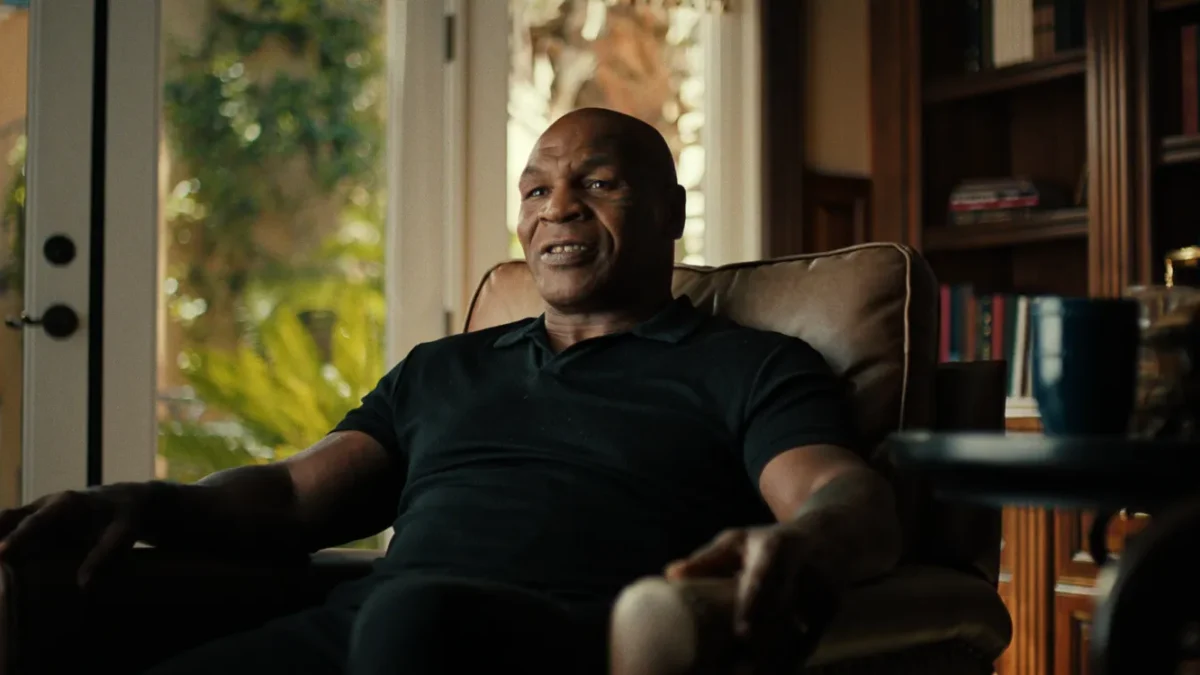
Netflix is returning to Mike Tyson’s life story with Tyson, a four-part docuseries directed by Floyd Russ and scheduled to premiere Tuesday, October 13. Across roughly four hours, the production gives Tyson another opportunity to recount his turbulent history largely on his own terms.
That access is both the project’s chief attraction and its defining limitation. Tyson can be emotionally exposed, funny and reflective, then suddenly evasive when the questioning reaches subjects he does not want to discuss. Russ retains several moments in which Tyson pushes him toward another topic, revealing the boundaries around an otherwise candid conversation.
Tyson is not an executive producer on the series, but his perspective remains dominant. Russ also never directly asks what Tyson hopes to gain by participating in yet another production about his life.
A Chronological Tour Through Tyson’s Past
The docuseries begins with Tyson’s difficult youth in Brooklyn, his juvenile encounters with the law and his time at a youth facility, where he discovered boxing. That experience led to his connection with trainer Cus D’Amato and eventually to the run of stoppages that made Tyson the youngest heavyweight champion ever.
From there, Russ charts the repeated rises and falls of Tyson’s boxing career. The series addresses his fights with Evander Holyfield, including the biting incidents, alongside the rape trial, his prison term for rape, the death of his daughter, drug addiction, recovery and subsequent relapses.
No major subject is entirely excluded, but the depth of each discussion depends on Tyson’s willingness to engage. While talking about his marriage to Robin Givens, he acknowledges some levels of abuse but stops short of confirming others. His response to the Indianapolis rape accusation is limited to brief denials.
Neither Givens nor Desiree Washington appears in the series. According to the material presented, they either declined to participate or did not respond to requests. Their absence means some of the most contentious chapters are told primarily through Tyson’s account.
Other Voices Add Weight
Tyson is not limited to its subject’s testimony. Russ interviews people from different periods of Tyson’s life, including childhood friends, gym partners, fellow boxers and family members.
Lennox Lewis and James “Buster” Douglas are among the notable boxing figures interviewed. Douglas discusses what it meant to defeat Tyson just weeks after the death of his mother, giving the series one of its strongest emotional passages.
Tyson’s children speak candidly about both the positive and negative sides of having him as a father. Friend and former manager Rory Holloway also brings unresolved anger to his account of Tyson firing his entire team.
Journalist and commentator Van Lathan periodically opens the door to a broader examination of Tyson’s place within American culture and the country’s racial history. The series, however, does not pursue those ideas in sustained depth, including the larger cultural role of the Black heavyweight champion. Donald Trump also appears as a talking head, offering opinions about the sexual assault accusations against Tyson.
A Conventional Sports-Documentary Approach
Visually and structurally, Russ keeps the production straightforward. The story is largely chronological, occasionally rewinding by days or hours without significantly changing the narrative. Interviews are paired with archival material, stock footage, inserts and recurring images of pigeons.
Even an unusual sequence in the fourth episode, when Tyson persuades Russ to join him in smoking hallucinatory toad venom, is presented without much stylistic experimentation. The filmmaking follows the familiar rhythms associated with ESPN and HBO sports documentaries rather than attempting a more ambitious historical portrait.
That conventional approach makes the series accessible, but it also reinforces how familiar this material has become. Tyson previously appeared in Animal Planet’s pigeon-centered documentary Taking on Tyson and inspired the Adult Swim animated series Mike Tyson Mysteries. He also mounted a long-running one-man show about his life.
Hulu offered an unauthorized dramatization with the 2022 limited series Mike. Tyson denounced that production and compared Hulu to a slave master, but its broad account covered much of the same territory he has repeatedly discussed himself.
ShowBiz Take
The significance of Tyson is not that it uncovers a previously hidden life. Instead, the docuseries demonstrates how Tyson continues to occupy mainstream cultural space despite his criminal history and the many controversies attached to his public life.
For viewers already interested in Tyson, his volatile mix of openness, humor, sorrow and hostility can still be compelling. Those looking for substantial new information, a balanced treatment of the accusations against him or a deeper cultural analysis may find the series too controlled by its subject and too visually familiar.
Ultimately, Tyson works less as a definitive reassessment than as another revealing example of Tyson shaping his own narrative—speaking freely until he decides that he will not.
What Happens Next?
Tyson is scheduled to premiere on Netflix on Tuesday, October 13.