
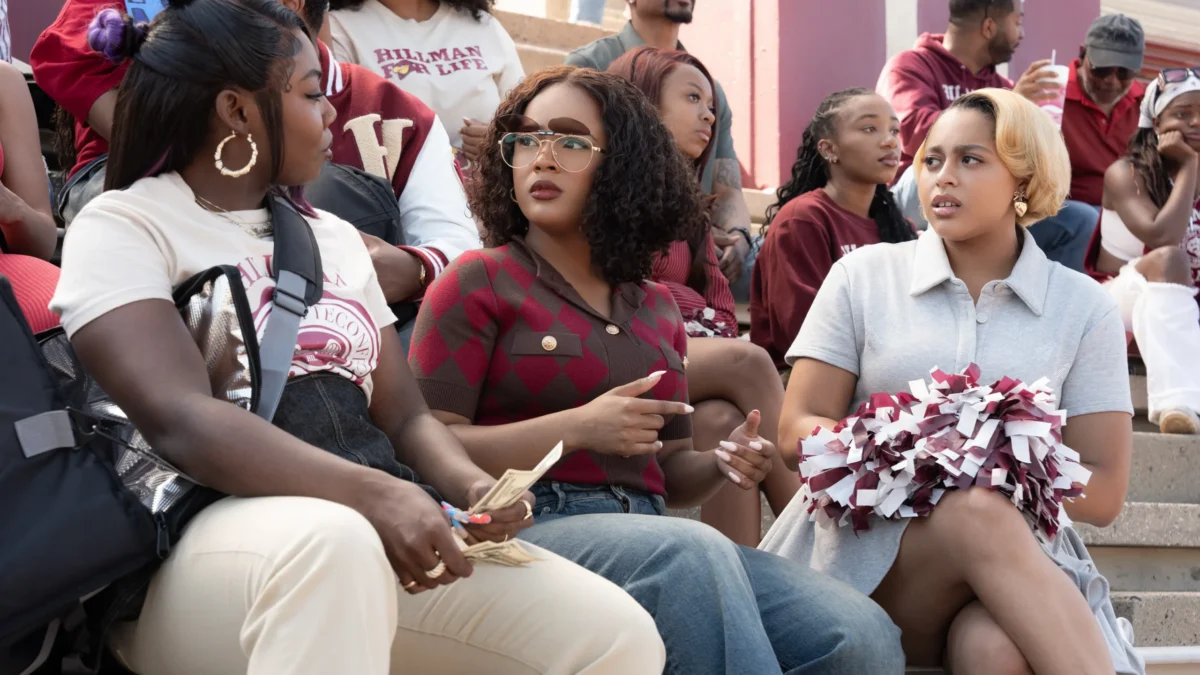
Netflix has reopened the doors of Hillman College with a lively new version of “A Different World,” arriving 39 years after the original NBC series premiered. Now streaming, the single-camera dramedy successfully brings the fictional, historically Black college into the Gen Z era, even if its ambitious first season often races through its stories.
Created by Felicia Pride and executive produced by Debbie Allen, who helmed the earlier sitcom, the reboot centers on Deborah Wayne, played with sparkling energy by Maleah Joi Moon. Deborah is the artistic but unfocused youngest child of Whitley Gilbert-Wayne and Dwayne Wayne, with Jasmine Guy and Kadeem Hardison returning as the couple.
Deborah had expected to attend NYU’s Tisch School of the Arts, but an unfortunate incident leads to her acceptance being rescinded. That turn sends her to Hillman, her parents’ alma mater, where family history does not make the adjustment to college life any less chaotic.
A new class moves into Hillman
The 10-episode season covers an entire academic year, beginning with the confusion of move-in day. Deborah struggles to sort out her schedule while meeting students whose backgrounds, priorities and personalities quickly clash with her own.
Her roommate Rashida Duvall, played by Alijah Kai Haggins, is a direct, practical scholarship student from Compton. Rashida has little patience for Deborah’s scattered behavior or the advantages she believes come with being the child of prominent Hillman alumni.
Kennedi Reece plays Hazel, the third member of their circle. Sheltered by a conservative upbringing, Hazel arrives with a sweet disposition and a determination to pursue what the show describes as her Michelle Obama dreams.
Across campus, Cornell Young IV plays Shaquile Johnson, Deborah’s former flame and the only child of Ron Johnson, once again portrayed by Darryl M. Bell. Shaquile has rejected an opportunity at a Division 1 university in favor of Hillman, where he hopes to elevate the school’s football program.
His roommates widen the new ensemble further. Chibuikem Uche plays Kojo, a Nigerian-Ghanaian transplant from the U.K., while Jordan Aaron Hall portrays Amir, a queer Harlemite rebuilding his life after several missteps.
Big ideas, limited time
This “A Different World” works best when it embraces the particular concerns of its young characters. Its version of modern HBCU life includes social media, financial-aid pressures, romance and strained friendships, alongside political questions affecting Black Americans. The students and faculty also confront the consequences of near-nonexistent federal funding under the Trump administration.
Friendships receive as much attention as romantic entanglements, with breakups and breakdowns between friends becoming a significant part of the season. The series also offers a look at how Dwayne and Whitley’s lives have developed across the past four decades rather than using them only as nostalgic cameos.
The production ties generations together without surrendering the spotlight to the returning cast. Familiar characters move through the story, but the younger performers are allowed to establish Hillman as their own world. New viewers can follow the show without knowing its history, while audiences familiar with the original “The Cosby Show” spinoff and the long-running Dwayne-Whitley romance will find additional layers.
The principal weakness is speed. Earlier television comedies could spread plots across seasons containing more than 20 episodes; this reboot attempts to fit a full school year into 10 half-hour installments. As a result, developments that might otherwise build over several episodes can feel compressed.
Episode 7, “Sometimes You Get the Culture… Sometimes The Culture Gets You,” demonstrates both the show’s strengths and its limitations. It combines a sexual health and wellness thread with Kojo’s story about diaspora wars and the end-of-year talent show. The different pieces are tightly assembled, but the sheer amount of material leaves little room for the characters or audience to pause.
That breathless momentum does not erase the reboot’s appeal. The season remains energetic and assured, with Pride and Allen presenting a clear vision of how Hillman can speak to another generation. A soundtrack featuring Summer Walker, Mariah the Scientist and Alex Isley helps define its contemporary setting, while appearances by known artists continue a tradition associated with the original series.
The first “A Different World” became a major cultural touchstone by centering Black Gen X characters on television. HBCU enrollment subsequently rose by 26%, an increase considered most likely connected to the show’s popularity. That legacy gives Netflix’s version an unusually demanding standard to meet.
Rather than trying to duplicate its predecessor, the reboot focuses on the passions, pressures and inherited challenges shaping Gen Z. It is funny, untidy and consistently engaging—an affectionate return to Hillman that respects the earlier series while making space for a distinct new class.
“A Different World” is now streaming on Netflix.