
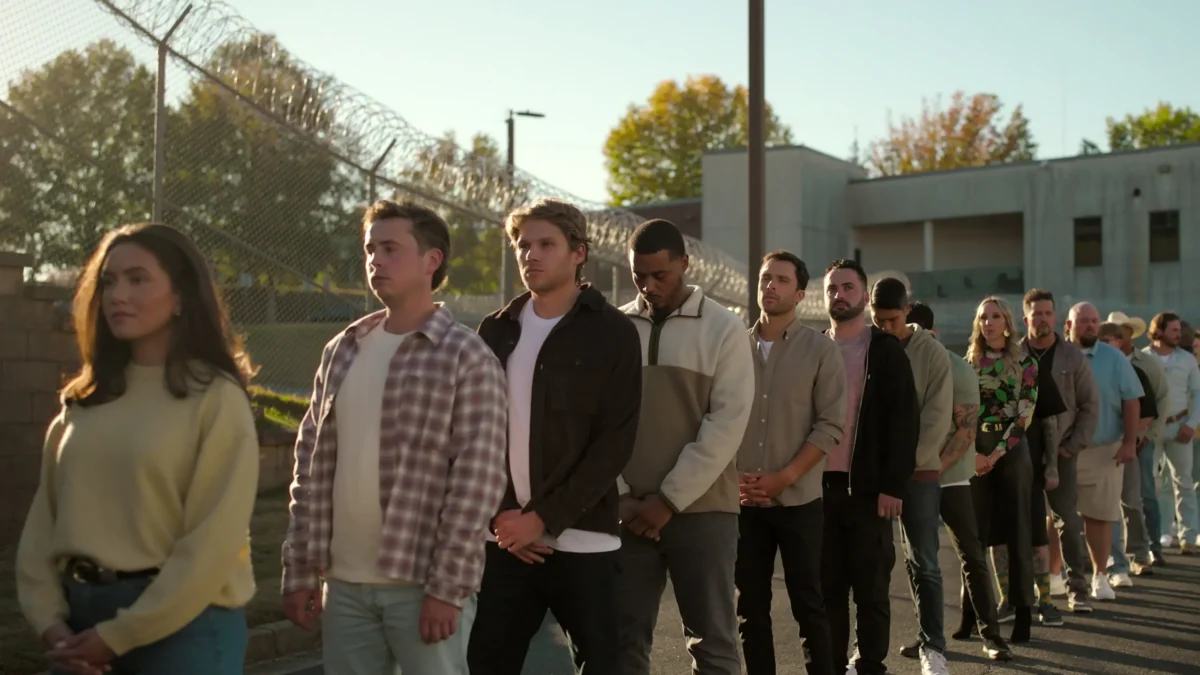
Netflix is reopening one of psychology’s most controversial chapters with “The New Stanford Prison Experiment,” a reality series debuting Oct. 21 that places 30 participants inside a simulated prison environment for two weeks.
Executive produced by Jane Lipsitz and Dan Cutforth through Alfred Street Industries, the project unfolds in a decommissioned section of the Adult Detention Center in Cherokee County, Georgia, which remains a working prison. Eight participants are assigned as guards, divided between day and night shifts, while the other 22 become prisoners.
The series is designed to reconsider the central premise behind the infamous 1971 Stanford prison experiment: Does power corrupt? It also explores conformity, dominance and submission, voyeurism, and the ethical limits of reality television.
Unlike the original study’s largely homogeneous group of male college students, the Netflix production brings together people from different races and backgrounds, including three women. Some participants also had criminal histories, a significant departure from the selection process used in 1971.
Revisiting a Notorious Experiment
Stanford psychology professor Philip Zimbardo launched the original experiment in August 1971 with funding from the U.S. Office of Naval Research. He recruited 24 male college students who had passed psychological screenings and had no criminal records or medical conditions. All were white apart from one Asian American participant, and they came from similar economic backgrounds.
Stanford’s psychology department was converted into a mock prison featuring small cells, a corridor used as a prison yard and a closet designated for solitary confinement. Participants, who were paid $15 per day — equivalent to $124.79 in 2026 — were randomly assigned to serve as guards or prisoners. Prisoners were identified by numbers on their uniforms, while guards were encouraged to preserve order by any means necessary.
By the second day, prisoners had barricaded their cells with beds. Guards responded with fire extinguishers and made the prisoners strip and sleep on the concrete floor. As punishments became increasingly cruel and several prisoners suffered mental breakdowns, the experiment was stopped on its sixth day rather than continuing for the planned two weeks.
It is now regarded as a major ethical failure because of inadequate safeguards, insufficient informed consent, poor oversight and Zimbardo’s dual role as both the researcher and the mock prison’s superintendent.
Safeguards Behind the Netflix Series
Lipsitz and Cutforth said the new production employed extensive background checks and psychological testing, informed consent, round-the-clock access to medics and psychologists, and confessional interviews throughout the experiment. Participants could say the safe word “pineapple” if they wanted to leave or speak with a therapist or producer.
Off-duty guards were also stationed nearby in case an intervention became necessary. Major Boughner served as commander of both the functioning side of the correctional facility and the experimental unit.
Three experts continually observed the participants and advised production on ethical issues: Harvard Business School behavioral scientist Alison Wood Brooks, former federal corrections officer Michael Cantrell and Pulitzer Prize-winning journalist Trymaine Lee.
No crew members were stationed inside the pod, with the action instead captured on Robocam. Participants were paid, although Lipsitz and Cutforth did not disclose the amount. Lipsitz said the compensation was intentionally not high enough to make money the primary reason for joining, and the show offers no large final prize.
“We were definitely nervous to take on something that has already failed,” Lipsitz told Variety, adding that there were points when producers wondered whether the new experiment would also end on its sixth day.
Six Participants Dropped Out
The realities of the setting became clear immediately. When the 22 prisoners entered the facility, they heard yelling and heckling from real inmates located on the other side of the walls. Cutforth said that experience affected the arrivals and contributed to some departures.
Six participants ultimately dropped out because the experience became too intense, although not every departure appears in the finished series.
Among those cast was “Scary” Larry Foy, who estimated that he had previously spent more than 300 days in jail and told his cellmate he had tried to kill his brother. Lipsitz said Foy had completed substantial recovery work, had changed his life pattern and now works as an advocate for reform. She maintained that production’s screening process was intended to prevent anyone posing a threat from entering the group.
The experiment takes a darker turn on day six, mirroring the point at which the 1971 study was terminated. One guard team responds to a possible uprising with a punishment that even the other shift considers extreme. The production later introduces several interventions, including an assertion of the hierarchy and a major role reversal that changes the group dynamic.
Lipsitz characterized the experience as more emotionally intense than physically intense. Although there were moments of concern, the real prison guards never had to enter the experimental pod to intervene.
ShowBiz Take
What makes the Netflix series significant is not simply its return to a notorious premise, but its attempt to confront the failures that made the original experiment so damaging. The diverse casting, professional oversight, informed consent and emergency protections create a markedly different framework, while the working-prison setting preserves an unsettling degree of realism.
The project also places reality television itself under examination. Viewers are not only being asked to consider how ordinary people respond to authority, but also where a filmed social experiment should draw its ethical boundaries.
What Happens Next?
“The New Stanford Prison Experiment” arrives on Netflix Oct. 21. Lipsitz said its outcome suggests that “Does power corrupt?” may not have been the right question in the first place, while Cutforth expects the series to prompt conversation and strong reactions. The producers are leaving viewers to decide what its participants ultimately reveal about power, morality and human behavior.