
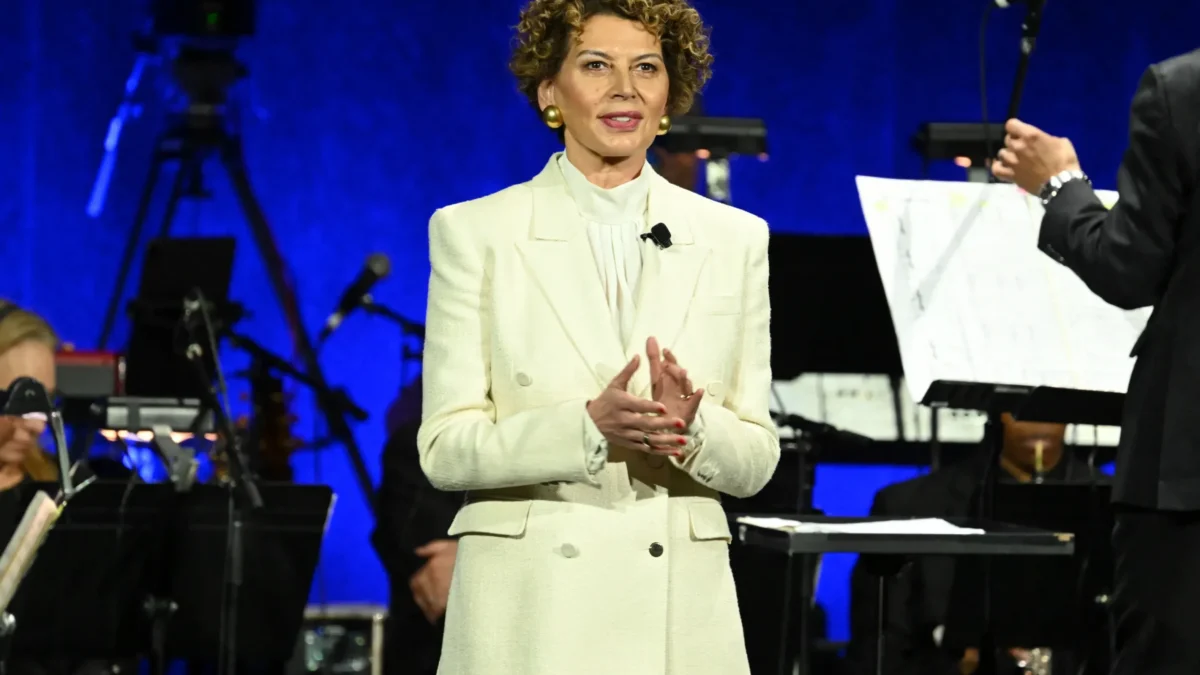
Donna Langley has delivered a blunt verdict on a potential combination of Paramount and Warner Bros. Discovery, warning that further consolidation could hurt the feature film business.
“I think it is bad. I think it’s bad for everything,” the chairman of NBCUniversal Entertainment & Studios said during a Q&A at the Bloomberg Screentime conference.
Langley’s concern centers on theatrical output. She argued that the current year has demonstrated that audiences will still turn out when studios provide a consistent and appealing range of movies.
“What this year has proven is, if you build it, they will come,” she said. Langley also pointed to young moviegoers developing the habit of visiting cinemas, saying the industry needs to keep that audience engaged.
In her view, maintaining the number of films reaching theaters is essential. Langley acknowledged that eliminating a studio is not the stated intention behind the Paramount-Warner Bros. Discovery combination, but said such an outcome would be damaging.
“Look back at Fox-Disney. It wasn’t great,” she added.
Paramount has committed under a legal settlement to have the combined studios release 30 theatrical films annually during the first two years following the merger. That number would increase to 32 films a year for the subsequent three years. The deal is expected to close next Tuesday.
The Taylor Sheridan Deal
Langley also addressed Universal’s five-year film and television agreement with Taylor Sheridan, which is scheduled to begin in early 2029. The deal, made last fall, will move Sheridan away from his longtime studio home at Paramount.
She said the opportunity emerged during a period of corporate disruption and instability, when shifting industry conditions created a chance to seek a competitive advantage.
Her initial conversations with Sheridan focused on movies. Langley said she knew his Paramount film arrangement was a first-look deal and did not carry the same restrictions as his television agreement.
“That’s how it started, and then we just got to talking, and one thing led to another,” she said.
NBCUniversal Faces Its Own Corporate Change
While Langley is critical of one major industry combination, NBCUniversal is preparing for a substantial restructuring of its own. Parent company Comcast plans to spin off NBCUniversal with Sky as a standalone, publicly traded company.
Langley said she is approaching that separation with optimism rather than concern.
“I’m mostly excited and optimistic about it. I’m not fearful of it at all, actually,” she said, adding that no longer being tied to Comcast, whose stock she said has struggled for some time, could benefit the new company.
The change will give NBCUniversal greater control over its direction, though Langley acknowledged that independence will bring additional pressure. She compared that challenge with the demands already attached to releasing movies multiple times each year.
Langley also recognized questions surrounding the scale of a slimmer company. However, she said the transition could give NBCUniversal an opportunity to examine new areas of growth during what she characterized as a period of historic transformation.
The split is expected to be completed by mid-2027.
A Cautious Box Office Outlook
Universal is the world’s No. 1 movie studio this year, during the strongest overall box office period since the pandemic. Even so, Langley is more guarded about what 2027 may deliver.
“I think 2027 has a different complexion to it,” she said. “I don’t think it has as much potential for the kind of big billion-dollar hits like this year.” She expects 2028 to mark a return to stronger blockbuster potential, while emphasizing that the movie business can still produce unexpected results, both positive and negative.
Two films exemplified that unpredictability for Langley: Universal’s Christopher Nolan epic The Odyssey and Focus Features’ Obsession.
Langley said she had been confident that The Odyssey would cross the billion-dollar mark and go beyond it, but its performance pattern still surprised her. The movie’s third week outgrossed its second, an unusual development she described as part of a theatrical run filled with unexpected turns.
Obsession, meanwhile, became what Langley called a “good old-fashioned over-performing surprise.” The studio acquired the film for $15 million after identifying its potential to connect with the cultural moment. It ultimately grossed more than $500 million worldwide.
“We caught lightning in a bottle,” Langley said.
What Happens Next?
The coming stretch will bring several consequential milestones for Langley and NBCUniversal. The Paramount-Warner Bros. Discovery deal is expected to close next Tuesday, Sheridan’s five-year Universal agreement begins in early 2029, and NBCUniversal’s separation from Comcast is targeted for completion by mid-2027.
At the same time, Langley’s theatrical forecast leaves room for uncertainty. Although she sees fewer obvious billion-dollar opportunities in 2027, this year’s results have reinforced her view that surprises remain one of the defining features of the film business.