
Naomi Watts says the screen industry’s treatment of women over 50 has shifted in a meaningful way — and she pointed to last week’s Emmy nominations as evidence that older actresses are increasingly being recognized in major categories.
The British actor made the comments at the San Sebastián Film Festival, where she is receiving this year’s Donostia Award. Speaking about opportunities for women past 50, Watts reflected on the warning she received early in her career that time was already running out.
“I was told at the beginning that I better get my skates on because it all finishes at the age of 40,” Watts said. “And here we are today. I’m in my late 50s. Look at the Emmys last week [and] the number of women in strong categories over 50. That’s heartening to see.”
Watts noted that she arrived in the business late “by Hollywood standards,” citing her breakout role in David Lynch’s acclaimed “Mulholland Drive” at age 31. Her comments came a week after Sarah Paulson told Variety about a lack of film offers after her portrayal of Marcia Clark in “The People v. O.J. Simpson: American Crime Story.”
Watts said she believes the industry has moved in a better direction. “I do think things have changed,” she said. “Women are consumers of film and TV, and their stories should be reflected. That narrative had to be shifted. And I am grateful to be a small part of that shift.”
Among the Emmy nominees over 50 cited in the conversation were Rhea Seehorn for “Pluribus,” Jean Smart for “Hacks” and Allison Janney for “The Diplomat.”
A festival honor and a new role
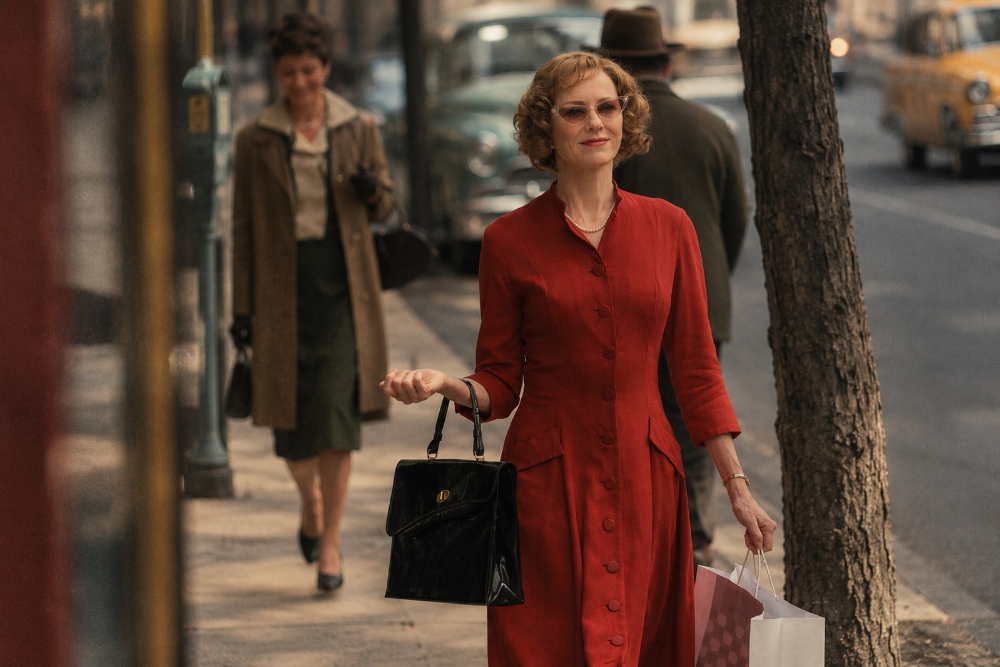
Watts is also in San Sebastián with “The Housewife,” the feature debut of Ben Shirinian. The film is the Donostia Award Screening and stars Watts alongside Tye Sheridan, Luke Evans, Michael Imperioli and Lena Olin.
Set in 1964 and based on a true story, “The Housewife” follows a young journalist who searches for a potential Nazi officer living secretly in New York and becomes close to the suspect’s charming wife. Watts plays Hermine, a character she described as unusually difficult and morally disturbing.
Watts said she had a “huge amount of fear” in taking on the part. “It was like nothing I ever played before: this duality of this woman who had done horrific things, heinous crimes, and yet blending into society as a normal person – very much a good citizen, a good wife, baking cookies, showing up to church,” she said. “That duality and living with that secret was interesting to me as an actor.”
The actor said she remains drawn to material involving “grief and identity,” but stressed that Hermine pushed her into new territory. “This character is like nothing I’ve ever played,” Watts said. “I’m at an age now when some might joke I’m in my villain era, but this is an extreme one and not a joke. I felt compelled to play this story.”
Asked about the film’s connection to World War II and the Holocaust amid current global conflicts, specifically the ongoing war in Palestine, Watts said: “It’s a very, very scary time what is going on in the world globally.”
She added, “We must be vigilant, we must pay attention, and not let that happen again. Hopefully this film sparks a dialogue. We don’t give answers; we hopefully send you away with questions of how did this happen and, who do you relate with in this story, and how we can avoid this happening ever again.”
Watts also spoke about representation and the importance of storytelling in the current moment. “We have to tell these stories; storytelling is important, particularly now,” she said. She added that she intends to continue supporting minorities and representation on screen, saying, “I’m proud to be a part of the LGBTQ community. Minorities are being attacked right now, and it’s frightful and unacceptable. My heart is with these communities, particularly my family. I’ll do whatever I can to stick up for minorities.”
Discussing the experience of playing an immigrant in the United States while being an immigrant to the country herself, Watts said she “moved to America with hopes and dreams,” which she has “surpassed.” She described Hermine as a woman living in the aftermath of World War II who was trying “to find a new place and erase the past,” at least for a time.
“In terms of me, I have American children, I do love America, and what’s going on today is complicated and certainly nerve-wracking, but I have faith that things will work out in time,” Watts said of the current U.S. political climate.
Looking back at “Mulholland Drive”
Watts also reflected on “Mulholland Drive” when asked about similarities between that film and “The Housewife,” particularly the way both roles engage with duality. She said both parts are “deeply psychological and confronting,” but described the experiences of playing them very differently.
“‘Mulholland Drive’ was nothing but fun,” Watts said. “It was coming at a time in my life when I didn’t have any breaks after years of struggle, so every day on set was just a wonder. Getting to learn how Lynch works and directs was truly wonderful. I’ll never forget those days.”
Watts called working with the late Lynch “an incredible break,” recalling that she had spent about 10 years trying to land a film role before that opportunity arrived. “I was very much a journeyman actor, working wherever I could, but I had a lot of rejection,” she said. “It took someone like David Lynch to see through the veneers I had created. We had a beautiful conversation, and he gave me the role of a lifetime.”
“I’m forever indebted to David Lynch; he is in my heart forever,” Watts added. “This is a film that has remained in people’s consciousness for decades, and I think it really launched me because every great filmmaker saw this film.”
The San Sebastián Film Festival runs Sept. 18-26.