
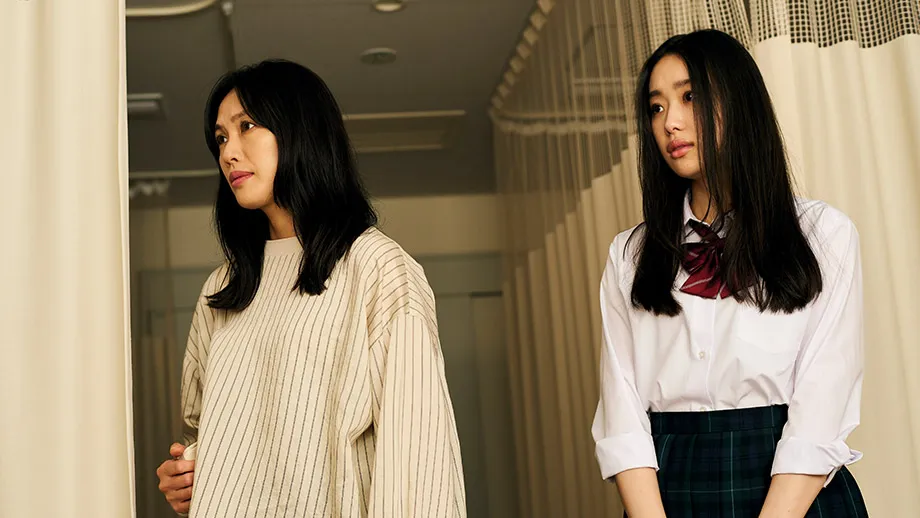
Matsumura Shingo is turning emotional distance into something audiences can see in “Between Us,” his new film playing in the Tokyo International Film Festival’s Nippon Cinema Now section, a strand dedicated to Japanese cinema.
The story centers on childhood best friends Makoto and Kasumi. An incident during a camping trip shared by their families drives them apart, leaving wounds that remain unresolved when they meet again six years later in their high school drama club.
Kawashima Ririka, Kurasawa Anna, Kikuchi Akiko, Usuda Asami, Saito Yoichiro and Miura Takahiro star in the film. Rather than explaining every feeling directly, the screenplay allows silence, physical separation and carefully observed performances to carry much of the characters’ emotional history.
Distance Becomes Part of the Drama
Matsumura, whose credits include 2023’s “The Lump in My Heart,” uses controlled, largely still compositions to capture what Makoto and Kasumi cannot say. The director has established a personal rule against handheld camerawork in his films, partly as a way of separating his big-screen work from the compact-camera footage commonly seen on YouTube and social media.
“The second reason is that I want to capture the emotion of the actors truthfully, slowly,” Matsumura said.
That approach becomes central to “Between Us.” Even when the former friends occupy the same environment, they are frequently positioned far away from one another. For Matsumura, the challenge was not simply showing that the girls had become estranged, but suggesting that each remained conscious of the other.
“Though they are apart, they are feeling the existence of the other,” he explained, adding that he sought to communicate that connection through the performers’ eyes and the space separating them.
The drama club itself is struggling. Kasumi’s seriousness has caused other members to leave because they feel unable to keep pace with her. Makoto’s arrival does not immediately erase the tension between the two, and the film continues to emphasize their separation.
A script discovered by Kasumi begins to change that dynamic. The work, also titled “Between Us,” gives the characters an indirect way to express feelings they have been unable to communicate outside the rehearsal process.
In one of the film’s key formal choices, separate read-throughs are edited as if Makoto and Kasumi are exchanging lines. Although they are not in the same room, the cuts gradually bring them closer.
“The play is a fiction, but they are speaking in their own language,” Matsumura said. “And by saying their lines, they are able to say what they were not able to say in the real world.”
A Personal Story With Wider Inspiration
Although “Between Us” focuses tightly on two people and their families, Matsumura traced its beginnings to a broader period of crisis. His inspiration developed through a succession of disasters and conflicts beginning with the 2011 Great East Japan Earthquake, followed by the pandemic and wars around the world.
Those events do not appear literally in the story. Instead, Matsumura connected them to the idea of experiences being treated as settled even when their consequences remain active. He described the past trauma binding Makoto and Kasumi’s families, as well as the real-world events that influenced him, as “unresolved.”
“Once it’s not on the news, we feel that it’s kind of in the past solved, but it’s really not in reality,” he said, referring to the earthquake, the nuclear power plant and war.
That thinking led him toward a deliberately simple dramatic question: What happens when two people who are facing away from one another finally turn and look at each other?
Matsumura said he gave his two lead performers no specific direction. He instead trusted their ability to listen closely, absorb one another’s words and respond naturally, allowing them to perform according to what they felt.
ShowBiz Take
“Between Us” matters because its filmmaking method is inseparable from its subject. The story is about people who cannot easily close the gap between them, while the staging, editing and refusal to rely on handheld movement make that gap visible. The play within the film then becomes more than a drama-club project: It provides Makoto and Kasumi with language for what has remained unspoken.
The film also represents the variety Matsumura sees in contemporary Japanese cinema. He said there is no single mainstream style at present, while limited financing and budgets restrict the scale of what filmmakers can portray compared with the United States.
He does not regard those limits as entirely negative. In his view, Japanese filmmakers are choosing subjects within reach but pursuing different ideas, resulting in many films about varied, smaller-scale concerns rather than one dominant topic.
What Happens Next?
Matsumura has not decided which direction his own work will take after “Between Us.” He said he is weighing whether to continue following his instincts through artistic films that express what is inside him or to turn more directly toward society and a mass audience.
“I don’t know which way I’ll go, as of now,” he said.