
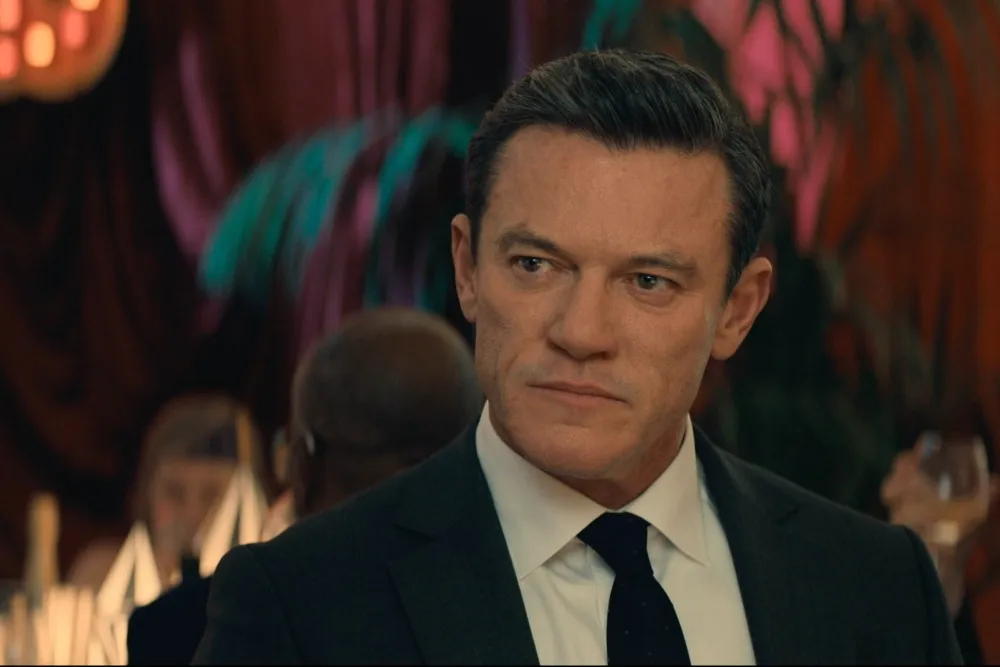
Luke Evans is juggling another genre-spanning run, moving from a Tony-nominated Broadway performance to the psychological tensions of ITV’s “The Party” — while leaving the door cautiously ajar for another trip into the Tolkien universe.
The actor co-produced and stars in “The Party,” a five-part adaptation of Elizabeth Day’s novel that is currently available on ITVX. ITV Studios represents the series for global sales.
Evans first encountered Day’s book while reading during the Covid pandemic lockdown. He subsequently helped bring the project to television and enlisted Sarah Solemani to adapt it. Solemani also appears in the series as Lucy, the wife of Evans’ character, Martin.
The drama examines class, concealed sexuality and the complicated boundaries between romantic and platonic love. Speaking to Variety, Evans explained how the television adaptation expands Martin and Lucy’s relationship while making consequential changes to Martin’s story.
How “The Party” reshaped Martin
One major addition is Lucy’s pregnancy, which Evans said places further emotional pressure on Martin and helps establish that the couple have had a physical relationship. The series gives viewers more time with Martin and Lucy together, presenting them as a functioning, if unconventional, couple whose connection contains genuine love.
Another significant departure from the novel is Martin serving time in detention for something he did not do. Evans described that experience as a permanent scar: Martin emerges with a criminal record and the knowledge that he paid the price for somebody else.
The character also draws in part from Evans’ own experiences. He and Solemani held lengthy Zoom conversations in which she asked about his upbringing and personal history.
“I can relate to Martin,” Evans said, pointing to his identity as a gay man from a working-class and highly religious background. He also discussed being an only child and entering unfamiliar environments after receiving opportunities that changed his circumstances.
Evans said he spent years observing, learning and adapting in situations where he did not feel like an insider. Solemani took some of those real experiences and ideas and worked them into Martin’s story, creating what Evans described as “slight parallels” between actor and character.
The series provides closure to its current storyline, but Evans believes more could potentially be explored. Day revisited the characters in another book, “One of Us,” which was published near the end of filming.
“There are lots of unanswered questions,” Evans said when asked whether “The Party” could return. However, no further series has been confirmed.
Evans on sexuality, acceptance and fear
Discussing the recent focus on male relationships and homophobia in projects including Richard Gadd’s “Half Man” and Russell T Davies’ “Tip Toe,” Evans said progress has not eliminated the pressures that can lead people to conceal their identities.
He described New York, where he had recently spent time during a seven-month stay in America, as its own accepting world, while stressing that the city does not represent the entire country. He also said the United Kingdom has advanced considerably in equality and acceptance, but warned that those gains do not feel secure.
Evans argued that political rhetoric can create threats around a person’s “existence,” “authenticity” and identity, prompting some people to retreat or hide. He said he knows that happens within his own industry.
For Evans, remaining closeted was not an option because he was already openly gay before beginning his movie career. In “The Party,” Martin’s choices are further shaped by Ben, who has selected a particular kind of life and consequently requires Martin to behave in a certain way to remain part of it.
A demanding Broadway return
Evans also reflected on his five-month Broadway stint as Frank-N-Furter in the revival of “The Rocky Horror Picture Show,” a performance that earned him a Tony nomination.
He called the experience “nuts” in an unexpectedly joyful way, but also ranked it among the most difficult work he has undertaken. Evans had not performed in a musical for 18 years before stepping onto a Broadway stage in six-inch stiletto boots for eight shows each week.
He compared the physical challenge to a cross-country marathon, saying the production continued to reward him, culminating in the Tony recognition.
The run also carried personal meaning because of Tim Curry, who originated the role and played Frank-N-Furter in the film adaptation. Evans wrote Curry a letter two weeks before completing the show. Curry’s team delivered it, and Evans was told that Curry appreciated the message.
Evans finished the production two weeks later, and Curry died the following day. The actor said he kept a photograph of Curry in his dressing room and thought about him daily throughout the run.
“I’m just so grateful I sent the letter,” Evans said, describing his involvement with the show as “magical.”
Could Bard the Bowman return?
As for Andy Serkis’ upcoming “The Hunt for Gollum,” Evans offered enthusiasm rather than confirmation. After playing Bard the Bowman in “The Hobbit” trilogy, he questioned whether the human character would still be alive during the new feature’s place in the story’s chronology.
When told the film would be set between “The Hobbit” and “The Lord of the Rings,” Evans suggested that Bard’s son, Bain, might be more likely to appear.
“But I think Bard doesn’t,” he said, before adding: “Take me back to Wellington. I’d love to go!”
There is currently no confirmation in the supplied material that Evans or the character will be part of “The Hunt for Gollum.”
ShowBiz Take
Evans’ latest stretch captures the unusually broad range of his current work: co-producing a character-driven British thriller, returning to musical theater after an 18-year absence and entertaining questions about revisiting one of his blockbuster roles.
More importantly, “The Party” appears to be a notably personal undertaking. Evans did not simply take the leading role; he helped move the adaptation forward, brought Solemani into the project and allowed elements of his own upbringing and experience to inform Martin. Whether the drama continues remains uncertain, but its unanswered questions — along with Day’s follow-up novel — leave a clear path for further exploration.