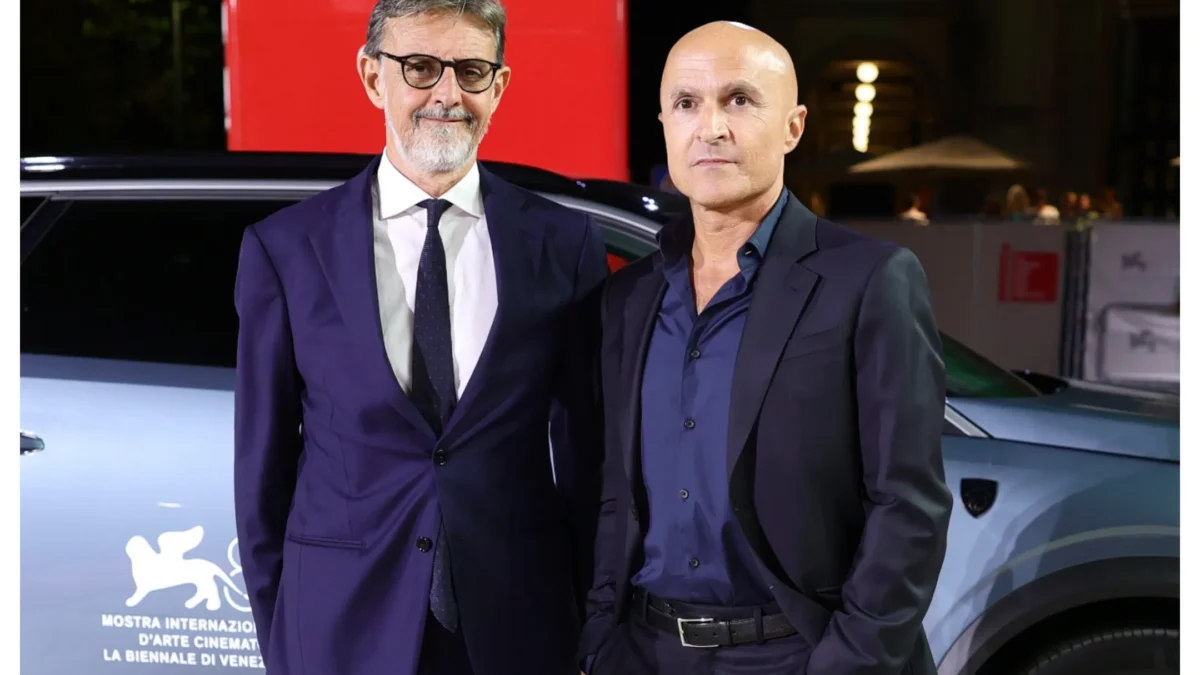
Italian producer Lorenzo Mieli is one of the speakers at the CAA and Finch & Partners The Future of… Creativity forum unfolding today on the fringes of the Venice Film Festival.
The symposium at the La Scuola Grande di Santa Maria della Misericordia, also featuring George Clooney, Venice Artistic Director Alberto Barbera and jury president Maggie Gyllenhaal as guest speakers, will explore the future of storytelling in the age of AI.
Venice regular Mieli is well placed to make a meaningful contribution to the discussion as the producer of Be Brave, the first ever documentary made with AI to screen in Venice’s official selection.
The film appears to be a classic bio-doc in which director Francesco Carrozzini attempts to pin down Renzo Rosso for a portrait of his audacious career as the founder of the Diesel brand and the OTB Group – Only The Brave fashion empire, which also includes the Jil Sander, Maison Margiela, Marni and Viktor&Rolf labels.
But all is not what it seems.
Interviews with the likes of former Vogue Editor-in-Chief Anna Wintour; fashion designers John Galliano, Johan Lindeberg and Glenn Martens; communications guru Maurizio Marchiori, and Adriano Goldschmied, the so-called “Godfather of denim” and Rosso’s first partner on Diesel, among others, are real, even if the backdrops have sometimes been retouched.
But Rosso’s interventions across the documentary are generated purely by AI as is most the “archive” material showing snapshots of his childhood, youth and early career achievements. Carrozzini, whose pursuit to track down Rosso for a face-to-face interview is interwoven into the storyline, is also AI-generated even though he exists in real life.
Mieli spearheaded the project, with Mario Gianani, his partner at joint Rome-Based production house Our Films, and its COO, Gabriele Immirzi, also on board as producers.
The producer’s embrace of AI may seem surprising given his past work at the forefront of human creativity, with his more than 100 credits including Paweł Pawlikowski’s Fatherland, Paolo Sorrentino’s The Hand of God, Luca Guadagnino’s Queer and Sofia Coppola’s Priscilla to name but a few.
But it is very much in keeping with Mieli’s pioneering track-record across his career, overseeing the growth of the The X-Factor format in Italy in the 2010s as the CEO of Fremantle Italia, or helping to usher in the Italian high-end drama boom with the groundbreaking 2015 HBO deal for Paolo Sorrentino’s The Young Pope, which led to partnerships on Saverio Costanzo’s My Brilliant Friend and Guadagnino’s We Are Who We Are.
Be Brave is one of two documentaries being launched on the festival circuit by Our Films this fall alongside the late Eleanor Coppola’s Making Marie Antoinette, which has just been announced for Telluride and then heads to the New York Film Festival.
Watch on Deadline

Mieli and Gianani are also at the festival as producers on Gianni Amelio’s Out of Competition title Nessun Dolore about a Rome bookseller who finds himself on the wrong side of the law after he welcomes undocumented migrants into his home.
Talking to Deadline, ahead of the Be Brave premiere Out of Competition in Venice next week, Mieli says Our Films’ exploration of AI is a natural progression.
“Directors and their artistic vision are at the heart of what we do,” says Mieli. “They are the reason we keep doing this incredibly challenging job: supporting and working with directors we love, discovering new ones to love, and creating films, TV series, and documentaries, all the while striving to make something beautiful and fresh, and setting a new challenge for ourselves in the process.”
“That’s the first point, and I want to frame it right away by saying we didn’t just ‘choose’ AI; rather, Francesco Carrozzini, the documentary’s director, and I decided to work with AI and challenge ourselves to truly understand what it is, to grasp the nature of this tool everyone is talking about. A tool that is so divisive, so fascinating, yet also so frightening.”
Mieli adds that the decision to work with AI for the documentary also stemmed from the fact that there was very little archive material capturing Rosso’s life and career behind the scenes. Another consideration was that other companies and directors were pitching Rosso with documentary ideas and time was of the essence.
“There was a lack of material that felt truly significant, authentic, vital, or compelling, beyond the usual official footage,” says Mieli. “We reviewed what was already out there and found the existing material to be very cold, mostly official interviews and promotional content.
“Then, looking at the AI developments emerging at the time, it struck us that AI might be the tool to recreate ‘real’ material, capturing the genuine truths we wanted to convey, while simultaneously being entirely artificial and fabricated, created using this new technology to tell the story.”
Beyond the practical reasons, Mieli and Carrozzini felt the experimentation with AI as a filmmaking tool would also chime with “the two main pillars” of Rosso’s career.
“Renzo Rosso has always focused on two main areas: creative freedom and innovation, he is always experimenting with new things and has a constant eye on the future; in fact, he has an obsession with the future,” says Mieli.
“Everyone who has even interviewed him describes how he constantly challenges you, pushes you to look beyond what you already know, what you see, and the status quo; he urges you to imagine how people will dress tomorrow and to envision things you have never seen before.”
While the decision to put AI at the heart of the documentary’s production made sense on a practical and philosophical level, Mieli recounts it was easier said than done.
“The technological tool we used became both the form and the content of the documentary. That’s what led us to build the fictional narrative woven into the documentary, to show how it aligns with Renzo’s challenge of ‘Don’t be afraid’. And this was despite the fact that, when we started working on it, we didn’t really know AI; we didn’t know what we could or couldn’t achieve, how it would progress, what the risks were, or what worked and what didn’t,” he says.
“Ultimately, we found ourselves grappling with AI, because it’s a tool that offers incredible possibilities but also has significant downsides, things that don’t work, aren’t interesting, or are limiting.”
Our Films spent more than a year and a half developing its own AI model that would enable Carrozzini to make his film.
“We worked hard and created our own model—essentially a proprietary system built on our own extensive libraries and assets that we fully owned: Francesco’s images, his photos, and videos of him speaking,” says Mieli.
Mieli and Carrozzini were joined on the project by writers Michele Abatantuono and Lara Prando, and AI creative director Roberto Beragnoli, Senior Creative Producer Marco Pianigiani and Director of Photography Matteo Vieille. Editing was by Rocco Bernini and Nicole Pagin, with music by Ralf Hildenbeutel.
Beragnoli oversaw the development of the tailored AI model, working with Italian company Blackstone, which has a track record in visual effects and applying AI systems to audiovisual production, while Pianigiani is credited with shaping the film’s narrative architecture and rhythm, in collaboration with the writers, AI artists and editorial team.
According to detailed production notes, the model drew on established feature-film VFX pipelines, adapted to the specific demands of AI generation, and rather than revolving around individual prompts, the process began with the screenplay.
The image pipeline combined Nano Banana 2, Flux 2 Pro, GPT Image 2 and Adobe Photoshop (Firefly) to generate original imagery; while video generation drew on Seedance 2, Seedance 2.5, Kling 3, Sora 2 Pro and Veo 3.1, with the model selected shot by shot according to the demands of each sequence.
The entire audio component was developed through an ElevenLabs-based pipeline for voice synthesis and AI-assisted sound processing.
Mieli describes the whole process as “fun” but serious and arduous as well. He stresses the lengths the production went to ensure an ethical approach in terms of the original elements used to generate the imagery and audio in the film.
“It’s fun to play with, but it’s not really just a game; it has to be taken very seriously. We need to learn it, understand it, use it, change it, and master it, rather than letting AI master us,” he says.
“We’ve actually worked toward an AI that aligns with what artists want, specifically ownership and creative control, rather than just focusing on rights and image ownership; essentially, all the issues people are rightly fighting for regarding AI.”
As discussions get underway in Venice on the impact of AI on storytelling, Mieli says the film and TV world needs to take the bull by the horns.
“The responsibility lies with us, the community of producers and directors, to study and understand it, and to see if we can build an AI that is fair and fosters a balanced relationship. But first and foremost, we need the curiosity to get to know it; you can’t talk about it without studying it.”