
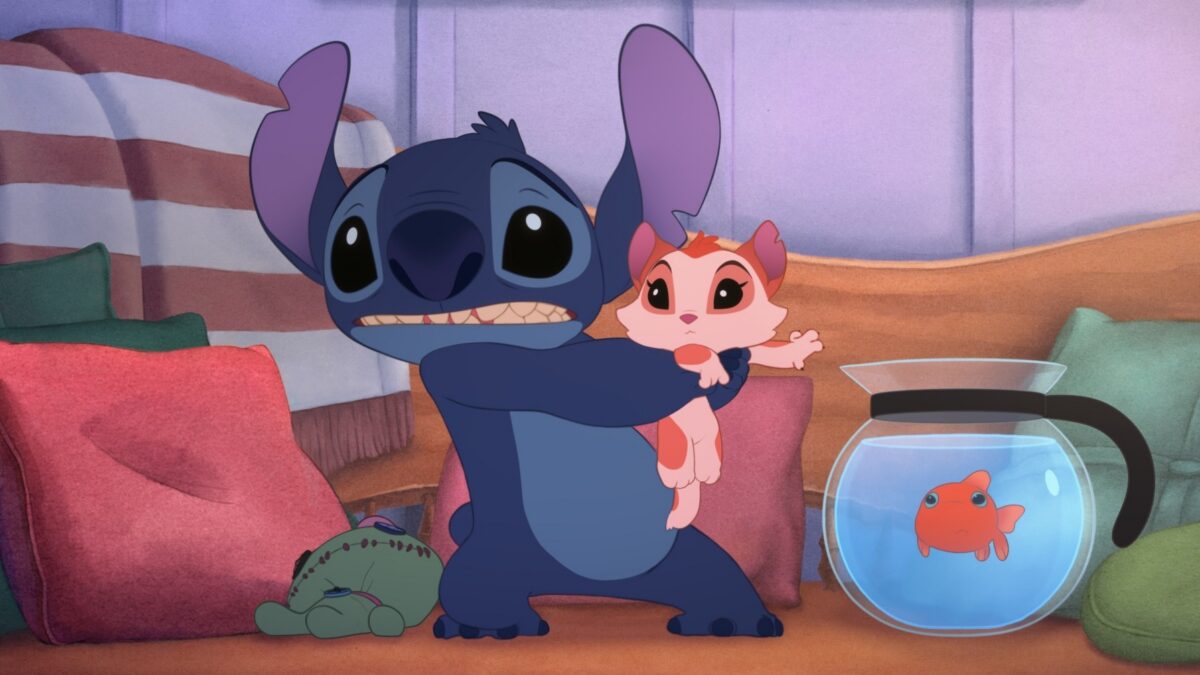
Disney Animation is returning to the world of “Lilo & Stitch” with “Lilo & Scratch,” a six-minute animated short built around comic chaos, escalating destruction and an ambitious combination of hand-drawn and CG techniques.
Directed by Malcolm Pierce and Fawn Veerasunthorn, the project is Disney Animation’s first “Lilo & Stitch” production since the original 2002 feature. It is also the unit’s first short in five years. “Lilo & Scratch” will play before Disney’s “Hexed,” which is set for release on Nov. 25.
A New Match for Stitch
The short signals its slapstick intentions immediately, opening with a clip of the Three Stooges. Its story begins when Lilo brings home a cuddly kitten she names Scratch, then leaves her new pet with Stitch, who is happily watching the comedy trio.
Scratch soon reveals a destructive side capable of competing with Lilo’s beloved blue “dog.” What follows is a series of increasingly absurd confrontations as Stitch and the kitten attempt to outdo each other.
“Stitch is awesome,” Pierce said. “I feel like what I love is that he sort of lets his intrusive thoughts win, but he’s kind of a troublemaker too, which is really fun.” The director said the team wanted to find a situation that would allow Stitch to make his most mischievous choices.
Veerasunthorn, who was still in art school when the 2002 film arrived, said its bold comedy and the character’s desire to belong made a major impression on her as an artist.
The new short began with what Veerasunthorn described as a casual hallway conversation with Walt Disney Animation Studios chief creative officer Jared Bush. The idea was to make a comedy-led project that displayed the fun of animation. Veerasunthorn, Pierce and producer Nathan Curtis ultimately focused on one central premise: What would happen if the chaotic Stitch had to care for a mysterious, adorable cat?
The filmmakers initially designed Scratch to look stranger and more mysterious. They later concluded that the character needed to be much cuter for audiences to embrace her. The contrast allows Scratch to appear harmless before matching Stitch’s appetite for mayhem.
“We thought, who would be the worthy opponent of Stitch?” Veerasunthorn said. That one-upmanship generated so many ideas that the short’s first cut ran about 10 minutes, requiring the team to remove a number of jokes to reach the finished six-minute version.
Pierce said the short was also an opportunity to remind audiences of Stitch’s harder edge: a character who breaks things, becomes grumpy and creates trouble, despite his now-familiar image.
Hand-Drawn and CG Artists Share the Frame
Behind the comic battle, “Lilo & Scratch” became a test of how multiple artistic methods could work together within Disney Animation’s production pipeline.
VFX supervisor Jeremy Sikorski said the team wanted to merge an old-school Disney 2D aesthetic with a modern CG process. He cited earlier short-form projects “Paper Man” and “Once Upon a Studio” as previous opportunities to explore related ideas, while “Lilo & Scratch” allowed the studio to push the approach further.
The filmmakers studied the original feature before developing a toolset that allowed artists working in different media to combine their work. A background, for example, could be created as a hand-painted watercolor while the Lilo and Stitch characters appearing against it were built as 3D sculptures.
An early test paired a hand-drawn Scratch with a CG Stitch holding a blaster. As Scratch ate the weapon, the blaster shifted from CG into hand-drawn animation. Sikorski said the completed test convinced the team that the concept could work.
The backgrounds also reflect the production’s flexible approach. Some were painted digitally in Photoshop to resemble watercolor, while others were traditionally painted by hand on paper.
Veerasunthorn said the largely non-verbal characters made the project especially suited to animation. She also highlighted the collaboration between hand-drawn artists and CG animators, noting that the methods had previously been treated more as an either-or choice.
Building Scratch’s Sound
Composers Haim Mazar and Grace Fisher were tasked with finding a musical identity for Scratch and supporting the short’s rapid-fire action. Fisher described the kitten as having a distinctive “heavy metal voice.”
The score’s comedic sequences took inspiration from Carl Stalling and “Tom and Jerry” cartoons, while the composers sought a balance between something recognizable and something contemporary.
Mazar said the music was designed to feel melodic and occasionally lyrical, with an element of pop and the potential to become an earworm. The recording combined an orchestra with smaller ensembles, close-miked shakers and Hawaiian guitars, creating a mix of tactile sounds and a more contemporary production style.
ShowBiz Take
“Lilo & Scratch” matters on two levels. It revives “Lilo & Stitch” at Disney Animation for the first time since the 2002 feature, while also giving the studio its first short in five years. Just as importantly, the project puts artistic experimentation at the center of that return.
By allowing traditional watercolor backgrounds, digital painting, hand-drawn characters and CG sculptures to coexist—even within the same frame—the short turns Stitch and Scratch’s comic rivalry into a showcase for how different animation disciplines can collaborate.
What Happens Next?
Audiences will get their look at Stitch’s new feline opponent when “Lilo & Scratch” plays ahead of “Hexed,” arriving Nov. 25.