
Why This Matters
Lamar Manson, the Philadelphia artist known professionally as Black Ice, helped change the way a generation heard poetry. His death Wednesday at 54 closes a chapter for a performer whose voice moved fluidly between street-corner testimony, hip-hop cadence, theater and television, making spoken word feel urgent, commercial and culturally central.
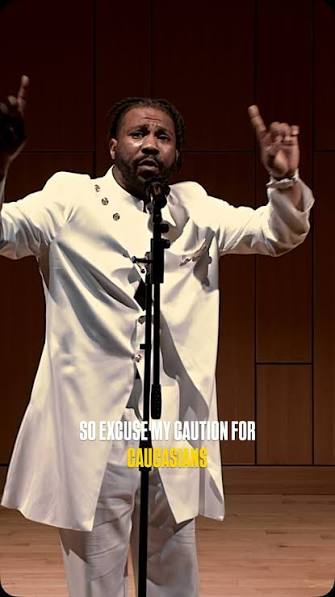
Manson died surrounded by loved ones, according to those close to him. No cause of death was immediately disclosed. For audiences who encountered him through “Def Poetry Jam,” his performances were not simply recitations; they were fully inhabited acts of storytelling, often delivered with a controlled intensity that made silence in a room feel as powerful as applause.
Black Ice emerged from Philadelphia’s deep tradition of music, protest art and lyrical invention. The city has long produced artists who blur the boundaries between soul, rap, jazz and social commentary, and Manson stood firmly in that lineage. His work carried the pulse of hip-hop while preserving the intimacy of poetry, placing lived experience at the center of the performance.
He is widely recognized as the first poet signed to Def Jam Records, a milestone that underscored the growing visibility of spoken-word artists during the late 1990s and early 2000s. At a time when major entertainment companies were still trying to determine whether poetry could travel beyond cafes, campuses and open-mic nights, Black Ice became proof that the form could command mainstream attention without surrendering its edge.
His association with “Def Poetry Jam” made him one of the defining figures of the franchise, both on television and on Broadway. The HBO series, created during a period when premium cable was expanding the boundaries of live performance programming, introduced millions of viewers to poets whose work addressed race, love, politics, faith, masculinity and survival with a directness rarely found in traditional variety formats.
As part of that movement, Manson shared in a wave of recognition that brought spoken word into elite entertainment spaces. His career was tied to productions honored with Tony, Peabody and Emmy recognition, an unusual awards footprint for an artist rooted in poetry and hip-hop. That distinction speaks to how far the form traveled during his prime years — from neighborhood stages to Broadway marquees and televised cultural history.
Industry Context
Black Ice’s rise coincided with a pivotal moment for hip-hop’s expansion into every corner of the entertainment business. Rap was already a dominant commercial force, but the broader ecosystem around it — poetry, dance, documentary, fashion, theater and criticism — was still fighting for institutional recognition. Spoken word became one of the key bridges between the underground and the establishment.
“Def Poetry Jam” arrived as an important companion to “Def Comedy Jam,” which had previously changed the trajectory of stand-up comedy by creating a national platform for performers who were often underserved by traditional gatekeepers. With poetry, Def Jam and HBO took a bigger creative risk. The bet was that language itself, presented with force and theatricality, could hold the screen.
Manson was central to that bet paying off. His performances embodied the connection between the emcee and the poet without reducing one to the other. He could sound conversational, confrontational and lyrical within the same piece, a quality that made his work accessible to hip-hop fans while also resonating with theatergoers and literary audiences.
In the entertainment industry, artists like Black Ice helped broaden the definition of what a “performer” could be. He was not a conventional recording artist, not strictly an actor and not only a poet in the academic sense. He occupied a hybrid space that has become far more familiar in today’s market, where musicians stage autobiographical theater pieces, comedians publish memoirs, poets build digital followings and performance clips can travel globally within hours.
His career also foreshadowed the current appetite for personal, socially engaged storytelling. The themes that powered the spoken-word boom — identity, inequality, grief, desire, community and resilience — are now central to prestige television, documentary film, podcasting and contemporary theater. Manson’s generation helped train audiences to listen for those stories in first-person voices.
For Philadelphia, his passing carries particular weight. The city’s artistic identity has always been inseparable from its neighborhoods and its musical vocabulary, and Black Ice represented a distinctly Philly style of truth-telling: unsentimental, rhythmic, spiritually aware and unafraid of confrontation. His success gave local poets and performers a visible example of how regional authenticity could translate on national stages.
The loss also arrives at a moment when the entertainment industry is reassessing legacy across hip-hop’s first half-century. As pioneers, innovators and adjacent cultural architects age, their contributions are being documented with new urgency. Black Ice belongs in that conversation, not simply as a participant in a popular series, but as one of the artists who helped give spoken word a durable place in the business of entertainment.
What Happens Next?
In the coming days, tributes from fellow poets, musicians, actors and fans are expected to continue spreading across social platforms, with many likely to revisit clips from his “Def Poetry Jam” appearances and stage performances. For an artist whose impact was so closely tied to the electricity of live delivery, those recordings will serve as both archive and introduction.
Details regarding memorial services or public celebrations of life had not been broadly announced as of Wednesday. Given Manson’s stature in Philadelphia and within the spoken-word community, it would not be surprising to see artists organize gatherings that reflect the open-mic tradition he helped elevate: part remembrance, part performance, part call to carry the work forward.
His death may also renew interest in preserving the history of the Def Poetry era. While the franchise remains a landmark, many of its most important performances circulated before the current streaming and social-video economy fully matured. Curated retrospectives, archival releases or documentary projects could help situate Black Ice and his peers within the larger story of hip-hop theater and televised performance.
For younger poets, Manson’s legacy is both artistic and professional. He demonstrated that spoken word could be more than an entry point; it could be a career, a stage language and a cultural force. The next measure of his influence will be heard in the performers who cite him, sample him, study him and step to the microphone with the same conviction that words can still move a room.