
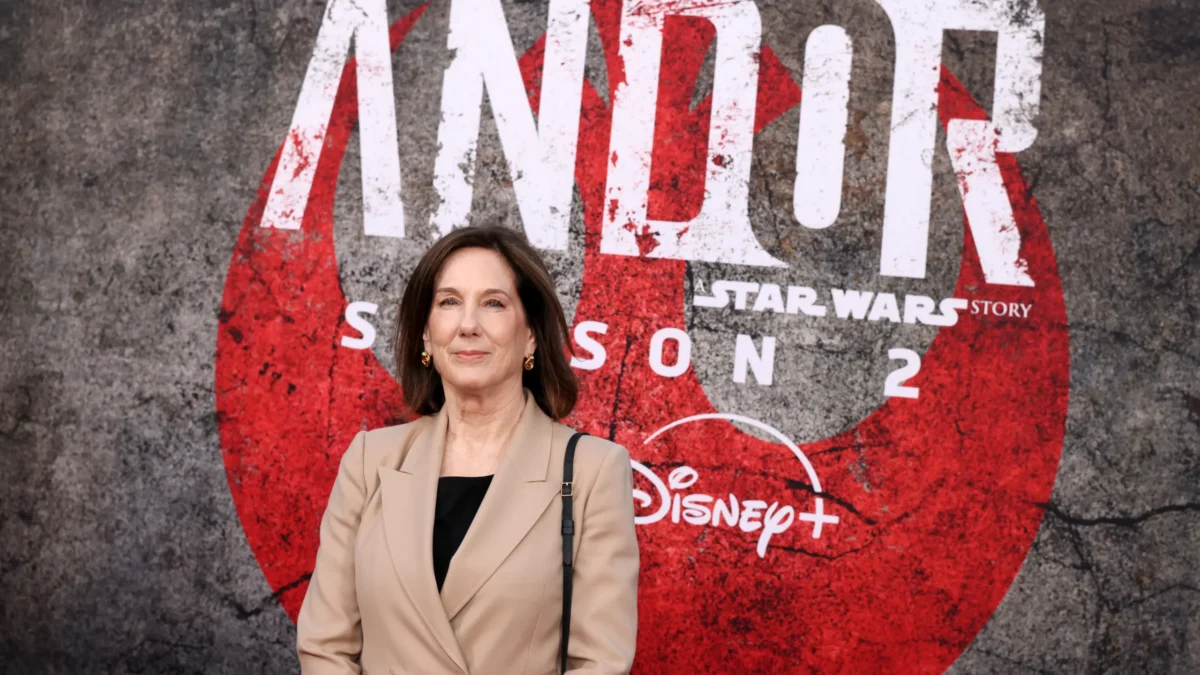
Kathleen Kennedy says she feels “a bit of relief” after stepping down from Lucasfilm earlier in 2026, ending a 14-year run leading the company behind the Star Wars franchise.
The longtime producer reflected on her departure Wednesday night during a career-focused interview at Bloomberg’s annual Screentime event in Los Angeles. When interviewer Brad Stone asked whether leaving Lucasfilm felt bittersweet, Kennedy rejected that description.
“I suppose there’s a bit of relief,” she said. “These jobs are not easy and stepping into something like that that George [Lucas] had created was an incredible challenge.”
Lucas personally selected Kennedy as his successor at the company. She recalled asking the Star Wars creator whether he had material she could study for guidance on where to take the storytelling.
“He said, ‘No, no, it’s all here,’” Kennedy said, pointing to her head as she recounted the exchange. “I said, okay, well that’s going to be interesting to try and mine that.”
Kennedy said she ultimately received “a couple of paragraphs” containing story ideas, rather than full story treatments.
By the time she moved into the Lucasfilm role, Kennedy had a lengthy producing résumé. She was a longtime creative collaborator of Steven Spielberg and had produced Jurassic Park, Lincoln and Munich, along with major titles including Back to the Future, Twisters and Gremlins.
Balancing loyal fans with new stories
Kennedy’s years as the public face of Lucasfilm included both acclaim and intense backlash. Andor drew praise, while the response to The Acolyte became particularly vicious in some corners of the fan base.
Addressing the challenge of serving such a broad audience, Kennedy said long-running franchises must weigh the attachment of established fans against the need to move forward creatively.
“Well, I think that that’s the challenge that all franchises [face], certainly something that’s been around now for 50 years,” she said. “You’ve got people where this means a lot to them. But at the same time, the challenge is to try to create something new, something original. So finding that balance is really the toughest thing.”
Asked whether she had learned anything from perceptions that Lucasfilm sometimes listened too closely to particular groups of fans, Kennedy said audience feedback required attention “without making that be a referendum.” She also emphasized the importance of backing artists who arrive with clear ideas for stories set within the Star Wars galaxy.
Kennedy named three projects among the accomplishments that made her proudest: restarting the film franchise with 2015’s Star Wars: The Force Awakens and launching the Disney+ series Andor and The Mandalorian.
She was less specific when the conversation turned to regrets or decisions she might change.
“I mean, I don’t think you can do anything in terms of the movie business where every single thing is going to be a perfect hit,” Kennedy said. “I think you learn things, I always like learning things from the movies that we do, the postmortems we do on what worked, what didn’t. But I’m always proud of the work that’s been done.”
Looking back at difficult Lucasfilm decisions
Kennedy also revisited the 2017 removal of directors Phil Lord and Chris Miller from Solo because of creative differences. Asked about moving from supporting filmmakers to being the executive responsible for dismissing them, she replied, “Well, that really only happened once, thank god.”
During the making of 2016’s Rogue One: A Star Wars Story, director Gareth Edwards was also sidelined and Tony Gilroy was brought in to finish the project alongside him.
“I wasn’t required to do that,” Kennedy said of the Solo situation. “There are many complicated situations that develop that certainly reach a point where you have to make a difficult decision like that. Certainly my track record shows that I’ve worked with a lot of different directors, I’ve made many kinds of movies, and I’ve never been in a situation like that.”
Kennedy joined Lucasfilm in 2012, shortly before Disney purchased the company for $4.05 billion that year. She said the deal brought “an enormous expectation” from the studio, but remained emphatic that the acquisition was worthwhile.
“Oh, yeah, I think there’s no question,” she said. “And I think Star Wars was a perfect acquisition for Disney and it’s what George wanted. There was no other company he wanted to sell the franchise to other than Disney.”
What Happens Next?
Lucasfilm is now being led by longtime Star Wars creative Dave Filoni and executive Lynwen Brennan. Kennedy, meanwhile, is returning to independent producing through the company she shares with her husband, veteran filmmaker and producer Frank Marshall.
Her connection to Star Wars is not over. Kennedy is producing the upcoming Ryan Gosling movie Star Wars: Starfighter, directed by Shawn Levy.
As she re-enters independent producing, Kennedy is also watching the wider entertainment business closely. She expressed concern about the possible merger of Paramount Skydance and Warner Bros. Discovery, particularly the prospect of a studio disappearing and fewer movies and other projects being made.
“I think we’re all worried about that,” she said. “The ability for the studios to be able to scale the work that many of us do. I think that’s the biggest worry. We’ll see. If it really is 30 movies a year, we’ll see.”
Kennedy said she has spent recent months trying to understand the industry’s direction as corporate consolidation continues and artificial intelligence becomes more integrated into Hollywood workflows. Rather than reaching immediate conclusions, she has been meeting people involved in the new technology and absorbing the changes around her.
She is also reconnecting with people who fell out of her orbit during her years at Lucasfilm. As Kennedy put it, “You get in a bit of a bubble when you’re doing something like Star Wars.”