
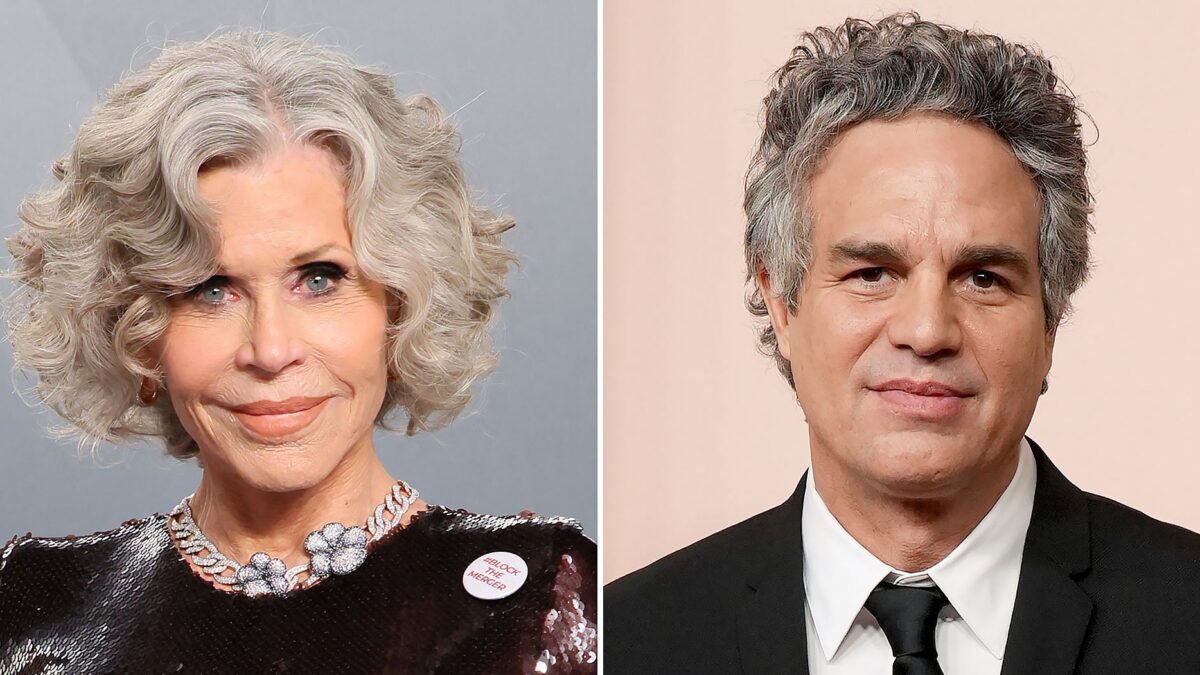
Jane Fonda is backing Mark Ruffalo after Paramount accused the actor of being “antisemitic,” with Fonda’s Committee for the First Amendment arguing that the studio’s characterization reflects a broader and increasingly fraught battle over political speech in Hollywood.
The veteran actor and activist’s organization issued a defense of Ruffalo, pushing back on the suggestion that his public comments about Israel, Gaza and U.S. foreign policy should be treated as hatred toward Jewish people. The group framed the dispute as a free-expression issue, saying artists must be able to speak on matters of war, human rights and government policy without being professionally stigmatized.
Ruffalo, an Oscar-nominated actor known for “Poor Things,” “Spotlight” and his long-running role as Bruce Banner/The Hulk in Marvel films, has been among the more politically outspoken stars in the industry for years. His activism has spanned climate change, labor rights, voting rights and Middle East policy, often making him a visible figure in public debates that studios generally prefer their talent to avoid.
Fonda’s intervention is notable not only because of her own history as one of Hollywood’s most enduring political voices, but also because it comes at a moment when entertainment companies are under intense pressure from multiple sides. Studios, agencies, streamers and guilds have been navigating employee activism, audience backlash, advertiser sensitivity and political scrutiny since the Oct. 7 Hamas attacks in Israel and the ensuing war in Gaza.
The dispute underscores a central tension now facing the entertainment business: how companies respond when public figures attached to major projects take political positions that some viewers see as principled advocacy and others view as inflammatory or discriminatory.
A Hollywood Free Speech Flashpoint
The Committee for the First Amendment, led by Fonda, has positioned itself as a defender of artists who speak out on politically charged issues. The name evokes one of the most consequential chapters in Hollywood history, when actors, writers and directors organized against government pressure and blacklisting during the Red Scare era.
By defending Ruffalo, Fonda’s group is drawing a direct line between past industry crackdowns and today’s climate, where social media campaigns can rapidly turn a celebrity’s statement into a reputational crisis. The committee’s argument is that the label “antisemitic” should not be used casually or as a substitute for engaging with criticism of a government or military campaign.
At the same time, the sensitivity around antisemitism is not abstract. Jewish organizations, studio employees and many public figures have warned that antisemitic incidents and rhetoric have risen sharply in recent years, including in cultural spaces. For Hollywood companies with global audiences and diverse workforces, the challenge is responding forcefully to bigotry while not appearing to suppress political dissent.
That balancing act has become increasingly difficult. In the past two years, actors, writers and executives have faced petitions, open letters, cancelled appearances, rescinded opportunities and internal workplace complaints over comments related to Israel and Gaza. The result is an industry environment in which talent representatives and corporate communications teams now treat political speech as a serious business risk.
Why Ruffalo’s Case Matters
Ruffalo’s profile makes the confrontation especially visible. He is not a fringe performer or a newcomer with limited leverage; he is a respected actor with awards-season credibility and franchise recognition. When a company as prominent as Paramount publicly associates a figure of that stature with antisemitism, it raises questions about how studios define misconduct and what standards they use when responding to politically controversial speech.
For actors, the case is being watched as a test of whether major companies will draw a bright line between hate speech and political criticism. For executives, it illustrates the difficulty of protecting corporate values while managing the optics of disciplining or condemning artists whose views may divide audiences.
Fonda’s support also gives Ruffalo institutional cover from a figure who has long understood the professional cost of political activism. Fonda’s own career was shaped by controversy over her antiwar activism during the Vietnam era, and she has frequently spoken about the price paid by artists who become symbols in national political battles.
That history gives her defense additional weight. Fonda is not simply commenting as a colleague; she is speaking as someone whose public life has been defined by the collision of celebrity, protest and institutional backlash.
Industry Context
Hollywood has long relied on politically engaged stars while also fearing the commercial consequences of their engagement. Studios benefit from performers who appear socially conscious, especially with younger audiences, but corporate tolerance often narrows when activism threatens partnerships, international markets or brand relationships.
The Israel-Gaza debate has magnified that contradiction. Unlike many domestic political issues where the industry’s center of gravity is relatively predictable, this conflict has exposed deep divisions among artists, executives, fans and advocacy groups. Statements that one group views as essential moral clarity can be interpreted by another as erasure, hostility or prejudice.
As a result, companies have increasingly issued carefully calibrated statements — and, in some cases, sharper rebukes — in response to talent comments. Those responses can satisfy one constituency while inflaming another, creating a cycle in which the studio itself becomes part of the story.
Fonda’s committee is entering that cycle with a clear message: Hollywood should be wary of reviving a culture of punishment around political speech. Whether that message gains traction beyond activist circles may depend on how other prominent industry figures respond.
What Happens Next
The immediate question is whether Paramount further clarifies its position or lets the controversy fade. Ruffalo’s representatives have not signaled any retreat from his broader activism, and Fonda’s defense is likely to encourage supporters who see the accusations against him as an overreach.
The larger question is how studios will handle similar disputes going forward. As election-year politics, international conflicts and labor issues continue to collide with celebrity platforms, Hollywood will likely face more cases in which free speech, corporate reputation and audience outrage intersect.
Fonda’s defense of Ruffalo may not resolve the debate, but it ensures the conversation is no longer only about one actor’s comments. It is now about the rules of political expression in an industry that sells stories about courage, conscience and dissent — while still trying to manage the risks when its own stars practice them in public.