
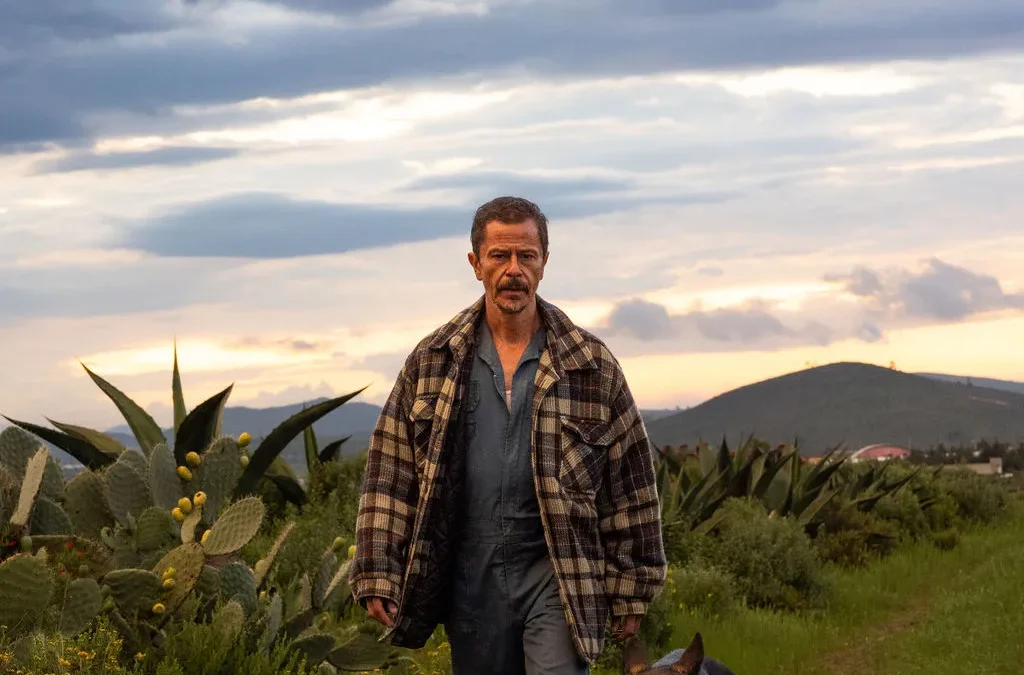
Rodrigo García Saiz is bringing his second feature, “Morro,” to the San Sebastián Film Festival as a New Directors contender, with a story he describes as his most personal work so far.
The film centers on Mateo, a veterinarian in rural Mexico whose quiet life is marked by unresolved guilt over the loss of his son. That fragile routine changes when he treats Morro, the injured dog of a local drug lord. The animal’s presence opens a silent bond between man and dog, giving Mateo a renewed sense of purpose in a town where violence remains an underlying force.
For García Saiz, whose previous feature was “Lluvia,” the project grew out of two deeply personal concerns: his lifelong connection to dogs and his reflections on Mexico after leaving the country. The filmmaker now lives in Madrid.
“I’ve always had a connection with dogs and I also wanted to reflect on the violence in Mexico since I left it,” García Saiz said. “But not so much about showing the violence itself, but about what happens to the people who stay. And how an animal that doesn’t judge, that asks for nothing but love and gives love, could help.”
Although “Morro” includes the presence of organized crime through the dog’s owner, García Saiz is clear that the film is not designed as a drug-trafficking drama. He said the violence is not explicitly depicted onscreen, describing it instead as something embedded in the film’s “moral and physical context.”
The core question, he said, became one of emotional rescue rather than plot mechanics. “So the premise is really: Who saves whom?” García Saiz said. “I started researching, went into conflict zones, and discovered this story, which is loosely based on the experience of someone I met through a friend.”
That real-life source did not immediately open up to the filmmaker. García Saiz said the person was initially reluctant to share the full account, but gradually began to trust him. From there, García Saiz built the screenplay with Carlos Armella and other collaborators.
“At first, he was a little hesitant because he didn’t really want to tell us the whole story,” García Saiz said. “But little by little, he opened up. I gradually gained his trust, and he started telling me things, and I began putting the story together with another screenwriter [Carlos Armella] and some other collaborators. It was really exciting to realize that what I had in my head actually happens in real life. So I made the story very much my own and it became a story that really came from my heart.”
Finding the right animal to play Morro became one of the production’s key challenges. García Saiz did not want a trained dog for the part. He eventually found one that reminded him of the dog connected to his research, and the animal developed a bond with lead actor Gustavo Sánchez Parra, whose credits include “Amores Perros” and Michael Rowe’s Cannes-winning “Leap Year.” Sánchez Parra even took the dog home.
“He looked a little like the dog from the story I researched,” García Saiz said. “And when I saw him, I fell in love with him because he had such a beautiful expression. He could also believably be a drug dealer’s dog, but at the same time, he’s such a gentle, sweet animal.”
The film’s approach extended to its format. García Saiz shot “Morro” on 35mm with cinematographer Alfonso Herrera Salcedo, whose credits include “Spectre.” The director described the choice as a return to essentials and said the expense and discipline of film stock changed the atmosphere on set.
“Shooting on 35mm was also a way of going back to basics,” he said. “The set became almost like a church where everyone had to be quiet. There were no cell phones because the film stock is obviously very expensive, and you can’t just improvise, especially when you’re working with an animal and such a great actor. Everyone had to be completely focused and attentive.”
García Saiz also credited Kodak, PhotoKem and others with supporting the decision, saying the format helped give “Morro” its particular spirit.
“Morro” is produced by Calouma Films, alongside Central Films and The 42 Film. The producers are Paola Cortés, who also worked on “Lluvia”; Alberto Müffelmann, whose credits include “I’m No Longer Here”; Julia Cherrier, associated with “The Intruder”; and Pablo Guerrero, whose credits include “New Order.”
García Saiz already has another intimate project in view. He said he is working on a film about his relationship with his father, who died on the filmmaker’s tenth birthday.
The 74th San Sebastián Film Festival runs Sept. 18-26.