
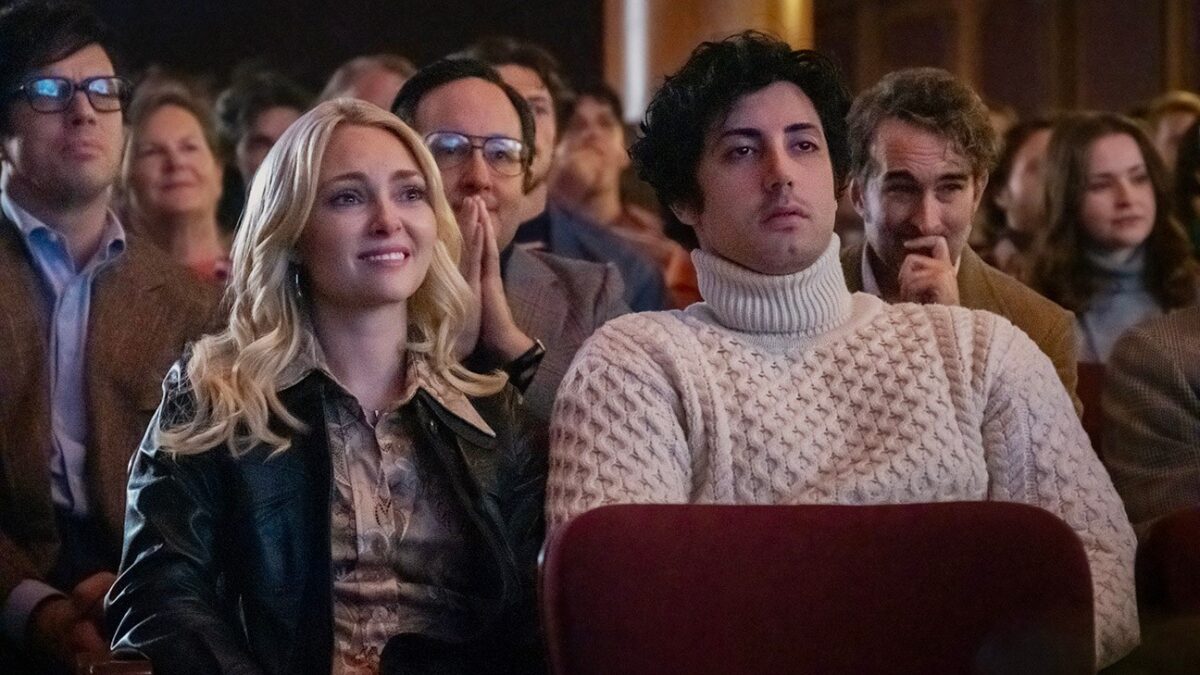
P.J. Byrne has reached a new career peak in 2026, collecting eight credits and landing his biggest movie role to date in Peter Farrelly’s I Play Rocky.
The New Jersey native plays Oscar-winning Rocky producer Irwin Winkler in the biographical awards contender, opposite Anthony Ippolito as a young Sylvester Stallone. The role anchors a prolific year that also includes Coyote vs. Acme, The End of Oak Street, the conclusion of Byrne’s recurring character on The Boys and a series-regular position on USA’s The Rainmaker.
A Bigger Role Built From Smaller Parts
I Play Rocky dramatizes the battle to make the original film with Stallone in the title role. In 1975, Winkler and producing partner Robert Chartoff were developing Martin Scorsese’s New York, New York while also considering Stallone’s underdog screenplay. Stallone refused to sell unless he could star, even as increasingly lucrative offers were made for the script.
Winkler and Chartoff ultimately backed Stallone, risking their homes and names to keep him in the lead while distributor United Artists sought to replace him with an established star. That history gave Byrne’s casting an extra layer of meaning: I Play Rocky initially considered a better-known name for Winkler before its producers decided to bet on Byrne.
“They all knew me from these small parts. Then they just believed in me enough to give me a shot,” Byrne told The Hollywood Reporter. “I want to tell the world that there’s honestly no small parts. Someone will ultimately give you a chance.”
Farrelly had already directed Byrne in Green Book, where the actor played a record executive, and Byrne later appeared in Dear Santa, which Farrelly co-wrote for his brother Bobby to direct. Byrne said Farrelly told him after Green Book that he needed a larger movie role. Casting director Rick Montgomery knew Byrne from commercials, while producer Toby Emmerich’s New Line tenure included Byrne’s appearances in Horrible Bosses and Final Destination 5.
Finding the Scene in the Moment
Byrne’s improvisational style helped shape one of I Play Rocky’s comic highlights. In a screening-room sequence, Winkler discovers that Stallone and Carl Weathers had not boxed before and that Stallone dismissed the boxing choreographer hired for the production.
The screenplay gave Winkler the line, “It’s a boxing movie!” Byrne asked Farrelly for room to expand the character’s exasperation, adding a comparison to The Godfather: “It’s not about the mafia. It’s about a nice Italian family that loves pasta.” He then improvised Winkler angrily observing that a staircase “happens to be” stairs and a door “happens to be” a door as he leaves.
That freedom reflects an approach Byrne developed during commercial auditions after moving to Los Angeles. He learned to arrive with alternate dialogue and jokes in order to distinguish himself. Between acting jobs, he provided script coverage and performed development work for Chris O’Donnell’s production company, eventually becoming a vice president before leaving to pursue acting full-time.
Byrne had initially studied finance at Boston College, but a professor encouraged him to attend drama school. He went on to DePaul University in Chicago. His financial background later informed his audition for Martin Scorsese’s The Wolf of Wall Street, when he created a monologue in which a stockbroker manipulated a widow into handing over $100,000. Scorsese recited part of that audition speech back to him during a callback.
Byrne eventually played Rugrat, a founding member of the film’s Stratton Oakmont operation, and later reunited with Scorsese on the 2016 series Vinyl. His other show-business roles have included projects such as Babylon, The Big Cigar, A Complete Unknown and The Boys.
His memorable Babylon sequence was filmed across three days. Byrne said director Damien Chazelle incorporated material he had added during his audition and encouraged more experimentation on set. Byrne’s voice was gone for a month after filming his close-ups.
ShowBiz Take
Byrne’s 2026 run matters because I Play Rocky turns the qualities that made him a reliable supporting performer—preparation, improvisation and relationships with repeat collaborators—into the foundation of his largest film role. The movie’s own story about backing talent over status also mirrors the decision to cast Byrne and Ippolito rather than build the production solely around established names.
Asked whether the strained relationship between Winkler and Stallone in more recent years affected his performance, Byrne said his responsibility was to portray their bond during the period when Rocky was created. The film concludes with real footage from the 1977 Oscars, when Rocky won best picture and Winkler brought Stallone onstage with the producers.
What Happens Next?
I Play Rocky is now playing in movie theaters nationwide. Byrne’s busy 2026 slate also includes Coyote vs. Acme, a project he said nearly went unseen. He added that he had learned the film could be nominated for best animated feature because more than 75 percent of it is animated, and said he hopes it receives recognition.