
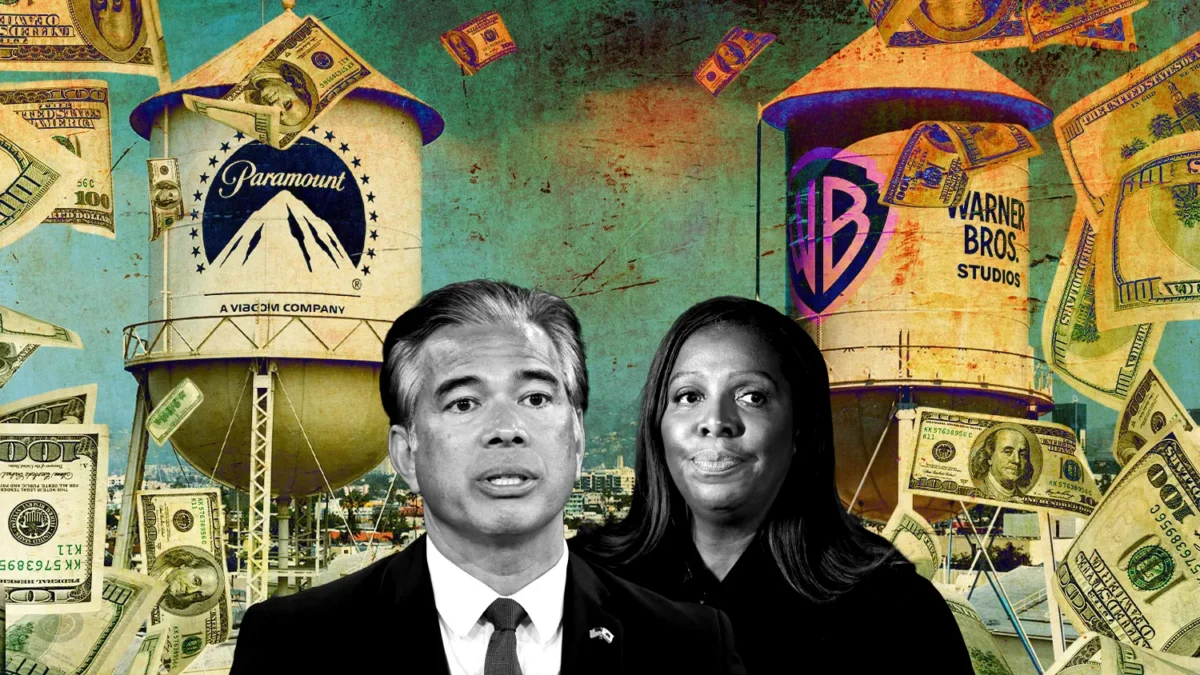
Los Angeles County’s economic-development arm is warning that California could take a multibillion-dollar hit if Paramount follows through on the possibility of moving operations out of the state amid the legal fight over David Ellison’s proposed $111 billion merger with Warner Bros Discovery.
In a leaked September 10 internal document, L.A. County’s Economic Development Corporation estimates that even a partial departure would carry steep consequences. “At a minimum, relocating Paramount’s headquarters and other operations out of California would result in losses of 2,750 and 5,550 job-years in California across all industries and losses of between $1.01 billion and $2.03 billion in economic output between October 1, 2026, and September 30, 2031,” the report says.
The warning lands as Paramount is fighting an antitrust action brought by a coalition of blue-state Attorneys General seeking to block the merger. The company also filed a pointed federal court response on September 11, arguing that the lawsuit should not derail the Warner Bros Discovery transaction.
The California Stakes
The county report paints an even more severe picture if Paramount were to complete a broader exit from California. According to the document, once Paramount had “completed the entire relocation of its headquarters and other operations out of California,” the state would face the permanent loss of approximately 28,990 to 57,980 full-time jobs statewide across all industries, along with annual economic-output losses of between $10.6 billion and $21.2 billion.
The report emphasizes that those losses would not be temporary. “Note that since this employment would be lost to California permanently, these figures are more appropriately expressed as full-time jobs instead of job-years,” the document says.
Paramount has downplayed any serious contemplation of leaving California. Still, the relocation scenario has hovered over the merger fight, with leaks suggesting Ellison has considered Tennessee, Georgia or Texas if the Attorneys General do not shift toward negotiations by October 1.
That date carries its own financial significance in the deal drama. According to the source material, October 1 is when Ellison’s side would have to begin paying Warner Bros Discovery shareholders $7 million a day if the deal collapses. Paramount has cited those payments as “extraordinary losses” in seeking a $1.88 billion bond from the blue-state and WGA plaintiffs; the ticking fee would amount to more than $635 million per quarter.
The L.A. County analysis also looks at the potential upside if the merger proceeds and Paramount remains committed to production in California. The report says Paramount’s post-merger commitment to make 30 features a year for three years would generate between 1,020 and 2,760 job-years across all industries in California and between $377.7 million and $1.01 billion in economic output from October 1, 2026, through September 30, 2031.
Paramount Pushes Back In Court
Alongside the economic warnings, Paramount’s September 11 Defendants’ Answer to Complaint and Defenses sharply rejects the antitrust case filed July 13 by California Attorney General Rob Bonta, New York Attorney General Letitia James and others.
In the 25-page filing, Paramount argues that the plaintiffs’ case “amounts to a series of attempted shortcuts and assumptions that collapse under scrutiny.” The company’s position is that the proposed transaction would help the entertainment marketplace rather than harm it.
“Paramount’s proposed merger with Warner Bros. (the ‘Merger’) will enhance competition, not diminish it,” the filing states.
The company further argues that the deal would have benefits across several sectors of the business. “The Merger will benefit movie theaters by bringing more films to the big screen,” Paramount’s filing says. “It will benefit cable companies by providing more high-quality content on TV in the face of declining cable subscriptions. It will benefit content creators by increasing investment in, and production of, films and TV shows.”
The filing continues that consumers would benefit “not only with more high-quality content in theaters and on cable, but also with a better combined streaming offering to create real competition against dominant tech giants like Netflix, Disney, and Amazon.”
Paramount’s latest response tracks with its July 13 declaration that the Attorneys General’s action “distorts settled antitrust law and is based on a misrepresentation of competition in the entertainment industry today.” The company sharpened that argument in the September filing, stating: “Plaintiffs’ entire theory of leverage falls apart—models that ignore the real world have no basis in a court of law.” It added: “Day by day, the weak case against this Merger gets even weaker.”
What Happens Next?
Paramount executives are scheduled for court-ordered settlement talks with the Attorneys General next month. The case is also moving toward a March 2, 2027 trial, with bond hearings, the October 1 fee deadline and a possible Supreme Court intervention all looming over the dispute.
Bonta’s office was silent when Deadline reached out for a response to Paramount’s official filing. No comment was provided on the L.A. County report.