
Why This Matters
Christopher Nolan’s leap into Homeric spectacle has delivered the kind of opening-day result that can change the conversation around theatrical risk. The filmmaker’s The Odyssey, a $250 million undertaking developed over three years, earned an estimated $51 million on Friday from 3,919 North American theaters, immediately positioning the film as one of the season’s defining box office events.
That number is striking not simply because it is large, but because of what it represents. In a single day, Nolan’s mythological epic surpassed the entire opening weekend haul of Interstellar, which launched to $47.5 million in 2014 before becoming one of the director’s most discussed long-tail performers. For a dense adaptation of an ancient poem, sold without superheroes, multiverse cameos or familiar franchise machinery, the result is a loud endorsement from moviegoers.
The opening also arrives at a moment when studios have been recalibrating what kinds of films deserve massive theatrical investment. A $250 million budget attached to an auteur-driven literary epic would have sounded nearly impossible to justify in the streaming boom years, when adult-skewing ambition was routinely pushed toward platforms. Nolan’s latest suggests that scale, authorship and theatrical exclusivity can still combine into a commercial proposition when the filmmaker’s brand is strong enough.
For exhibitors, the Friday performance is especially meaningful. Theater owners have spent the post-pandemic era arguing that audiences will show up for event cinema if Hollywood gives them movies that feel urgent on the big screen. The Odyssey appears to fit that definition: a prestige spectacle with premium-format appeal, an established director whose name functions like a franchise, and a campaign that emphasized immersion rather than plot familiarity alone.
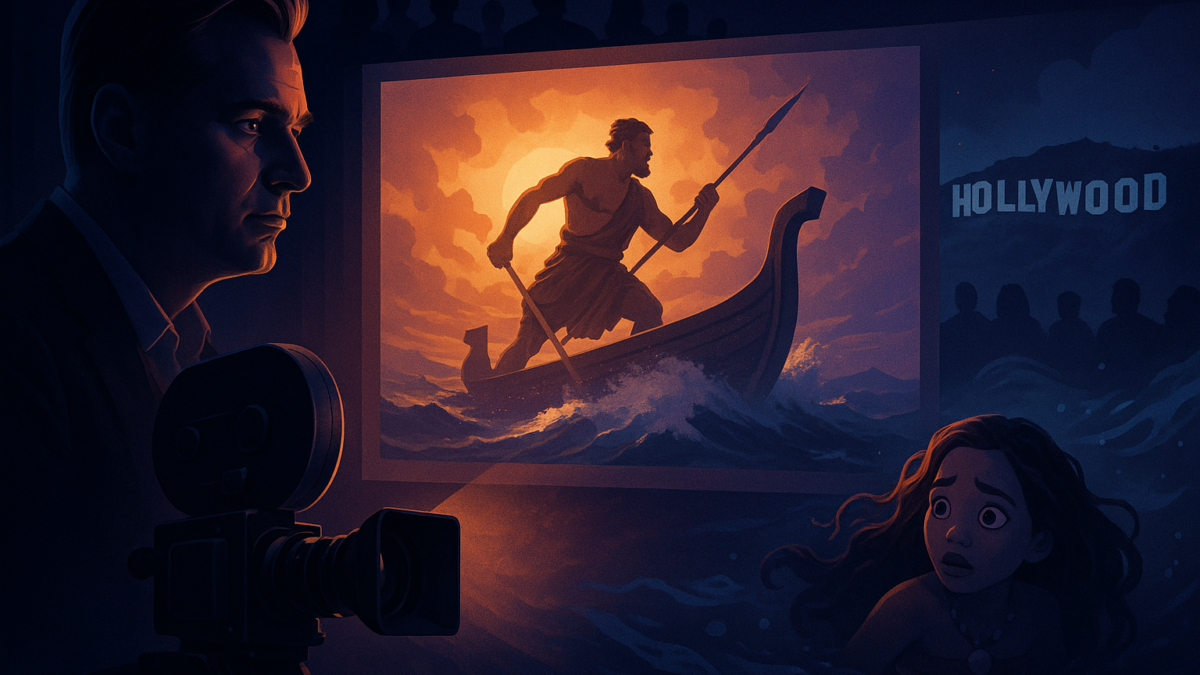
The contrast with Disney’s Moana is hard to ignore. While Nolan’s film surged, Disney’s seafaring property continued to lose momentum, underscoring the uneven state of the marketplace. Familiar IP remains valuable, but familiarity by itself is no longer a guarantee of dominance. Audiences may still embrace brands they love, but the weekend’s early returns suggest they are also willing to reward originality of execution, even when the source material is thousands of years old.
Industry Context
Nolan is one of the few filmmakers in contemporary Hollywood who can command blockbuster resources without handing the steering wheel to a preexisting studio universe. After the global success of Oppenheimer, his leverage only grew. That film proved that an adult historical drama, built around moral conflict and formal ambition, could become a cultural event when positioned as must-see cinema. The Odyssey now extends that argument into a far more expensive arena.
The economics remain daunting. A $250 million production typically requires extraordinary global returns once marketing and distribution costs are factored in. For most studios, that kind of spend is reserved for comic-book sequels, animated tentpoles or franchise chapters with extensive consumer-products potential. Nolan’s project is different. Its strongest asset is not a toyetic character or decades of cinematic continuity, but the promise of a director operating at maximum scale.
That makes the Friday gross more than a bragging-rights figure. It gives the film breathing room. A $51 million first day places The Odyssey on track for a muscular domestic opening, assuming Saturday and Sunday attendance holds at a reasonable level. Premium large-format screens, especially Imax and other high-end auditoriums, are likely to play a major role in the film’s staying power, as Nolan’s audience has repeatedly demonstrated a willingness to pay more for a carefully engineered theatrical presentation.
The result also lands at a complicated time for Disney. The studio remains one of the most powerful players in the business, with unmatched library strength and global franchise reach. But the recent softness around Moana adds to a broader industry debate about how often legacy animation brands can be extended before audiences begin to treat them as optional rather than essential. Disney’s challenge is not awareness; it is urgency.
Hollywood has spent years trying to identify the new rules of theatrical behavior. Superheroes have become less automatic. Animation has been inconsistent. Horror remains efficient but rarely fills the same revenue lane as mega-budget spectacle. Prestige dramas can break out, but usually at lower cost. Nolan occupies a rare intersection: he makes films that are marketed like blockbusters while retaining the aura of serious cinema. That combination is difficult to replicate, but studios will study it closely.
There is also a symbolic dimension to the weekend. The Odyssey is adapted from one of Western literature’s foundational texts, a work associated more with classrooms than multiplexes. Its early success suggests that audiences are not rejecting challenging or classical material; they are rejecting presentations that feel routine. When spectacle is paired with a sense of occasion, even an ancient journey can compete with the most aggressively modern IP.
What Happens Next?
The immediate question is how front-loaded The Odyssey proves to be. Nolan’s films often draw intense first-wave attendance from cinephiles and premium-format devotees, but his biggest successes have also benefited from repeat business and word of mouth. If the audience response remains strong through the weekend, the film could shift from impressive opening to genuine four-quadrant phenomenon.
International performance will be just as critical. A production of this size needs global scale, and Nolan’s reputation travels well. His films have historically performed strongly overseas, particularly when they offer visual grandeur and conceptual ambition. A Homeric adventure, with its mythic battles, journeys and emotional stakes, may have broader cross-border appeal than a more culturally specific drama.
For Disney, the path forward is less celebratory. The studio will look to stabilize Moana through family attendance, holiday playability and brand loyalty, but the weekend’s trajectory indicates that the film is no longer controlling the conversation. In a crowded marketplace, losing the event-status narrative can be difficult to reverse.
For the wider business, the takeaway is clear: the theatrical audience is still available, but it is selective. Nolan’s opening day gives studios a fresh case study in how ambition, scale and trust in a filmmaker can produce commercial heat. The coming days will determine whether The Odyssey is merely a huge opening or the start of a sustained box office voyage.