
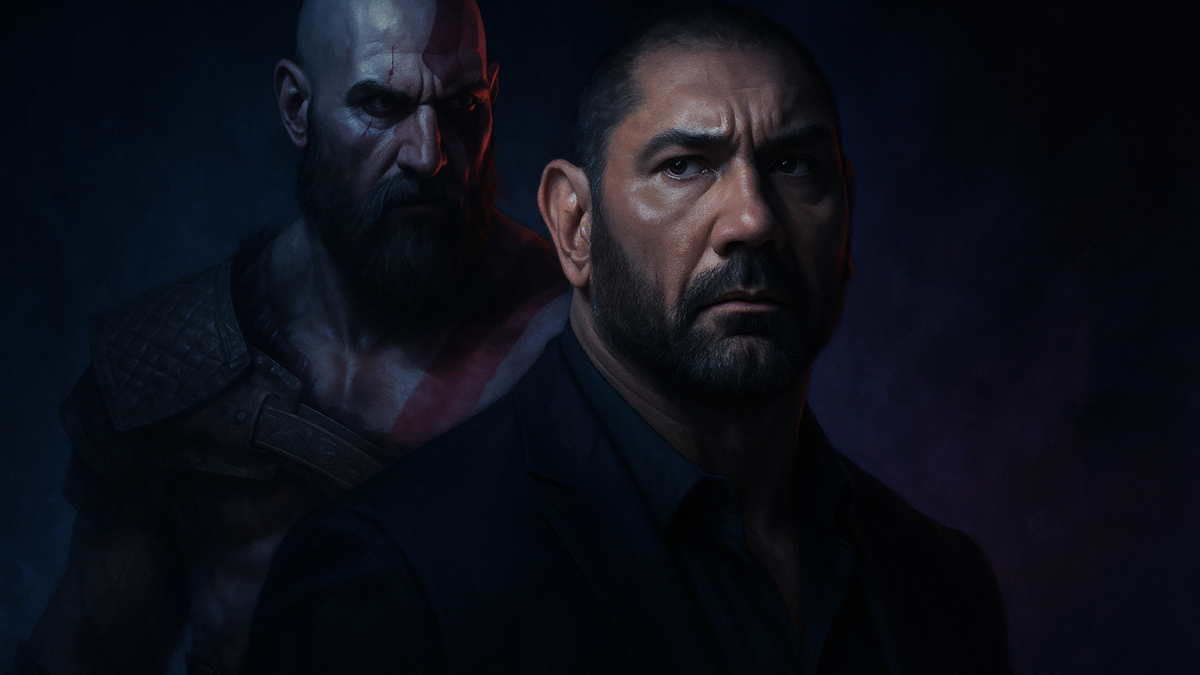
Dave Bautista is stepping into one of gaming’s most recognizable roles, with the former WWE champion and “Guardians of the Galaxy” actor set to play Kratos in Prime Video’s live-action “God of War” series.
The casting change comes after Ryan Hurst, who had originally been set to portray the Spartan warrior, exited the production following a bicep tear sustained during filming. Amazon MGM Studios and Sony Pictures Television moved quickly to keep the high-profile adaptation on track, with Bautista now taking over as the central figure in the series based on PlayStation’s blockbuster franchise.
The move gives Prime Video a major name at the center of one of its most closely watched genre projects. Bautista has long been a fan-favorite suggestion for Kratos, whose imposing physicality, haunted silence and explosive rage make him one of the more challenging video game characters to translate to live action. The role requires more than muscle; it demands an actor who can carry the weight of a violent past, a complicated father-son dynamic and the mythic scale of a world populated by gods and monsters.
Bautista’s casting is notable because it aligns with the second act he has been carefully building in Hollywood. After breaking out as Drax in Marvel’s “Guardians of the Galaxy” films, he has pushed beyond comic relief and action spectacle with roles in Denis Villeneuve’s “Dune,” M. Night Shyamalan’s “Knock at the Cabin,” “Blade Runner 2049” and Rian Johnson’s “Glass Onion.” He has repeatedly spoken about wanting to be viewed as a character actor rather than simply an action star, and Kratos could offer one of his most visible dramatic showcases to date.
For Prime Video, the series represents another major bet on established intellectual property at a time when streamers are leaning heavily on recognizable brands to cut through a crowded market. “God of War” is not just another game adaptation; it is one of Sony’s crown jewels, with the 2018 reboot and its sequel “God of War Ragnarök” widely praised for blending cinematic storytelling with brutal action and emotional intimacy.
That modern version of the franchise is expected to be the foundation for the television series. Rather than focus only on Kratos’ earlier years as the Ghost of Sparta in Greek mythology, the more recent games follow an older, more restrained Kratos as he journeys through the Norse realms with his son, Atreus. The material gives the show a clear emotional engine: a father trying to protect his child from both external threats and the darkness within himself.
That is a crucial distinction in the current wave of video game adaptations. The successes of HBO’s “The Last of Us” and Prime Video’s own “Fallout” have demonstrated that audiences will respond when studios treat game stories as character-driven dramas rather than mere exercises in fan service. At the same time, expensive misfires across the genre have shown that recognition alone is not enough. Tone, casting and fidelity to what audiences love about the source material remain essential.
Bautista’s arrival could help answer one of the biggest questions surrounding the project: who can make Kratos feel human without diminishing his mythic presence? In the games, the character is defined by restraint as much as violence. His most powerful moments often come in silences, terse exchanges and the visible struggle to avoid becoming the monster he once was. Bautista’s best recent performances have leaned into that same tension, using his size as contrast rather than the whole point.
The recasting also underscores the practical realities of mounting a large-scale streaming fantasy series. Productions of this size are physically demanding, particularly when centered on a character known for combat, weaponry and punishing movement. Hurst’s injury created a significant obstacle, but the swift pivot to Bautista suggests Amazon and Sony remain committed to moving the show forward rather than rethinking the project’s timeline from the ground up.
Industry watchers will be paying close attention to how Prime Video positions “God of War” within its broader genre slate. The service has invested heavily in fantasy, sci-fi and gaming-adjacent programming, from “The Lord of the Rings: The Rings of Power” to “Fallout.” A successful “God of War” could strengthen Prime Video’s standing with global audiences and deepen Sony’s growing strategy of expanding PlayStation properties into film and television.
For Sony, the series is part of a larger transmedia push that has already included “The Last of Us,” “Uncharted,” “Twisted Metal” and planned adaptations of other PlayStation titles. The company has been increasingly deliberate about pairing its gaming brands with premium production partners, aiming to preserve the value of the IP while reaching viewers who may never pick up a controller.
Bautista’s involvement also gives the show a marketing advantage. He brings name recognition across multiple fan communities: wrestling audiences, Marvel viewers, action fans and cinephiles who have followed his collaborations with prestige filmmakers. That crossover appeal matters for a series that will need to satisfy devoted “God of War” players while also inviting new audiences into a mythology-heavy world.
What Happens Next
With Bautista now in place, the next phase will be watching how production adjusts around the recasting and when Prime Video begins revealing additional details, including the full ensemble, creative approach and release window. The role of Atreus will be especially important, as the emotional core of the modern “God of War” story depends on the bond between father and son.
If the series can balance spectacle with intimacy, Bautista’s Kratos could become a defining entry in the next generation of video game adaptations. For now, Prime Video has secured a performer whose physical presence is obvious — and whose recent career suggests he may be ready for the quieter burden that comes with carrying the Blades of Chaos.