
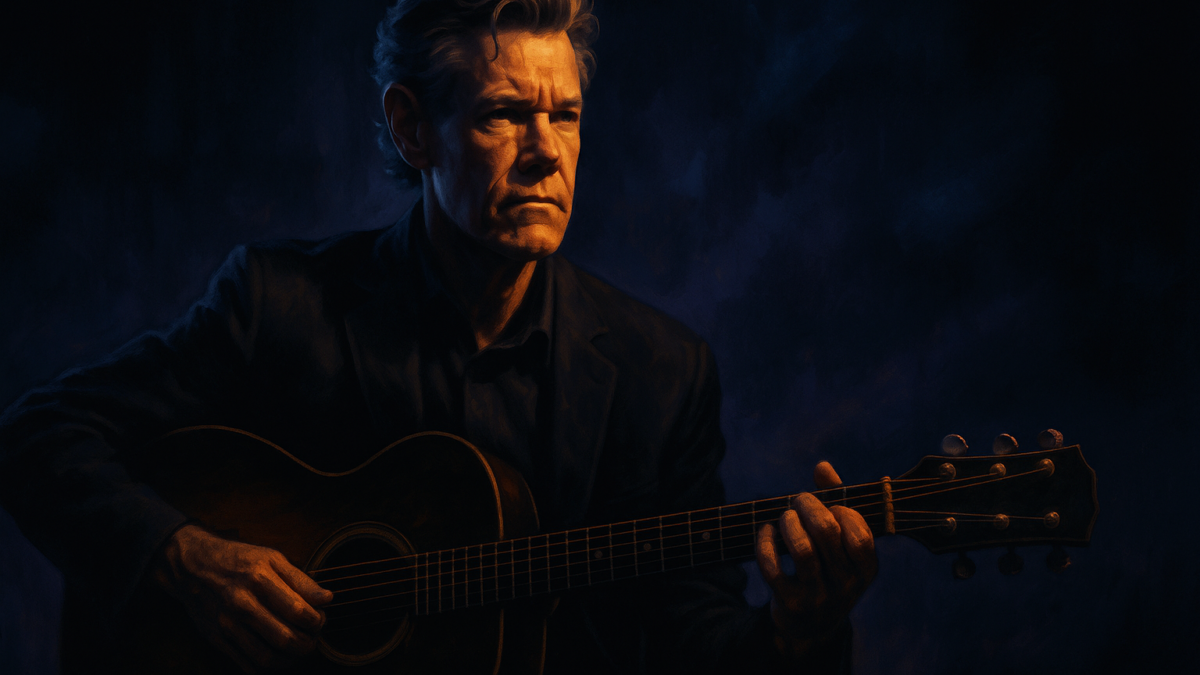
FEATURED ENTERTAINER OF THE WEEK
Randy Travis
Country music singer
July 09, 2026
Randy Travis Announces First Original Album in More Than 18 Years
Randy Travis has spent much of his career proving that restraint can be louder than spectacle. In the mid-1980s, when country radio was leaning toward polished crossover production, he arrived with a baritone that sounded carved from hardwood and a delivery that trusted silence as much as melody. He did not merely become a star; he helped move the center of country music back toward its roots. That is why this week’s announcement carries unusual weight. Travis has revealed plans for his first album of original music in more than 18 years, with the lead single “Fish On” scheduled to arrive Friday. For another artist, that might be a comeback note. For Travis, it is a new chapter in one of country music’s most improbable second acts. His voice changed the business once before. After a near-fatal 2013 stroke left him with aphasia and severely limited speech, the idea of new Randy Travis music became something more emotional than commercial. It became a question about legacy, technology, faith, memory and the stubborn durability of a song. The timing is fitting: the news arrives around the 40th anniversary of “Storms of Life,” his major-label debut and one of the essential albums in modern country history. That record helped launch the neotraditional movement, opened doors for a generation of singers, and made Travis the unlikely face of a revolution built on understatement. Four decades later, the same artist who once made Nashville listen again to fiddle, steel guitar and plainspoken heartbreak is back in the conversation not because of nostalgia alone, but because his catalog still feels active, his influence still audible, and his story still unfinished.
Quick Facts
| Born | May 4, 1959 |
| Birthplace | Marshville, North Carolina, U.S. |
| Nationality | American |
| Years Active | 1978–present |
| Residence | Tioga, Texas area |
| Spouse | Mary Davis, married in 2015; previously married to Elizabeth Hatcher Travis from 1991 to 2010 |
| Children | No biological children publicly documented |
Early Life
Randy Travis was born Randy Bruce Traywick in Marshville, North Carolina, a small town southeast of Charlotte. The landscape mattered. His earliest musical education did not come from conservatories or industry showcases, but from the everyday sound of rural North Carolina: church music, family singing, local radio, and the country records that his father loved. Harold Traywick encouraged his sons to perform, and Randy began singing with his older brother Ricky when he was still a child. The brothers performed as a duo, entering talent contests and playing local venues. Travis later became famous for sounding older than his years, and that quality was present early: a deep, serious voice attached to a young man who had not yet learned how much discipline a career would demand. His adolescence was turbulent. He had run-ins with the law and seemed headed toward a very different future until music became less a hobby than a lifeline. A key turn came when he entered a talent contest at Country City USA, a club in Charlotte managed by Elizabeth Hatcher. Hatcher recognized not just the voice, but the possibility of a career if the young singer could be steadied. She became his manager, mentor and later his wife. In the late 1970s and early 1980s, he performed under variations of his birth name before becoming Randy Travis, a stage name that was simpler, more memorable and eventually inseparable from the sound of modern country.
Family
Parents
- Harold Traywick, who encouraged his sons’ interest in country music
- Bobbie Tucker Traywick
Siblings
- Ricky Traywick, Randy’s older brother and early performing partner
- Randy Travis is one of six children; not all siblings are widely identified in major public sources
Career
The Randy Travis career began with rejection so consistent that it now reads like an industry parable. In the early 1980s, he and Elizabeth Hatcher moved closer to Nashville, where Travis took work at the Nashville Palace, a club near the Grand Ole Opry. He cooked, washed dishes and performed when he could. The arrangement sounds almost too neat in hindsight: the future country standard-bearer working in the kitchen while record executives passed through the room. But the hardship was real. Labels repeatedly passed on him because he was considered too country at a time when Nashville was still enjoying the afterglow of the Urban Cowboy era and chasing smoother pop-country sounds. Travis did not fit that fashion. His phrasing owed more to George Jones, Merle Haggard and Lefty Frizzell than to arena polish. His voice was rich but unforced, masculine without swagger, and emotionally direct without theatrical excess. Warner Bros. eventually signed him, and the breakthrough came through persistence and a little radio luck. “On the Other Hand” was first released in 1985 and made only a modest impact. Then “1982” reached the Top 10, giving the label reason to reissue “On the Other Hand.” The second time, country radio understood what it had. The song went to No. 1 and established Travis as a major new voice. His 1986 major-label debut, “Storms of Life,” did more than sell records. It shifted taste. The album’s spare arrangements, moral seriousness and old-school country architecture helped accelerate the neotraditional wave that would soon include artists such as George Strait, Dwight Yoakam, Patty Loveless, Keith Whitley and, a little later, Alan Jackson. Travis was not alone in that movement, but he became one of its most visible faces. He proved that deeply traditional country could be commercially dominant in the modern marketplace. “Storms of Life” produced signature songs including “On the Other Hand” and “Diggin’ Up Bones,” and it made clear that Travis was not a novelty or throwback act. He was contemporary precisely because he sounded rooted. The follow-up, “Always & Forever,” turned success into superstardom. Released in 1987, it included “Forever and Ever, Amen,” one of the most beloved country singles of its era. The song is often remembered as a wedding staple, but its power lies in how casually Travis delivers devotion. He does not oversell it. He lets the melody do the smiling. That performance became a template for his greatest work: emotionally generous, vocally controlled and instantly recognizable. Through the late 1980s and early 1990s, Travis became one of country’s defining male vocalists. Albums such as “Old 8×10,” “No Holdin’ Back” and “Heroes & Friends” kept him high on the charts while also broadening his circle of collaborators. “Heroes & Friends” was particularly revealing, pairing Travis with artists who had influenced him and artists who stood beside him. It framed him not merely as a hitmaker, but as a bridge between generations. Like many country stars of his stature, he eventually moved into acting. He appeared in films, television dramas and Westerns, often playing characters who drew on his solemn screen presence. His acting career never overtook his music, but it expanded his public image and placed him before audiences who may not have followed country radio closely. By the late 1990s and early 2000s, Travis made another important turn: gospel and inspirational music. This was not a cynical pivot. Faith had long been part of his public and musical identity, and albums such as “Inspirational Journey,” “Rise and Shine,” “Worship & Faith” and “Glory Train” became a major part of his later catalog. “Three Wooden Crosses,” released during that period, gave him one of the most significant songs of his second act and returned him to the upper reaches of the country charts. The song’s story-driven structure suited him perfectly. It was moral, dramatic and plainspoken, a reminder that Travis did not need youth-market reinvention to remain relevant. Then came the crisis that redefined everything. In 2013, Travis suffered viral cardiomyopathy and a massive stroke. He underwent emergency treatment and faced a long, difficult recovery. The stroke affected his ability to speak and sing, and for an artist whose identity was so completely tied to one of the most recognizable voices in American music, the loss was devastating. Yet Travis did not disappear. With Mary Davis, whom he married in 2015, by his side, he made public appearances, attended honors, supported stroke awareness, and gradually returned to the stage in a different way. His 2016 induction into the Country Music Hall of Fame became one of the most emotional public moments in modern country history. It was not only a career honor; it was a communal act of gratitude. In recent years, renewed interest in Travis has been shaped by both reverence and innovation. The 2024 release “Where That Came From” used AI-assisted vocal technology under the supervision of his longtime producer Kyle Lehning, built from past Travis recordings and a guide vocal by singer James Dupré. The project sparked discussion, but it was also carefully framed as an artist-approved effort to extend Travis’s musical presence rather than exploit it. Now, with a new album of original music announced after more than 18 years, Travis returns to a landscape he helped create. Modern country is full of singers who owe something to his phrasing, his traditionalism or his insistence that emotional clarity can be commercially powerful. The remarkable part is that his career no longer depends on proving that. The proof is everywhere.
Television
- Hee Haw (1980s–1990s) — Guest performer
- Matlock (1992) — Guest actor
- Wind in the Wire (1994) — Lead performer
- Touched by an Angel (1996–2003) — Wayne Machulis
- King of the Hill (1999) — Himself, voice
- The Tonight Show and major country music broadcasts (2000s) — Musical guest
Filmography
- Frank & Jesse (1994) — Cole Younger
- The Rainmaker (1997) — Billy Porter
- Fire Down Below (1997) — Ken Adams
- Black Dog (1998) — Earl
- The White River Kid (1999) — Sheriff Becker
- Texas Rangers (2001) — Frank Bones
- National Treasure: Book of Secrets (2007) — Musical performer cameo
Awards & Honors
- 1986 — Country Music Association Awards (Horizon Award) — Won
- 1987 — Grammy Awards (Best Male Country Vocal Performance) — Won
- 1987 — Academy of Country Music Awards (Top Male Vocalist) — Won
- 1987 — Country Music Association Awards (Male Vocalist of the Year) — Won
- 1987 — Country Music Association Awards (Album of the Year) — Won
- 1988 — Grammy Awards (Best Male Country Vocal Performance) — Won
- 1988 — Country Music Association Awards (Male Vocalist of the Year) — Won
- 1989 — Grammy Awards (Best Male Country Vocal Performance) — Won
- 1999 — Grammy Awards (Best Country Collaboration with Vocals) — Won
- 2003 — Country Music Association Awards (Song of the Year) — Won
- 2004 — Grammy Awards (Best Southern, Country or Bluegrass Gospel Album) — Won
- 2005 — Grammy Awards (Best Southern, Country or Bluegrass Gospel Album) — Won
- 2007 — Grammy Awards (Best Southern, Country or Bluegrass Gospel Album) — Won
- 2016 — Country Music Hall of Fame (Modern Era Artist) — Inducted
Business Ventures
- Built one of country music’s most valuable legacy brands through recording, touring, publishing, merchandise and licensing tied to his Warner Bros. catalog and later gospel recordings.
- Maintains an official touring and merchandise operation through his public-facing Randy Travis brand.
- Published the 2019 memoir “Forever and Ever, Amen: A Memoir of Music, Faith, and Braving the Storms of Life” with Ken Abraham, extending his career story into publishing.
- Has participated in carefully supervised legacy recording projects, including the artist-approved AI-assisted 2024 single “Where That Came From.”
Philanthropy
- The Randy Travis Foundation supports stroke and aphasia awareness, reflecting Travis’s own recovery after his 2013 stroke.
- Travis and Mary Travis have used public appearances to bring attention to stroke recovery, caregiver support and the long-term effects of aphasia.
- His gospel and inspirational work has frequently intersected with benefit concerts, faith-based events and charitable music programming.
Current Projects
- A newly announced album of original music, his first such project in more than 18 years.
- Lead single “Fish On,” scheduled to arrive Friday.
- Public appearances and concert events associated with the Randy Travis legacy, often presented with guest vocal support.
- Ongoing work connected to the Randy Travis Foundation and stroke awareness.
- Career anniversary attention tied to the 40th anniversary of his 1986 major-label debut “Storms of Life.”
Interesting Facts
- Randy Travis was born Randy Bruce Traywick and performed under earlier stage names before becoming Randy Travis.
- Before his record deal, he worked at the Nashville Palace, where he both cooked and sang.
- “On the Other Hand” was not an immediate smash on its first release; it became a No. 1 hit after being reissued.
- Nashville labels initially rejected him in part because he was considered too traditional for the country market of the early 1980s.
- “Storms of Life” helped make traditional country commercially fashionable again at a crucial moment in Nashville history.
- “Forever and Ever, Amen” became a signature wedding song, but its success also cemented Travis as a vocalist who could make sincerity sound conversational rather than sentimental.
- His album “Heroes & Friends” paired him with major influences and peers, making the project feel like a family tree of country music.
- He moved successfully into gospel music and won multiple Grammy Awards in gospel categories, not just country categories.
- “Three Wooden Crosses” became one of the rare inspirational story songs to make a major impact on mainstream country radio in the 2000s.
- His 2016 Country Music Hall of Fame induction was especially emotional because it followed his long recovery from a near-fatal stroke.
- The 2024 single “Where That Came From” was created with AI-assisted technology but was authorized by Travis and developed with longtime producer Kyle Lehning.
- Singer James Dupré has played an important role in Travis’s later live appearances, helping present the songs while Travis remains physically present with audiences.
- Travis’s influence can be heard in the phrasing and traditionalist instincts of many later male country singers.
- His acting résumé includes work with major film figures, including Francis Ford Coppola on “The Rainmaker.”
Why ShowBiz Selected This Entertainer
Randy Travis is featured this week because he has announced his first album of original music in more than 18 years, with “Fish On” set as the lead single. The news would be meaningful for any Country Music Hall of Fame member, but for Travis it resonates on several levels. It arrives as his landmark major-label debut “Storms of Life” reaches its 40-year milestone, reminding listeners that his career began by challenging Nashville’s assumptions about what could sell. It also follows years of public recovery after his 2013 stroke, a period that transformed him from hitmaker into a symbol of endurance. The new music connects the young traditionalist who once made “too country” sound like a compliment with the modern legacy artist navigating new tools, new limitations and renewed affection from fans. Travis matters this week not because he is returning to the past, but because his past still has enough force to make the present stop and listen.
Watch Next
- Storms of Life
- Always & Forever
- Old 8×10
- No Holdin’ Back
- Heroes & Friends
- Inspirational Journey
- Rise and Shine
- Worship & Faith
- Glory Train
- Forever and Ever, Amen music video
- Three Wooden Crosses music video
- Where That Came From
- The Rainmaker
- Touched by an Angel episodes featuring Randy Travis