
FEATURED ENTERTAINER OF THE WEEK
Angélique Kidjo
Singer
August 09, 2026
Angélique Kidjo Makes History With Hollywood Walk of Fame Honor
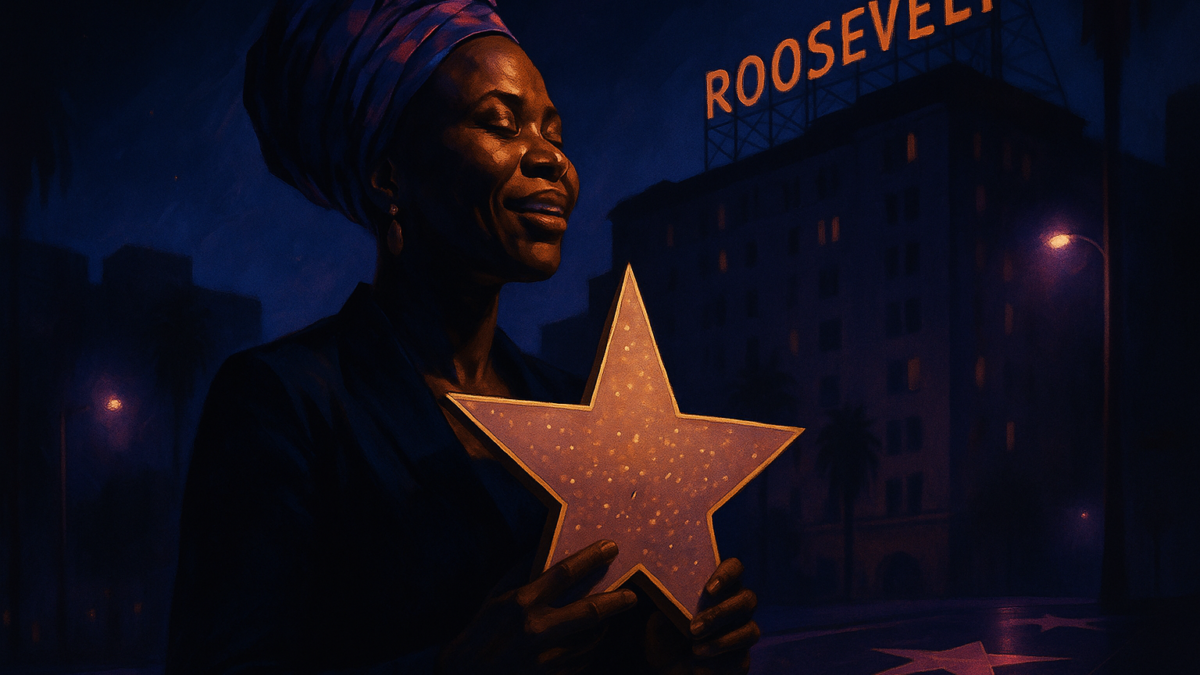
Angélique Kidjo has spent her career making borders sound smaller. A song can begin in Benin, pick up the swing of Cuban brass, borrow the insistence of American funk, salute a Nigerian political firebrand and still land with the intimacy of a family story. That has always been her particular gift: not simply blending styles, but revealing the conversations that were already happening between them. This week, that lifelong argument for cultural connection receives one of Hollywood’s most visible symbols. Kidjo is set to become the first Black African performer to receive a star on the Hollywood Walk of Fame, a milestone that says as much about Hollywood’s widening view of global entertainment as it does about her own astonishing résumé. She arrives at the honor not as a novelty from the category once called “world music,” but as a central figure in modern music: a five-time Grammy winner, a fearless interpreter, a political voice, a mentor to younger African artists and one of the rare performers able to command a concert hall, a festival field and a United Nations stage with equal authority. The Walk of Fame star is a Hollywood moment. Kidjo’s career, however, has always been larger than Hollywood.
Quick Facts
| Born | July 14, 1960 |
| Birthplace | Ouidah, Dahomey, now Benin |
| Nationality | Beninese-French |
| Years Active | 1980s-present |
| Residence | New York City |
| Spouse | Jean Hébrail |
| Children | One daughter, Naïma Hébrail Kidjo |
Early Life
Angélique Kidjo grew up in a household where music was not treated as decoration. It was language, inheritance and daily discipline. Her mother, Yvonne, was a choreographer and theater director; her father, Franck, was a musician and postal worker. In Ouidah, a historic coastal city in Benin, performance was close at hand. Kidjo has often described singing from childhood and appearing with her mother’s theater troupe when she was still very young. That early exposure mattered. It gave her the stage not as a distant dream, but as a working environment: rehearsal, timing, audience, movement, voice. Benin’s cultural mix also shaped her ear. The country sits at a crossroads of West African traditions, colonial French influence, Yoruba and Fon heritage, Catholic ritual, Vodun practice and the aftershocks of the Atlantic slave trade. Kidjo absorbed music from home, church, radio and records. She listened to African artists, but also to Aretha Franklin, James Brown, Jimi Hendrix, Miriam Makeba, Celia Cruz and the rock and soul voices that reached West Africa through broadcast and vinyl. Her first local success came before international fame. As a teenager and young singer, she recorded in Benin and became known at home, but the country’s political climate in the late 1970s and early 1980s narrowed the possibilities for an independent artist. Kidjo left for Paris in 1983, a decision that would alter the scale of her life. She studied music, took in jazz, worked with musicians far from home and began translating the sound world of Benin into a language international audiences could feel without needing it simplified.
Family
Parents
- Franck Kidjo, musician and postal worker
- Yvonne Kidjo, choreographer and theater director
Siblings
- Angélique Kidjo was raised in a large family and has spoken publicly about having several siblings, including brothers who were also involved in music.
Career
Kidjo’s career is often described with the convenient phrase “global music,” but that undersells the precision of what she built. She did not simply leave Benin, enter Europe and become international. She constructed a bridge in both directions. After moving to Paris in the 1980s, she studied at the CIM jazz school and joined the Euro-African jazz group Pili Pili, led by Dutch pianist Jasper van ’t Hof. Those years gave her a technical and professional framework: jazz harmony, studio discipline, touring experience and the confidence to place her voice in dense arrangements without losing its edge. Her 1989 album “Parakou” helped introduce the singer she would become, but the real international breakthrough came with “Logozo” in 1991. Released by Island Records, it placed Kidjo in the lineage of globally minded pop while keeping West African rhythm at the center. Songs such as “Batonga” became signatures, not only because they were catchy, but because they carried her belief that girls, particularly African girls, deserved ambition, education and public space. Through the 1990s, albums including “Ayé,” “Fifa” and “Oremi” expanded her reach. “Fifa” was recorded partly in Benin and captured traditional musicians alongside contemporary production. “Oremi” moved through American R&B and soul with guests including Cassandra Wilson and Branford Marsalis, proving Kidjo could enter U.S. musical traditions without becoming a guest in her own work. She treated African influence on the Americas not as a footnote, but as the root system.
The 2000s confirmed her as a collaborator of unusual range. “Black Ivory Soul” explored links between West Africa and Brazil. “Oyaya!” looked toward the Caribbean. “Djin Djin,” released in 2007, brought together a guest list that seemed to map Kidjo’s artistic passport: Alicia Keys, Peter Gabriel, Joss Stone, Ziggy Marley, Carlos Santana and others. It won the Grammy Award for Best Contemporary World Music Album, a major moment not because it introduced her to serious listeners, but because it formally recognized a body of work that had long exceeded category boundaries. Kidjo’s later Grammy wins deepened the point. “Eve,” her 2014 tribute to African women, included women’s choirs recorded across the continent and reframed the female voice as archive, protest and celebration. “Sings,” her orchestral project with the Orchestre Philharmonique du Luxembourg, showed the durability of her songs in symphonic form. “Celia,” her tribute to Celia Cruz, connected Afro-Cuban music back to West Africa with scholarly joy rather than museum caution. “Mother Nature,” released in 2021, brought younger African artists into the frame, including Burna Boy, Yemi Alade, Mr Eazi, Sampa the Great and others, making clear that Kidjo was not guarding a legacy from the next generation. She was conversing with it.
One of her boldest moves came in 2018 with “Remain in Light,” a full reinterpretation of Talking Heads’ landmark 1980 album. The original record had famously drawn from African polyrhythms and Afrobeat. Kidjo’s version did not merely cover it; it redirected the gaze. By singing the album through her own Beninese and diasporic understanding, she transformed a Western art-rock classic into a kind of musical homecoming. The project was acclaimed because it asked a sharp question without sounding didactic: what happens when the source returns to claim the echo? That willingness to revisit, reframe and challenge has kept her from becoming a heritage artist. Kidjo’s catalog is full of tributes, but they are active tributes. Miriam Makeba, Celia Cruz, Fela Kuti, James Brown and Jimi Hendrix are not statues in her work; they are participants in an ongoing argument about freedom, rhythm and identity.
Her influence is also institutional. She has served as a UNICEF Goodwill Ambassador, founded the Batonga Foundation to support girls’ education in Africa and used major stages to argue for women’s rights, democracy, climate awareness and African cultural power. She has sung at World Cup events, Nobel Peace Prize concerts, Carnegie Hall, major festivals and diplomatic gatherings. Yet the most striking part of her longevity may be that her voice has never softened into politeness. It remains bright, percussive and commanding, capable of tenderness but rarely passive. Kidjo sings as if the audience has been invited into a responsibility. That is why the Hollywood Walk of Fame honor feels less like an endpoint than a correction. A performer who helped make global pop more honest is now being placed in one of entertainment’s most photographed corridors.
Television
- Austin City Limits (2003) — Musical guest
- Angélique Kidjo and Friends: Spirit Rising (2012) — Performer and central artist
- Later… with Jools Holland (Multiple appearances) — Musical guest
- The Late Show with David Letterman (Multiple appearances) — Musical guest
- The Tonight Show Starring Jimmy Fallon (2021) — Musical guest
Filmography
- The Truth About Charlie (2002) — Nightclub singer
- The CEO (2016) — Dr. Zimmermann
- Queen of Katwe (2016) — Soundtrack performer
- The Woman King (2022) — The Meunon
Awards & Honors
- 2008 — Grammy Awards (Best Contemporary World Music Album) — Won
- 2011 — Grammy Awards (Best Contemporary World Music Album) — Nominated
- 2015 — Grammy Awards (Best World Music Album) — Won
- 2016 — Grammy Awards (Best World Music Album) — Won
- 2020 — Grammy Awards (Best World Music Album) — Won
- 2022 — Grammy Awards (Best Global Music Album) — Won
- 2015 — World Economic Forum Crystal Award (Arts and advocacy) — Won
- 2016 — Amnesty International Ambassador of Conscience Award (Human rights advocacy) — Won
- 2023 — Polar Music Prize (Laureate) — Won
- 2026 — Hollywood Walk of Fame (Recording) — Selected
Business Ventures
- Co-author of the 2014 memoir “Spirit Rising: My Life, My Music,” written with Rachel Wenrick.
- Longtime recording artist whose catalog has been released through major labels and independent projects, with frequent creative partnership from her husband and producer Jean Hébrail.
- Founder of the Batonga Foundation, a nonprofit rather than a commercial venture, but one of the central institutions connected to her public life.
Philanthropy
- Founded the Batonga Foundation, which supports adolescent girls and young women in Africa through education, mentoring and community-based programs.
- Named a UNICEF Goodwill Ambassador in 2002 and has advocated for children’s rights, girls’ education and public health.
- Has worked with and supported campaigns connected to Oxfam, Global Citizen and other international advocacy platforms.
- Uses concerts, interviews and public appearances to speak about gender equality, African cultural representation, democracy and climate concerns.
Current Projects
- Set to receive a Hollywood Walk of Fame star in the Recording category, making history as the first Black African performer to receive the honor.
- Continues to tour internationally with a repertoire spanning her original catalog, Grammy-winning albums and reinterpretations of artists including Celia Cruz and Talking Heads.
- Remains active through the Batonga Foundation and global advocacy work focused on girls and young women in Africa.
Interesting Facts
- Kidjo began performing as a child in her mother’s theater troupe, long before she became a recording artist.
- She left Benin for Paris in 1983, a move shaped partly by the political restrictions facing artists in her home country at the time.
- Her song “Batonga” later inspired the name and spirit of her Batonga Foundation.
- She studied jazz at the CIM school in Paris, which helped shape the harmonic sophistication of her later work.
- Before her solo breakthrough, she sang with Pili Pili, the jazz-fusion group led by Dutch pianist Jasper van ’t Hof.
- Her album “Fifa” included recordings made in Benin with traditional musicians, preserving local textures within an international production.
- She has recorded in several languages, including Fon, Yoruba, French and English.
- Her 2018 version of Talking Heads’ “Remain in Light” reversed the usual direction of influence by bringing an African perspective to an album originally inspired by African rhythms.
- “Eve,” one of her Grammy-winning albums, was built around the voices and stories of African women.
- Her tribute album “Celia” connects Celia Cruz’s Afro-Cuban music to its African roots rather than treating salsa as separate from the continent.
- She has collaborated with artists across generations and genres, including Alicia Keys, Peter Gabriel, Carlos Santana, Burna Boy, Yemi Alade, Philip Glass and Branford Marsalis.
- She appeared in “The Woman King,” a film tied to the historical Kingdom of Dahomey, the region that is now part of modern Benin.
- Time magazine named her to the Time 100 list of influential people in 2021.
- The BBC has included her among major lists recognizing influential and inspiring women.
Why ShowBiz Selected This Entertainer
Angélique Kidjo is featured this week because her upcoming Hollywood Walk of Fame star is more than a ceremonial plaque. It is a historic recognition of a Black African performer whose career helped redefine the sound and status of global music. The honor connects directly to the larger arc of her life: a Beninese singer who left home under political pressure, built a career in Paris and New York, won five Grammys, collaborated across continents and used her platform to advocate for girls’ education and African cultural power. Hollywood is acknowledging what the music world has known for decades: Kidjo is not a visitor to the global stage. She helped build it.
Watch Next
- Angélique Kidjo: “Remain in Light”
- Angélique Kidjo: “Celia”
- Angélique Kidjo: “Mother Nature”
- Angélique Kidjo and Friends: Spirit Rising
- The Woman King