
FEATURED ENTERTAINER OF THE WEEK
A R Rahman
Music maestro
July 15, 2026
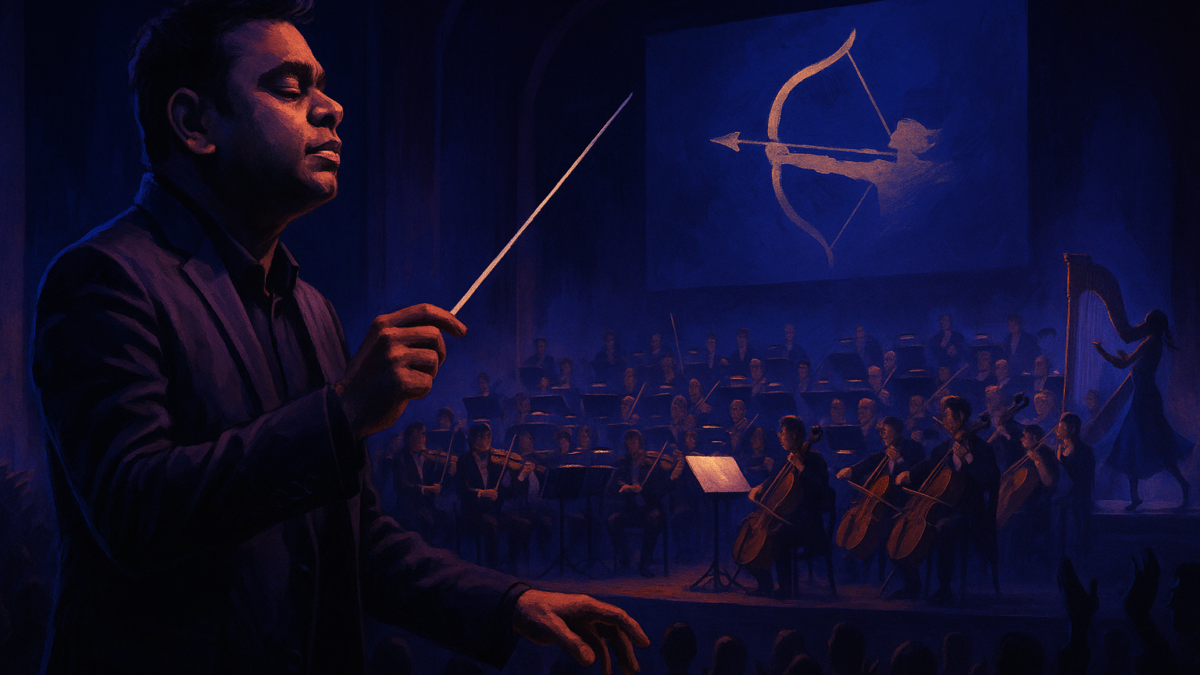
A R Rahman mesmerises Washington DC with National Symphony Orchestra
A R Rahman has spent more than three decades making borders sound unnecessary. In his best-known work, a Tamil folk rhythm can lean into a symphonic swell, a Sufi refrain can meet electronic programming, and a love song can carry the architecture of a prayer. This week, that gift found a grand American frame when Rahman performed with the National Symphony Orchestra at Wolf Trap, just outside Washington, D.C., in a concert that drew a packed audience and ended with a standing ovation. The evening was not simply a victory lap for a celebrated composer. It was a reminder of why Rahman remains one of the rare musicians whose career can move comfortably from Chennai studios to Broadway, from Hindi cinema to Hollywood awards stages, from devotional music to global orchestral spectacle. The Washington-area concert placed Indian melody, Western classical scale, live dance and a piece connected to his Ramayan project with Hans Zimmer in the same conversation. For another artist, that might sound like a themed crossover event. For Rahman, it felt like a continuation of the work he began with Roja in 1992: widening the emotional vocabulary of popular film music without making it feel academic or forced. His selection as ShowBiz.com’s Featured Entertainer this week is therefore not about one triumphant night alone. It is about what that night revealed. Rahman is still testing the elasticity of the concert hall. He is still turning film music into shared memory. And, perhaps most importantly, he is still refusing to let the categories around him decide what his music is allowed to become.
Quick Facts
| Born | January 6, 1967, as A. S. Dileep Kumar |
| Birthplace | Madras, Tamil Nadu, India |
| Nationality | Indian |
| Years Active | 1980s-present |
| Residence | Chennai, India |
| Spouse | Saira Banu; married in 1995, with separation publicly announced in 2024 |
| Children | Khatija Rahman, Raheema Rahman and A. R. Ameen |
Early Life
Before he became A R Rahman, he was A. S. Dileep Kumar, a child in a Chennai music household where the studio was not an abstract dream but a working reality. His father, R. K. Shekhar, composed and arranged music for Malayalam cinema, and the young Dileep grew up around keyboards, rehearsals and the daily craft of recorded sound. That early access came with a heavy cost. Shekhar died when Rahman was still a boy, and the family had to make music a means of survival rather than only expression. Rahman has often spoken about the period after his father’s death as one in which he worked young, helping support the family by playing keyboards and renting out musical equipment. It is one reason his later success never carried the air of accidental glamour. He knew the machinery of music from the inside: the waiting, the deadlines, the equipment, the discipline, the humility of playing for someone else’s composition before being trusted with his own. As a teenager and young musician, he worked as a session player with leading South Indian composers and bands, absorbing film music not as theory but as practice. He later studied Western classical music and earned a scholarship to Trinity College of Music in London. That combination became crucial: Indian melodic instinct, studio pragmatism, electronic curiosity and formal musical training. His conversion to Islam, along with his family, came before his breakthrough as a film composer, and he took the name Allah Rakha Rahman. By the time the film industry discovered him as a new sound, he had already lived several musical lives.
Family
Parents
- R. K. Shekhar, his father, was a composer, arranger and conductor associated with Malayalam cinema.
- Kareema Begum, his mother, was a major influence in his personal and spiritual life.
Siblings
- A. R. Reihana, singer and composer
- Fathima Rafiq
- Ishrath Qadri
Career
The first great turning point in Rahman’s career did not arrive through a film studio but through advertising. Before cinema fully claimed him, he wrote jingles, a discipline that sharpened his instinct for impact. A good jingle has to create identity in seconds. Rahman learned compression, texture and recall: how a small musical phrase can linger after the screen changes. That sensibility would later transform Indian film songs, where his introductions, interludes and sonic atmospheres often became as memorable as the melodies themselves. The decisive break came when director Mani Ratnam chose him to compose for Roja. Released in 1992, the film did more than introduce a promising newcomer. It announced a new grammar for Indian screen music. Roja sounded lush but clean, rooted yet modern, emotionally direct yet sonically adventurous. Songs such as Chinna Chinna Aasai and the film’s haunting themes suggested that synthesizers and folk-inflected melody did not have to be enemies. The score won Rahman the National Film Award, an extraordinary achievement for a debut film composer, and began one of Indian cinema’s most important director-composer partnerships. With Mani Ratnam, Rahman would go on to create music for films including Bombay, Dil Se.., Alaipayuthey, Kannathil Muthamittal, Guru, Raavanan, Kadal, OK Kanmani, Kaatru Veliyidai, Chekka Chivantha Vaanam and Ponniyin Selvan. Their collaborations are not merely popular albums; they are chapters in the evolution of contemporary Indian film sound. Bombay carried the ache of communal violence and private love. Dil Se.. turned obsession, politics and poetry into songs that travelled far beyond their film. Alaipayuthey made urban romance feel intimate and rhythmically alive. By the mid-1990s, Rahman had also become a major force in Hindi cinema. Rangeela introduced him to a wider Bollywood audience with a playful, modern sound that fit Ram Gopal Varma’s kinetic film. Taal gave Subhash Ghai’s lavish romantic drama a soundtrack built around melody, rhythm and immaculate production. Lagaan, Ashutosh Gowariker’s Oscar-nominated epic, required a different register: music that could sound rooted in a village, theatrical on a large canvas and emotionally accessible to international audiences. Rahman’s songs and score helped give the film its sweep. What made his rise unusual was not simply that he became successful in multiple languages. It was that he changed expectations in each of them. He made background scores more atmospheric. He made singers sound newly framed. He brought programming, choral writing and global instrumentation into mainstream Indian cinema without flattening regional character. His studio, Panchathan Record Inn in Chennai, became part of the mythology: a space associated with late-night experimentation, new voices and obsessive sound design. Rahman was also one of the first Indian film composers whose albums were widely discussed as independent listening experiences, not just promotional extensions of a movie. Then came the international phase, though it is misleading to treat it as separate from his Indian career. Bombay Dreams, produced by Andrew Lloyd Webber, took Rahman’s music to the West End in 2002 and later Broadway. He worked on the stage adaptation of The Lord of the Rings with Finnish folk group Värttinä and Christopher Nightingale. These projects mattered because they placed him in theatrical traditions where songs must serve narrative in a different way from Indian cinema. Rahman was not abandoning film music; he was expanding his workshop. The global breakthrough most casual Western audiences know is Slumdog Millionaire. Danny Boyle’s 2008 film gave Rahman a canvas that matched his hybrid instincts: Mumbai energy, electronic momentum, emotional urgency and a closing anthem in Jai Ho that became internationally recognizable. At the 2009 Academy Awards, Rahman won both Best Original Score and Best Original Song, becoming the first Indian to win two Oscars in the same night. His acceptance, including the line about choosing love over hate, entered Indian pop-cultural memory. The awards were more than symbolic validation from Hollywood. They changed the visibility of Indian composers in the global mainstream and confirmed that music shaped in Indian film traditions could compete without apology on the world’s most scrutinized entertainment stage. Rahman followed with further international work, including Danny Boyle’s 127 Hours, which brought him additional Academy Award nominations. Yet he never became a composer who existed only for export. He continued to work across Indian industries, delivering music for films such as Rockstar, Raanjhanaa, Highway, Tamasha, 99 Songs, Mimi and the Ponniyin Selvan films. Some albums became instant phenomena; others took time to find their audience, a familiar Rahman pattern. His music often rewards repetition because the first listen may catch the tune while the fifth reveals the architecture. There have been setbacks and uneven projects, as there are in any long career. Not every film gave him the narrative space his music deserves, and not every experiment landed with the mass audience. But his best work has a way of surviving the verdict of opening weekend. Songs reappear at concerts, in covers, in weddings, in political montages, in dance productions and in quiet private playlists. That afterlife is one measure of a composer who has written not only for scenes but for memory. Rahman’s career also matters because he built institutions around music. KM Music Conservatory in Chennai has trained young musicians in Western and Indian traditions. His Sunshine Orchestra initiative has given children from underserved backgrounds access to formal music education. He has mentored singers, programmers and instrumentalists, and his family itself reflects a continuing musical lineage. Today, when Rahman stands before an American orchestra and a multicultural audience, it is not a guest appearance by an exoticized film composer. It is the latest stop in a career built on translation: between languages, industries, faiths, technologies, generations and audiences.
Television
- The Oprah Winfrey Show (2009) — Guest performer
- MTV Unplugged India (2011) — Featured artist
- Coke Studio @ MTV (2013) — Featured composer and performer
- Harmony with A. R. Rahman (2018) — Host and curator
- The Voice India (2019) — Super Guru
Filmography
- Roja (1992) — Composer
- Bombay (1995) — Composer
- Rangeela (1995) — Composer
- Minsara Kanavu (1997) — Composer
- Dil Se.. (1998) — Composer
- Taal (1999) — Composer
- Lagaan (2001) — Composer
- Kannathil Muthamittal (2002) — Composer
- Swades (2004) — Composer
- Rang De Basanti (2006) — Composer
- Guru (2007) — Composer
- Jodhaa Akbar (2008) — Composer
- Slumdog Millionaire (2008) — Composer
- 127 Hours (2010) — Composer
- Rockstar (2011) — Composer
- Raanjhanaa (2013) — Composer
- Highway (2014) — Composer
- Tamasha (2015) — Composer
- Kaatru Veliyidai (2017) — Composer
- Mom (2017) — Composer
- 99 Songs (2019) — Writer and producer; composer
- Ponniyin Selvan: I (2022) — Composer
- Ponniyin Selvan: II (2023) — Composer
- Aadujeevitham: The Goat Life (2024) — Composer
Awards & Honors
- 1993 — National Film Award (Best Music Direction) — Won
- 1997 — National Film Award (Best Music Direction) — Won
- 2000 — Government of India (Padma Shri) — Won
- 2002 — National Film Award (Best Music Direction) — Won
- 2003 — National Film Award (Best Music Direction) — Won
- 2009 — Golden Globe Award (Best Original Score) — Won
- 2009 — BAFTA Award (Best Film Music) — Won
- 2009 — Academy Award (Best Original Score) — Won
- 2009 — Academy Award (Best Original Song) — Won
- 2010 — Grammy Award (Best Compilation Soundtrack Album for Motion Picture, Television or Other Visual Media) — Won
- 2010 — Grammy Award (Best Song Written for Motion Picture, Television or Other Visual Media) — Won
- 2010 — Government of India (Padma Bhushan) — Won
- 2011 — Academy Award (Best Original Score) — Nominated
- 2011 — Academy Award (Best Original Song) — Nominated
- 2018 — National Film Award (Best Music Direction) — Won
- 2018 — National Film Award (Best Background Score) — Won
Business Ventures
- Founded Panchathan Record Inn, his Chennai studio that became central to his sound and working method.
- Established AM Studios in Chennai, a major recording and post-production facility.
- Founded KM Music Conservatory in Chennai, an institution for music education across Western and Indian traditions.
- Co-founded Qyuki Digital Media with Shekhar Kapur and Samir Bangara, a creator-focused digital media company.
- Created and developed 99 Songs as a writer-producer, extending his work into film development and production.
Philanthropy
- Founded the A. R. Rahman Foundation, which supports education and music-related initiatives.
- Launched the Sunshine Orchestra initiative through KM Music Conservatory to provide music training to children from underserved backgrounds.
- Has supported disaster-relief and humanitarian concerts, including benefit performances connected to causes in India.
- Has been associated with public health awareness work, including the Stop TB Partnership.
Current Projects
- Performed with the National Symphony Orchestra at Wolf Trap near Washington, D.C., in a cross-cultural concert featuring Indian and Western orchestral elements.
- Presented music connected to his Ramayan project with Hans Zimmer during the Washington-area concert.
- Continues to compose for Indian and international film projects across multiple languages.
- Continues work through KM Music Conservatory and related music education initiatives.
Interesting Facts
- Rahman began his professional life as a keyboard player and session musician before becoming a film composer.
- His early advertising jingle work helped develop the concise musical hooks that later became a feature of his film songs.
- Roja was his first film as composer, and it won him a National Film Award.
- He built his reputation from Chennai rather than relocating permanently into the Hindi film industry, helping keep South Indian studio culture central to his identity.
- Panchathan Record Inn, his studio, became almost as famous among music followers as some of the albums created there.
- He has composed in multiple Indian languages, including Tamil, Hindi, Telugu and Malayalam, as well as for international productions.
- His work with Mani Ratnam is one of the most celebrated director-composer partnerships in Indian cinema.
- Chaiyya Chaiyya from Dil Se.. became internationally recognizable and was later used in Western film and television contexts.
- He won two Oscars on the same night for Slumdog Millionaire.
- He has worked in stage musicals as well as cinema, including Bombay Dreams and The Lord of the Rings stage production.
- His children Khatija Rahman and A. R. Ameen have both performed as singers.
- His nephew G. V. Prakash Kumar became a successful composer and actor in Tamil cinema.
- Rahman’s music often has a long afterlife, with songs from initially mixed or modestly received films later gaining devoted followings.
- He founded KM Music Conservatory to create formal training opportunities for young musicians in Chennai.
- His concerts frequently rearrange film songs for new settings rather than simply reproducing the original soundtrack versions.
Why ShowBiz Selected This Entertainer
Rahman is featured this week because his Washington-area concert with the National Symphony Orchestra captured the essence of his career in one evening. The performance at Wolf Trap was not merely a celebrity composer appearing with a prestigious orchestra. It was a live demonstration of the musical bridge he has been building since Roja: Indian melody in conversation with global arrangement, film emotion expanded into concert form, and popular songs treated with the seriousness of orchestral repertoire. The standing ovation mattered because it recognized more than nostalgia. Rahman’s audience now spans generations and geographies, from listeners who discovered him through Tamil cinema to those who first heard his name at the Oscars. Including a piece from his Ramayan project with Hans Zimmer also pointed toward the next chapter: a composer still curious about scale, myth and collaboration. More than thirty years into his film career, Rahman remains relevant because he does not behave like an artist guarding a museum of past triumphs. He keeps re-scoring his own possibilities.
Watch Next
- Roja
- Bombay
- Dil Se..
- Taal
- Lagaan
- Rang De Basanti
- Jodhaa Akbar
- Slumdog Millionaire
- 127 Hours
- Rockstar
- Highway
- Ponniyin Selvan: I
- Ponniyin Selvan: II
- Harmony with A. R. Rahman