
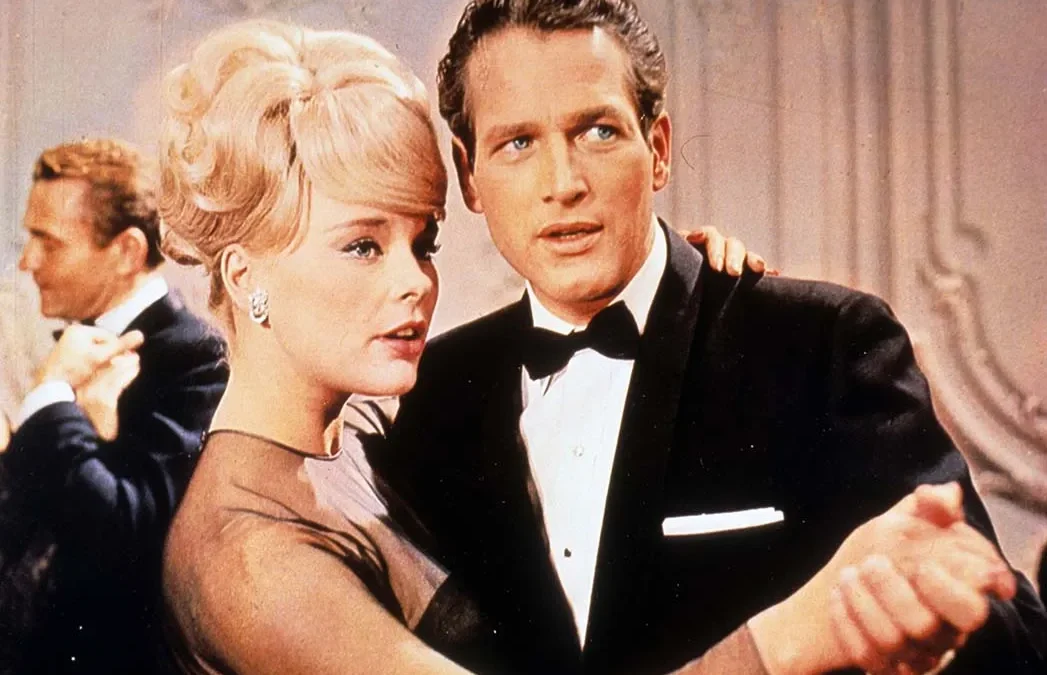
Elke Sommer, the German-born actress whose 1960s Hollywood run included The Prize, A Shot in the Dark, The Art of Love and Deadlier Than the Male, has died at 85.
Sommer died of heart failure at her Bel-Air home on Wednesday, her stepson, Sebastian Walther, told the German newspaper Bild.
“Elke passed away peacefully around 10 p.m. Now she can finally be with her beloved husband again [German hotelier Wolf Walther],” he said.
Her husband died from cancer in July. Sommer, who had no children of her own, married Walther in August 1993. He had served as general manager of New York’s Essex House and managing director of the Century Plaza Hotel.
From Europe to Hollywood
Born Elke Schletz in Berlin on Nov. 5, 1940, Sommer was the only child of Protestant minister Peter Schletz and homemaker Renata Schletz. Her father died when she was 14. At 17, she moved alone to London and worked as an au pair for a year before college.
Her entry into movies followed an unlikely discovery. While vacationing with her mother in Viareggio, Italy, Sommer was sitting in a café when someone pinned a ribbon on her and declared her the winner of a beauty contest. A newspaper photograph published the next day attracted a producer’s attention.
She was paid $2,000 to portray a German tourist receiving a guided tour of Rome in L’amico del giaguaro (1959). Italian actor Vittorio De Sica then offered her the role of a chambermaid opposite him in Men and Noblemen (1959), giving the actress an important early-career break.
After taking Sommer as her professional surname, she appeared in European films including Love, the Italian Way (1960), Daniela by Night (1961) and Why Bother to Knock (1961), her English-language debut. She also signed a seven-picture agreement with German producer Atze Brauner.
American producer Pandro S. Berman noticed Sommer in Das Mädchen und der Staatsanwalt (1962), in which she played a woman who becomes involved with an older prosecutor in an effort to free her mother from prison. Berman subsequently called her in Germany and asked whether she wanted to star opposite Paul Newman.
That opportunity became MGM’s The Prize (1963), the Mark Robson-directed thriller scripted by Ernest Lehman. Sommer played the Swedish chaperone of a Nobel Prize in Literature recipient, portrayed by Newman, and helped foil East German spies. She received the Golden Globe for best female newcomer, sharing the award with Tippi Hedren for The Birds and Ursula Andress for Dr. No.
Sommer also appeared in the 1963 war film The Victors.
A Memorable 1960s Screen Run
In 1964, Sommer played murder suspect Maria Gambrelli opposite Peter Sellers’ Inspector Clouseau in Blake Edwards’ A Shot in the Dark. The role remained closely associated with her decades later.
“It has happened frequently that I am on a golf course, for example, with the regular crowd on Tuesdays, and from a distance, I hear someone yelling, ‘Hey, Maria Gambrelli! How are you!?’” she said in a 2014 interview with Film Talk. Sommer added that she felt “very privileged” by the film’s lasting recognition.
She posed for Playboy for the first time that same year. Her other prominent roles included a woman in distress opposite James Garner and Dick Van Dyke in Norman Jewison’s The Art of Love (1965), as well as appearances with Glenn Ford and Rita Hayworth in The Money Trap (1965).
In 1966, she portrayed a fashion designer romantically involved with a self-absorbed actor played by Stephen Boyd in The Oscar. She also played a rebellious French movie star weary of making bubble-bath commercials in the Bob Hope comedy Boy, Did I Get a Wrong Number!
Her espionage and caper credits continued with Deadlier Than the Male (1967), The Corrupt Ones (1967), They Came to Rob Las Vegas (1968) and the Matt Helm spoof The Wrecking Crew (1968), starring Dean Martin and Sharon Tate. She also appeared with Bob Crane and Werner Klemperer in the 1968 Cold War comedy The Wicked Dreams of Paula Schultz.
A Career Beyond Hollywood
After her U.S. film career slowed, Sommer worked with Italian horror director Mario Bava. In Baron Blood (1972), her character faced a sadistic, 400-year-old nobleman played by Joseph Cotten. She followed that with Lisa and the Devil (1973), playing an American tourist drawn by Satan, portrayed by Telly Savalas, into a haunted Spanish house.
Her 1970s films also included Percy, Zeppelin, It’s Not the Size That Counts, Wolfgang Petersen’s One or the Other, Ten Little Indians, Carry on Behind and Richard Quine’s 1979 remake of The Prisoner of Zenda.
Fluent in five languages, Sommer made movies in Italy, France, Spain, England and Germany. She expanded her work to the stage, beginning in regional theater in 1970 with the lead in Irma la Douce. She later headlined productions of Born Yesterday, Cactus Flower, Woman of the Year and Same Time, Next Year.
Her television work included the 1982 ABC miniseries Inside the Third Reich, in which she played the wife of Joseph Goebbels, portrayed by Ian Holm. She was also a frequent guest on Dean Martin’s NBC variety show and appeared on St. Elsewhere, Fantasy Island and The Love Boat.
Sommer recorded several albums as a cabaret singer and pursued painting, holding her first exhibition at 24 and later hosting the PBS instructional series Painting With Elke Sommer. A race-car enthusiast and accomplished tennis player, she also hosted the syndicated program Elke Sommer’s World of Speed and Beauty.
She was married to Hollywood columnist and author Joe Hyams from 1964 until their 1981 divorce. The two met when Hyams, who was 17 years older, interviewed her for a New York Herald Tribune article about The Prize.
In December 1993, a Santa Monica jury awarded Sommer $3.3 million in libel damages from Zsa Zsa Gabor and Gabor’s husband, Frederick von Anhalt, over defamatory comments published in two German outlets in 1990.
ShowBiz Take
Sommer’s legacy reaches well beyond the glamour roles that defined her Hollywood profile. Her filmography moved across countries, languages and genres, while her work in theater, television, music, painting and automotive programming revealed a performer who repeatedly found new creative outlets.
Still, Maria Gambrelli remained a touchstone. Sommer’s own delight that strangers continued calling out the character’s name captured the enduring connection between the actress and one of her best-remembered performances.