

The pirate dream just won’t die. Buzz around a sixth installment of Disney’s Pirates of the Caribbean is relentless. This year, 1.6 billion watched the premiere of the second series of Netflix’s One Piece, about the search for the Pirate King’s treasure. And last week, Ridley Scott announced that he would be directing a new spin on Robert Louis Stevenson’s Treasure Island, starring Hugh Jackman as Long John Silver, the swaggering eye-patched buccaneer who launched a thousand clichés. With more than fifty film and television adaptations, the 1883 novel is a jewel of inspiration. But how close to the three centuries-old pirate reality is the Hollywood take?
I’m a marine archaeologist and the editor of Wreckwatch magazine. Last year, when I dived into the Caribbean waters of the Bahamas, time flipped. Images of Errol Flynn sword-fighting in Captain Blood in 1935, and Johnny Depp swinging down rigging rope with wrist chains in Curse of the Black Pearl of 2003,raced through my mind. Diving isn’t swashbuckling, but it is adventure. And these seas have seen more adventure than most.
“It was in Nassau that the legend of the pirates of the Caribbean was born,” says adventurer Chris Atkins, fresh from exploring and filming Mystery of the Pirate King’s Treasure in the Bahamas, “and the legend of Henry Avery, the real pirate king who brought $149 million of gold, silver and precious gems here in 1696.” The notorious Flying Gang outlaws — Blackbeard, Calico Jack Rackham, Anne Bonny and many more — lived in this pirate paradise in the 1710s, plotting attacks and enjoying the spoils of plunder.
Along with Dr. Michael Pateman and Atkins, we’d been given the first permission to dive these seas in search of the forgotten shipwrecks of the real pirates of the Caribbean. Not the fantasies. We had scrutinized primary sources and, alongside 3D model makers and an AI studio, reconstructed life in what was once the baddest town on Earth, helping us distinguish the truth from on-screen fiction.
And we hit the jackpot. “Not one pirate ship or prize had ever been found in these waters,” says Atkins. “In menacing hurricane season, our dive team discovered six wrecks, three from the first half of the eighteenth century linked to piracy: iron cannons, musket balls, scattered crates of tobacco pipes, glass wine bottles and an actual wooden hull burned to the waterline, a favorite pirate ploy to get rid of evidence of their crimes.”
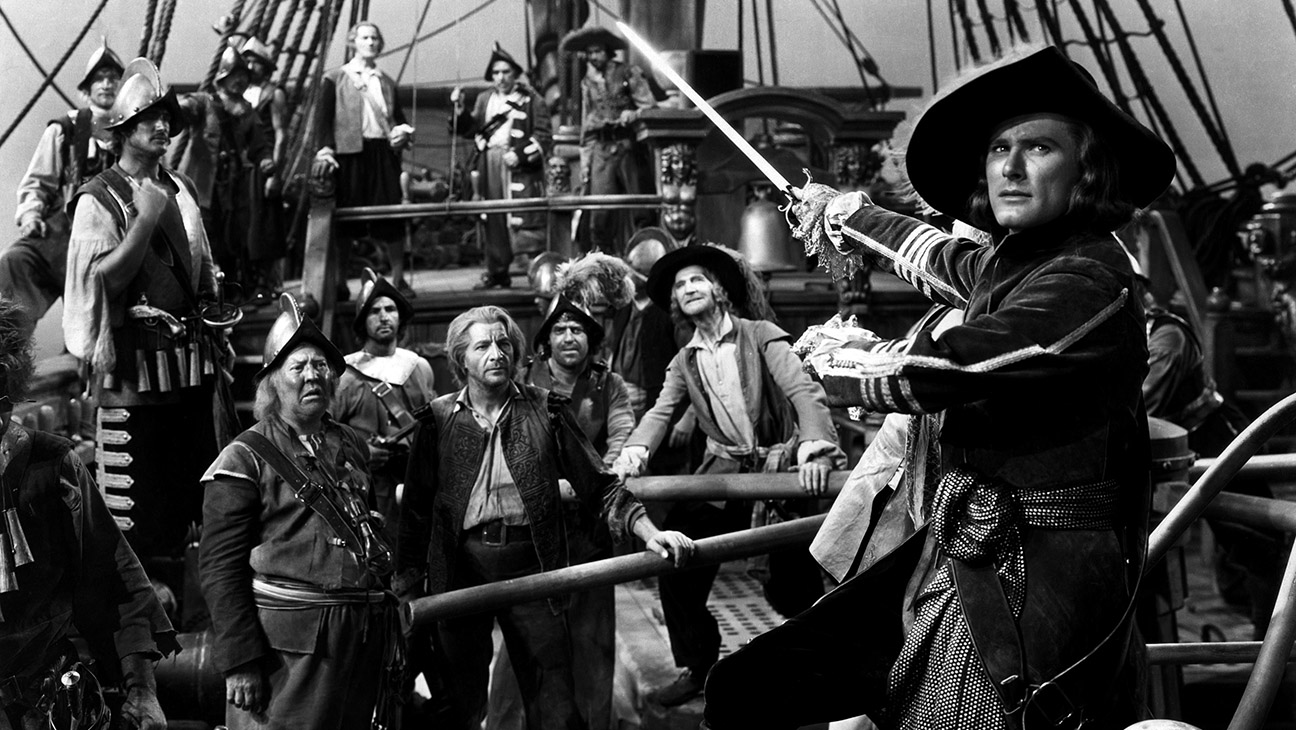
Errol Flynn, far right, in 1935’s Captain Blood.
Courtesy Everett Collection
Pirate films have come in and out of vogue since exploding onto the big screen with Douglas Fairbanks in the 1926 silent movie The Black Pirate. A no-punches-pulled introduction promised “an account of Buccaneers and the Spanish Main, the Jolly Roger, Golden Galleons, bleached skulls, Buried Treasure, the Plank, dirks and cutlasses, Scuttled Ships, Marooning, Desperate Deeds, Desperate Men, and – even on this soil – Romance.”
Errol Flynn, Burt Lancaster, Dustin Hoffman, Robert de Niro, Geena Davis and John Malkovich have all terrorized the high seas. Many films raked in riches, none more so than Disney’s five Pirates of the Caribbean series, which cost $1.27 billion to make and generated $5.66 billion in global sales. Others, like Roman Polanski’s Pirates, walked the plank in 1986 after costing $40 million to produce and taking $6.3 million in the box office. Renny Harlin’s Cutthroat Island bombed so badly it sank a production company.The less said about Graham Chapman’s Yellowbeard, the better.
But all of these fanciful depictions bear only a thin resemblance to the historical pirate life. Our time-travels to Nassau’s “Piratetown”, searching through hundreds of early eighteenth-century state records and pirate “tryals,” showed the captains of the big screen to be cartoon cutouts pulled largely from late nineteenth-century literature. Many of the most enduring tropes come from Stevenson’s Treasure Island, which invented the piratical clichés of buried treasure, walking the plank, shoulder-perched parrots, eyepatches and the drunkard’s ditty, “Fifteen men on the dead man’s chest, Yo-ho-ho, and a bottle of rum.”
The myriad pirate movies of Hollywood’s golden age — to give you an idea, there were at least 27 pirate films made between 1950 and 1954 — tend to follow the formula of a tragic and lovable outcast who swashbuckles into royal favor and polite society. Douglas Fairbanks in The Black Pirate (1926), Errol Flynn in Captain Blood (1935), Tyrone Power in Black Swan (1942) and Burt Lancaster in Crimson Pirate (1952) all played charming rogues — “criminally good-looking,” The New York Times called Flynn — wronged by the world and seeking justice.
Shirtless sword fighting was a virtual contract requirement, as was athletic star quality. Fairbanks’ iconic trick of plunging his knife into a sail and gliding down onto a ship’s deck was repeated by Will Turner (Orlando Bloom) in Pirates of the Caribbean: Curse of the Black Pearl. Cutting a rope to swing into the rigging became a jaw-dropping motif arc from The Black Pirate to Jack Sparrow (Johnny Depp) in At Worlds’ End, the 2007 Pirates of the Caribbean sequel. Real practical pirates had no time for showboating.
But while the big-picture plots of Hollywood pirate films are fabrications and idealizations, details are often rooted in reality — though perhaps unwittingly. The shirtless fencing, for example, recalls the real-life pirate Black Sam Bellamy, who took showing the flesh to the extreme in 1716 when his crew attacked the French trader St. Marie off Cuba, stark naked, gambling that acting as savages would terrorize the enemy into giving quarter without losing his crew or wasting gunpowder.
Or Take Robert Newton’s bellowing voice in Blackbeard the Pirate (1952). By using his home county Dorset dialect, by chance his trademark ‘Aaargh’ was on point, since coastal Devon and Cornwall were famous incubators for pirate crews.
The crimson tide of the 1710s was generally far more brutal and far less romantic than as depicted on screen. “Raids, drinking, and throwing women over men’s shoulders during attacks sit uncomfortably in the ‘Me Too’ movement, but these events were a sorry reality,” Dr. Rebecca Simon, an historian of early modern piracy, told The Hollywood Reporter. One scene that is uncomfortably authentic sees Jamie Waring pinning Lady Margaret, the daughter of Lord Denby, Governor of Jamaica, against a castle wall in The Black Swan and laughing that “I always sample a bottle of wine before I buy it.”
The ridiculously good-looking Jean Peters, as historical pirate Anne Bonny, may have been the star of Anne of the Indies (1951), and the “vilest-hearted sea monster that ever came out of the sea.” But “the real Bonny sailed with Captain Jack Rackham’s crew for just two months before capture and was only spared the hangman’s noose because she was ‘Quick with Child’,” says Simon, author of Pirate Queens. Bonny and Rackham’s reign of terror ended when they were caught by an English privateer and tried by the governor of Jamaica in 1720.
Pirates are only heroic onscreen. On the high seas, they did not hesitate to burn matches under victims’ eyelids and sew up their lips or cut them off and broil them to scare crews into revealing where their treasure was hidden. Fed-up pirates often voted out unsuccessful captains and, in mutinies, cast them away on deserted islands. Captain Barbossa was closer to the truth in Curse of the Black Pearl when he warned Elizabeth Swann that “the code is more of what you’d call a guideline than actual rules.” Pirates were chancers who lived to break rules.
“Whether we see the real pirates of the Caribbean as rapists and terrorists, or through a more modern lens as freedom fighters and early champions of democracy, really depends on how forgiving historians are willing to be,” the New Providence Pirates Expedition’s Michael Pateman told THR. WhenErrol Flynn’sCaptain Blood makes his crew sign Articles of Agreement, a pledge to be an equal band of brothers, sharing loot and establishing a kind of health insurance for buccaneers – losing a right arm in a skirmish earned you 600 Spanish pieces of eight – the film harks back to true pirate Articles of the 1720s.
***
Many Hollywood pirate films — including the Pirates of the Caribbean series — set their shore action in Port Royal, Jamaica. With its sweeping sugar plantations, the settlement may have been a wealthy nexus of trade and the seat of English control in the Caribbean, but it was never a pirate’s playground. The true pirate’s lair was Nassau on the island of New Providence in the Bahamas, where raids were planned and plunder laundered, and where raucous crews indulged in rum and strumpets.
Strolling along the shores of Nassau in the Bahamas today, you’ll find the menacing pirate vibe is long gone. Pirates’ caves where loot was hidden and Blackbeard’s Tower, thought by many to be authentic pirate hideouts, may be no more the real deal than Blackbeard’s Rum Cake sold to tourists downtown. Not a stone survives of the pirate fort that once protected the harbor entrance on what are now the grounds of the five-star British Colonial Hotel. Time has claimed the wood-framed and palm-thatched cabins and tents set up using ship sails that made Nassau’s Pirate Town look like a refugee camp.
Wreckwatch TV came to Nassau not to dig on land but to do archaeology underwater with the New Providence Pirates Expedition for the documentary series Mystery of the Pirate King’s Treasure. Most sea rats of the 1710s and 1720s were twenty-somethings brimming with testosterone and living for today, Marcus Rediker’s Villains of All Nations shows. They fought, partied hard, did it all again and often died young in storms or were hanged. “A merry life and a short one,” the infamous Welsh pirate Black Bart Roberts called his profession. Whatever was once stored and laundered on Nassau’s shores is long gone.
We came to dive Nassau hoping that, unlike on land, its waters would still preserve pirate secrets. After all, it was on ships’ decks, not town streets, that the one thousand[SK1] die-hards who turned Nassau into the most notorious pirates’ den in the world lived and died by the sword. Stolen frigates, schooners and sloops were their hot wheels. When pirate hunter Woodes Rogers sailed into town in 1718, he spotted forty ships abandoned on the shore. Could anything survive centuries of hurricanes and massive harbor dredging?
The three pirate-age shipwrecks we discovered in Nassau included a large burned ship. Word quickly spread that we’d likely found the Fancy, the flagship of Englishman Henry Avery, the real pirate king, who in 1695 pillaged the Mughal emperor’s treasure ship off India in the richest pirate heist on the high seas. Avery lit the fuse and threw the grenade that started the Golden Age of Piracy. The Fancy was scuttled off Nassau. Did we indeed find his iconic ship? It’s difficult to say with certainty, but analysis reveals the sunken hull is of the same period and of the same size.
Tracking down the hull of a pirate ship was more rewarding than finding pieces of eight or bottles of rum because of what they meant in both history and Hollywood.Only when our dive team motored east out of Nassau’s heavily built-over shores, to dive on a downed plane in the middle of nowhere that once carried Pablo Escobar’s cocaine, did the penny drop about what really attracted pirates to this place.
As the clouds danced, and the same trade winds that pirates chased three hundred years ago in search of galleons swept through my hair, I realized that Jack Sparrow and Hollywood were right all along. Treasure came and went, but being a free band of pirate brothers enjoying natural freedom was priceless.
Dead men, it seems, do tell tales.