
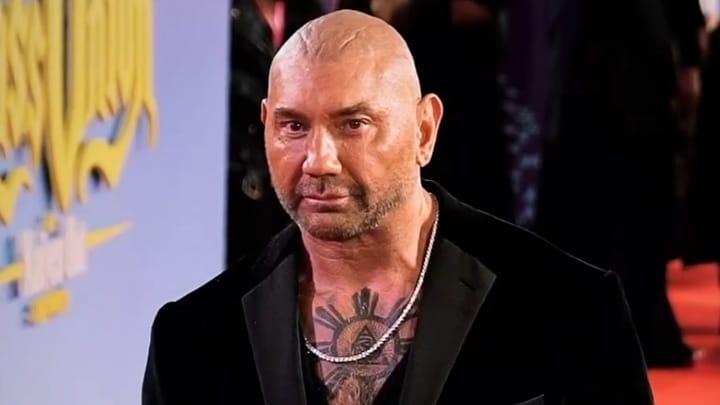
Dave Bautista has been tapped to play Kratos in Prime Video’s upcoming live-action adaptation of God of War, stepping into one of the most closely watched roles in the current wave of video game-to-television projects.
The casting follows a major behind-the-scenes change for the Amazon MGM Studios and Sony Pictures Television series. Ryan Hurst had previously been announced for the role earlier this year, but an on-set injury reportedly forced producers to reconsider the production timeline. Hurst suffered a torn bicep while performing a stunt in late June, creating a delay that could have pushed filming into 2027.
Rather than hold the project indefinitely, the studio moved quickly to secure Bautista, an actor whose physical presence and genre credibility have made him a frequent fan pick for Kratos for years. The former WWE champion has built a second career as one of Hollywood’s more reliable action performers, moving from Marvel’s Guardians of the Galaxy franchise to roles in Dune, Blade Runner 2049, Knock at the Cabin and Army of the Dead.
For Prime Video, the casting is a significant signal of intent. God of War is not a niche property. The PlayStation franchise is one of Sony’s most valuable gaming brands, with the 2018 soft reboot and its sequel, God of War Ragnarök, helping transform Kratos from a rage-driven mythological warrior into one of gaming’s most emotionally complex protagonists.
That evolution is central to why the role is so demanding. Kratos is not simply a larger-than-life fighter with an axe and a tragic past. In the more recent games, he is a grieving widower and cautious father attempting to escape the violence that defined him. Any live-action version will have to balance brutality with restraint, spectacle with silence, and mythic scale with intimate family drama.
Bautista has increasingly made the case that he is capable of more than action-heavy roles. While his performance as Drax in the Marvel Cinematic Universe turned him into a global star, he has repeatedly sought projects that ask for stillness, vulnerability and emotional weight. His work in Knock at the Cabin and Dune in particular suggested an actor interested in using his imposing frame in more layered ways.
That matters for God of War, a series whose success will likely depend less on faithfully recreating fight scenes and more on capturing the father-son dynamic at the heart of the modern games. The adaptation is expected to draw heavily from the Norse-era storyline, in which Kratos journeys with his son Atreus through a world populated by gods, monsters and old wounds.
Why the Recasting Matters
High-profile recastings are always delicate, but this one carries unusual visibility because of the character involved. Hurst, known for Sons of Anarchy and The Walking Dead, brought his own physicality and gravitas to the part, and his departure appears tied to circumstance rather than creative disagreement. That distinction may help soften fan reaction, though audiences invested in the franchise will inevitably scrutinize the change.
For studios, the decision reflects the hard economics of premium television. A series like God of War requires extensive pre-production, stunt coordination, visual effects planning and location logistics. Delaying into 2027 could have affected budgets, talent availability and Prime Video’s broader genre slate. Moving forward with a new lead allows the production to protect momentum around a property Amazon has positioned as a potential flagship.
The recasting also underscores how physically demanding modern television franchises have become. Streaming series adapted from games, comics and fantasy novels are expected to deliver feature-level action across multiple episodes. That expectation increases pressure on performers and stunt teams, particularly when the lead character is defined by hand-to-hand combat and mythological battles.
A Key Test for Video Game Adaptations
The industry context is important. Video game adaptations have moved from risky bets to prestige targets. HBO’s The Last of Us proved that a game-based series could win critical acclaim and awards attention, while projects such as Fallout and Twisted Metal have shown that audiences are willing to follow familiar gaming worlds into serialized television when the tone is right.
Sony has been especially aggressive in turning PlayStation properties into film and TV assets, using its game catalog as a pipeline for global entertainment brands. God of War is among the company’s crown jewels, which means the Prime Video series will be judged not only as an adaptation, but as a major test of how far Sony can extend its interactive storytelling into prestige streaming drama.
Bautista’s arrival gives the project immediate visibility beyond the gaming audience. He brings name recognition, action credibility and a built-in fan conversation that has followed him since viewers first began imagining him as Kratos online. That kind of organic enthusiasm can be valuable, but it also raises expectations. Fans will want the performance to feel less like stunt casting and more like a definitive interpretation.
Amazon MGM Studios and Sony Pictures Television have not yet revealed full casting details for key roles including Atreus, nor have they confirmed a premiere window. Creative decisions around the show’s tone, rating and mythological scope will be closely watched as production moves forward.
What Happens Next
With Bautista now set as the face of the series, attention turns to the rest of the ensemble and the production schedule. The studio will need to recalibrate stunt planning, costumes and character work around its new lead while maintaining the scale expected from the source material.
The next major milestone will likely be confirmation of additional cast members and a clearer timeline for filming. If Prime Video can stabilize the production quickly, God of War could remain one of the streamer’s most anticipated genre bets heading into its next phase of development.
For Bautista, the role offers a chance to anchor a major dramatic franchise on his own terms. For Amazon and Sony, it is an opportunity to turn one of gaming’s most iconic characters into a television event. The pressure is considerable, but so is the upside.