
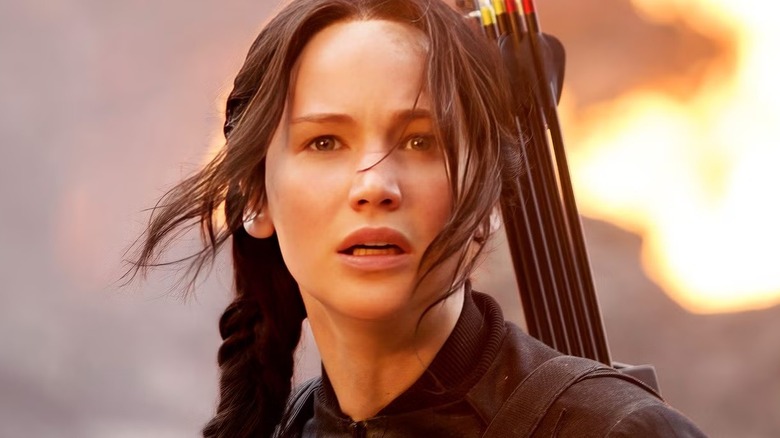
For viewers still chasing the survival tension, political intrigue and underdog spirit of “The Hunger Games,” television offers several compelling ways back into dystopian territory. These five sci-fi series place their protagonists inside tightly controlled worlds shaped by inequality, secrecy, propaganda and rebellion.
Some echo the arena structure of Suzanne Collins’ story, while others turn bunkers, small towns and even a moving train into their own battlegrounds. What connects them is the sight of ordinary people confronting systems designed to keep them powerless.
“Silo”
Apple TV’s “Silo” stars Rebecca Ferguson as Juliette Nichols, an engineer living in the underground Silo 18. Its isolated residents believe the surface world is toxic and uninhabitable, but a series of deaths pushes Juliette to question the official story and investigate the secrets holding her community together.
Based on Hugh Howey’s “Silo” trilogy, the show expands from one woman’s search for answers into a larger story of resistance. Juliette develops from an engineer into an antihero and revolutionary as the mysteries surrounding the silos and the outside world come into view.
Ferguson described the production as deeply collaborative in an interview with Awards Daily, saying she values being able to participate in the process and potentially sit in on writers’ rooms. “It’s one of the happiest jobs that I’ve ever done,” she said.
“The Society”
“The Society” begins when a group of high school students returns from a camping trip and discovers that every adult and younger child in town has vanished. Their initial excitement over living without supervision quickly evaporates: Roads out are blocked by forest, the internet is unavailable and there is no way to reach the outside world.
The wealthy teenagers attempt to create their own functioning society, only for the experiment to descend into power struggles, deception and deadly failures of survival. Unlike “The Hunger Games,” there is no visible outside authority demanding obedience. The danger grows from within the stranded community itself.
The Netflix series lasted one season before being canceled for COVID-19-related reasons, leaving its central mystery unresolved onscreen. Creator Christopher Keyser has, however, confirmed what would have happened in Season 2 if the show had continued.
“Paradise”
Sterling K. Brown plays Secret Service agent Xavier Collins in “Paradise,” a post-apocalyptic thriller that initially appears to follow life around U.S. President Cal Bradford, played by James Marsden. The apparent normality is deceptive: They are not living in Washington, D.C., but inside a vast bunker built for the apocalypse’s only survivors.
The manufactured community has hidden cameras, an artificial sky and a simulated sunrise, giving it the controlled quality of a “Hunger Games” arena. When Cal is murdered, Xavier is pulled into the bunker’s deeper secrets and a widening conspiracy.
Brown told CBC that the series was intended to make audiences think about their own world and whether they are contributing to its “betterment” or “detriment.” Across the first two seasons, the character histories and consequences continue building toward an explosive Season 2 finale.
“Snowpiercer”
In “Snowpiercer,” the remaining survivors of a frozen wasteland live aboard a train that is always moving but has no destination. The social hierarchy is built directly into its cars, with each section representing a different class and the impoverished “tailies” occupying the bottom rung.
The series adapts Bong Joon Ho’s 2013 film starring Chris Evans. Daveed Diggs leads the television cast as Andre Layton, a former police officer investigating a crime on the train. Jennifer Connelly plays Melanie Cavill, its influential Head of Hospitality, while Sean Bean portrays conductor Joseph Wilford.
Scarce food and resources allow those in authority to use propaganda to preserve control. Bean told Parade that Wilford does not view his actions as punishment, but as necessary for survival and technological progress—even as his blunt attitude toward the lower classes makes him a formidable symbol of the system Layton must navigate.
“3%”
“3%” takes place in a future Brazil divided between the poverty-stricken Inland and an elite society known as Offshore. Every year, 20-year-old Inlanders can attempt a punishing series of endurance tests called the Process. Just 3% are selected to leave poverty behind.
Bianca Comparato plays Michele Santana, who enters the Process with no loved ones remaining and a single hope of joining the elite. The trials resemble a grueling, manipulative job interview rather than entertainment, but the lower class is still forced to perform for access to a better life.
The series began as a three-part YouTube project before Netflix developed it into the streamer’s first original production shot in Brazil. Its rebellion comes through the Cause, a group seeking to end the Process and redistribute wealth. Michele’s involvement forces her to choose how far she will go against the system on which her own survival depends.
ShowBiz Take
These series do more than replicate the spectacle of an arena. “Silo” uses buried secrets, “The Society” explores self-created oppression, “Paradise” hides control beneath artificial perfection, “Snowpiercer” turns class into physical geography and “3%” makes social mobility a brutal test.
For “Hunger Games” fans, that variety is the real draw: five distinct worlds, each asking what happens when survival requires not only endurance, but the courage to challenge the rules.