
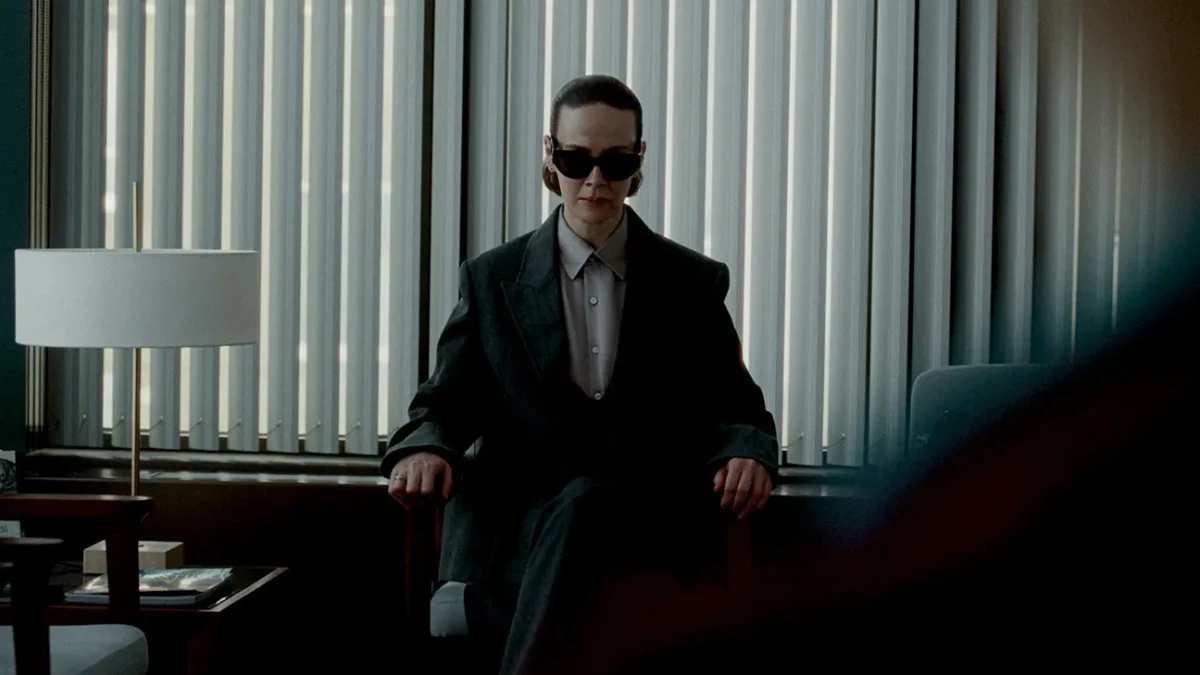
Cody Fern steps behind the camera with Closing Night, a Toronto International Film Festival Special Presentations entry that brings together Sarah Paulson, Naomi Watts, Dianne Wiest, Toby Wallace and Odessa A’zion for a family melodrama built around old wounds, a Broadway comeback and one long-buried secret.
The actor-turned-director’s debut, written by Fern and Devon Bostick, runs 1 hour and 55 minutes and places Paulson at the center as Sandra Vale, a celebrated stage and screen performer preparing for her Broadway return in Brecht’s Mother Courage. But from the start, Sandra’s professional composure is fraying: During rehearsals, she is having unexpected trouble with lines and motivation, even as she formally invites her estranged family to attend opening night.
The setup invites big emotions, and Closing Night is clearly aiming for a heightened, theatrical mode. The film also appears to nod toward John Cassavetes’ Opening Night, the 1977 Gena Rowlands film about an actress confronting a debilitating personal crisis. But Fern’s movie has difficulty binding its inspirations into a coherent tone, moving from archness and brittle comedy toward sorrow and anguish without making the transition feel seamless.
A family reunion built on resentment
Watts plays April, Sandra’s anxious sister, who bristles at being “summoned” after three decades of silence. Her immediate concern is Theo, her directionless son played by Toby Wallace, who is living in New York and has already made contact with his famous aunt before April can intervene. The film underscores Sandra’s outsized presence through posters around the city, making Theo’s encounter with her feel almost inevitable.
Dianne Wiest enters as Diane, April and Sandra’s tart-tongued, heavy-drinking mother, who initially refuses to travel from the family’s distant hometown, where she owns a run-down hair salon. Diane is still nursing her own grievance over Sandra sleeping with April’s boyfriend when Sandra was 15. But once April starts sending updates from New York, Diane changes course and gets on a plane.
Wiest emerges as one of the film’s sharper assets, particularly in moments that give Diane a lived-in comic edge. One of the character’s most revealing details comes when she specifies, while arranging travel, that she wants a hotel room with a minibar.
The next generation is represented by Theo and his girlfriend Lucy, played by Odessa A’zion. Lucy’s pregnancy becomes one of the early revelations after April, snooping in their bathroom, discovers a positive home pregnancy test. April also steals a hairbrush, a kleptomaniac detail the film introduces without giving it much dramatic weight.
Strong cast, uneven material
Paulson’s Sandra is played with severe intensity, a performance mode that connects to the film’s broader sense of heightened melodrama. The influence of Ryan Murphy, with whom Fern has worked frequently as an actor, also seems to hover over the film’s arch tone. But Closing Night lacks the camp that might have helped that style land more cleanly.
The film’s first half appears to chase the charged emotional register of Pedro Almodóvar-style stories about turbulent motherhood, family trauma and hidden truths. Yet the movie struggles to control that register. It is not that the performers are incapable; Paulson and Watts remain compelling screen presences. The issue is that the film asks them to push hard against material that does not always support the scale of their performances.
The story shifts more decisively after Sandra begins slurring and scrambling her lines before collapsing onstage. A shattering diagnosis follows, accelerating a thaw between Sandra and April, though Diane remains harder to soften. The film’s largest secret involves Theo and the reason Sandra separated herself from the family years earlier.
In the final act, the script takes a solemn turn as Sandra decides on a drastic step and asks April to help her see it through. Those scenes contain affecting moments, but the movement from early seriocomic family dysfunction to later grief and self-reproach is handled unevenly.
Among the characters, Theo and Diane come closest to feeling fully grounded. Theo is caught emotionally among the women in his family, while Diane brings the kind of humor and specificity that the film otherwise leans on heavily to cut through the intensity. Sandra and April, by contrast, sometimes feel as if they belong to an even more florid mode of family drama.
With Paulson, Watts and Wiest in the same ensemble, Closing Night has no shortage of acting power. The disappointment is that the movie’s tonal uncertainty keeps that lineup from generating the richer, sharper and more satisfying drama its premise promises.