
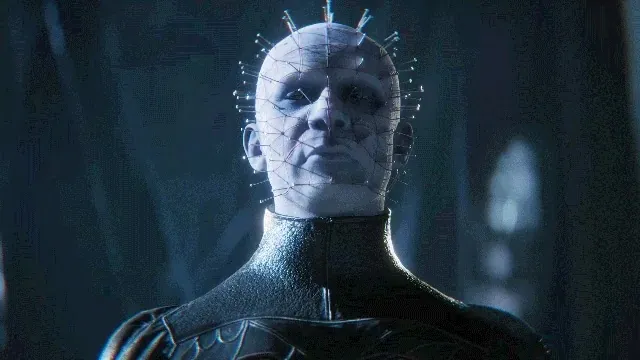
Clive Barker’s Hellraiser: Revival is bringing Barker’s horror franchise into games with a new standalone story set more than 20 years after the events of the first film — and the developers at Saber Interactive are making clear they are not sanding down the property’s sharper edges.
Previewed at Gamescom 2026 in August, the game centers on Aiden, a troubled young man whose relationship with his girlfriend, Sunny, pulls them into a nightmare built around pain, pleasure and the Cenobites. Doug Bradley returns as Pinhead, while Barker was involved in helping the team understand the spirit of Hellraiser without controlling every creative decision.
Saber Interactive game director Emil Esov said the project began not with Barker directly, but with the practical matter of speaking to licensors and IP holders about whether the rights were available. Once the opportunity became real, the studio moved quickly.
“We jumped at the opportunity because there was no Hellraiser game ever,” Esov said, before noting that the team eventually connected with Barker.
Barker’s Guidance, Not a Creative Leash
Narrative director Antony De Fault described Barker as “very easy to work with,” saying the creator understood that the developers needed space to make the game their own rather than simply execute instructions from afar.
According to De Fault, Barker’s main concern was that the team grasp the spirit of the series. From there, he “let us rip.” Barker did not challenge major creative choices, De Fault said, though he did offer guidance on the representation of the labyrinth and certain aesthetic decisions.
That freedom appears to have shaped the studio’s approach to adapting a franchise known for pushing horror beyond simple shocks. De Fault said the team was not nervous about interpreting Hellraiser through a game format. Instead, he called the assignment exciting because of the distinctive space the property occupies in horror.
He said Hellraiser gave the developers permission to push the game’s maturity, its graphic imagery, the blending of sex and violence, and what he described as philosophical horror in a way that might not have been possible with an original property or another IP.
Aiden, Sunny and a Story About Unfillable Voids
While the Cenobites remain part of the mythology, De Fault said Aiden is a new character created for the game, as are basically all of the characters other than the Cenobites.
De Fault described Aiden as “a very messed-up character,” with a history that includes addiction, prison and gangs. At the beginning of the game, Aiden is in what De Fault called “a pretty unhealthy relationship” with Sunny, who is described as a similar kind of person.
The narrative team sees both characters as people driven by an inner emptiness they are constantly trying, and failing, to fill. That idea, De Fault said, pushes them toward the extreme behavior shown in the Gamescom preview.
Esov said the team went back to Barker’s original work, the novellas and the first couple of movies while developing its understanding of the franchise. The developers did not go further than the early works, he said, because the goal was to dissect the essence of Hellraiser.
Although the team was familiar with Hellraiser in a general cultural sense before development began, Esov said they dug deeper into the material to capture the story, the idea and the overarching theme of discomfort in every scene. He described the game as a story about unfulfilled voids, adding that Hellraiser is, at its core, “transcendence gone wrong.”
Horror Influences and a Provocative Mandate
On the gameplay side, Esov said the developers studied other horror games, looking at how they work and what elements could be used or “weaponized” for Revival. He cited influences from Resident Evil, BioShock and Condemned: Criminal Origins, while also emphasizing that Saber tried to add its own ideas, including configuration as a gameplay element.
The preview apparently does not shy away from blood, gore, violence or sexual innuendo, all of which the discussion framed as part of the film series’ identity. De Fault said the team has been called “sickos” in press coverage of the game, but argued that provocation is central to what Hellraiser is.
“The purpose of Hellraiser as a piece of art is to be nobly provocative,” De Fault said. “So, the game is also provocative.”
For De Fault, that provocation is not meant to exist only for shock value. He said the intent is to make players think, to expand the mind and to avoid seeing the world in purely binary terms such as pain and pleasure. As long as the material had a philosophical purpose, he said, the team felt it was valid within the spirit of Hellraiser.
Doug Bradley’s Pinhead Has an Agenda
Bradley’s involvement came later in production than Barker’s broader creative guidance. De Fault said Bradley consulted on Pinhead, recorded his lines, read the script and provided notes on how the character might behave or speak.
De Fault said Bradley was “extremely supportive” and responded strongly to the fact that Pinhead has a clear agenda in the game. In Revival, Pinhead is trying to accomplish something over the course of the story, and his motivations drive the plot as much as Aiden’s do. De Fault said that differs from the other Hellraiser projects in which Bradley performed the character, and gives Pinhead more agency and more lines.
What Happens Next?
Clive Barker’s Hellraiser: Revival is scheduled to launch October 8, 2026, for Nintendo Switch 2, PlayStation 5, Windows and Xbox Series X/S.