
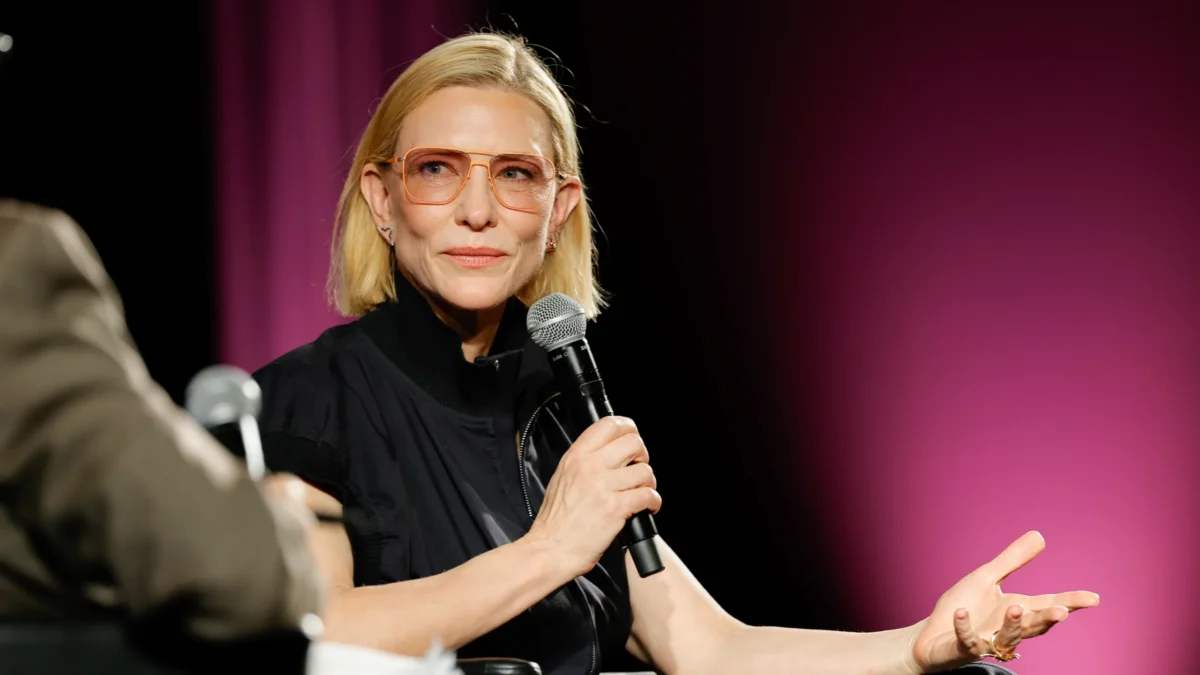
Cate Blanchett has presented the first five short films produced through her Displacement Film Fund at the Tokyo Film Festival, bringing the initiative’s inaugural slate to audiences alongside fund directors Shahrbanoo Sadat and Mohammad Rasoulof.
The two-time Oscar winner joined Sadat and Rasoulof for a post-screening Q&A after the festival showed Rotation by Maryna Er Gorbach, Sadat’s Super Afghan Gym, Hasan Kattan’s Allies in Exile, Mo Harawe’s Whispers of a Burning Scent and Rasoulof’s Sense of Water.
Blanchett, who launched the Displacement Film Fund in 2025, described the program as the result of a long effort by a committed group seeking to support filmmakers who have experienced displacement.
“One in 70 people around the world is displaced. A group of us began asking: Why aren’t these urgent and compelling stories more visible in the mainstream? We wanted to find a way to help bring them to audiences,” Blanchett said.
She also pointed to the creative possibilities of the short-film format, describing it as a space in which filmmakers can take risks and experiment. The fund, she explained, wanted to give that opportunity to the selected artists.
Stories Beyond a Label
During the discussion, Blanchett emphasized that displacement is part of the filmmakers’ experience but should not be treated as the defining feature of either the artists or their work. She echoed Sadat’s observation that terms such as “displaced” and “refugee” do not fully define a person.
“These filmmakers happen to be displaced, but that is not the defining characteristic of their work,” Blanchett said.
Although Blanchett said she has not personally experienced displacement, she spoke about finding a strong connection to the five films as both an audience member and a film artist.
“They speak about things I’ve experienced, too,” she said. “The filmmakers reach into very different forms and stories to express our common humanity.”
Two of the shorts place questions of belonging, identity and adjustment at the center of their stories. Rasoulof’s Sense of Water follows an exiled Iranian writer struggling to learn the language of his adopted home.
Sadat’s Super Afghan Gym, meanwhile, centers on Afghan housewives in Kabul who meet at a local gym during the sole hour of the day reserved for women. As they train, the women discuss body norms and their everyday lives.
Sadat said the film grew from her interest in the social pressures that can leave people feeling uneasy about their bodies or convinced that they must change themselves to gain acceptance.
“Whether we move from one place to another, or live in Asia or elsewhere, we carry our first home with us: our bodies,” she said. “With Super Afghan Gym, I wanted to talk about these feelings of not being comfortable in your own body.”
A Surprise Guest Joins the Q&A
The Tokyo presentation also brought an unexpected addition to the stage. Godzilla Minus One filmmaker Takashi Yamazaki appeared during the Q&A and praised the selection of films, highlighting the balance across the five-short program.
Yamazaki expressed confidence that the Displacement Film Fund would continue with further editions and said he looked forward to watching the films that emerge from them.
The initiative operates with the Rotterdam Film Festival’s Hubert Bals Fund as its management partner. Its founding partners are Amahoro Coalition, Droom en Daad, Master Mind, the Tamer Family Foundation and UNIQLO.
A second group of filmmakers was announced at last year’s Cannes Film Festival. That cohort includes Mo Amer, Annemarie Jacir, Akuol de Mabior, Rithy Panh and Bao Nguyen.
ShowBiz Take
The Tokyo screening marks a key step for the Displacement Film Fund: the project has moved from its stated ambition of supporting displaced filmmakers to publicly presenting its first five completed shorts.
Just as importantly, Blanchett and the fund’s directors are resisting the idea that the filmmakers should be viewed only through the circumstances of displacement. The range described at the festival—from an exiled writer confronting a new language to women discussing their bodies and daily lives in a Kabul gym—supports the fund’s broader focus on individual stories and forms of expression.
With a second cohort already identified, the Tokyo event serves not only as a showcase for the first group but also as an early indication of the fund’s continuing work.
What Happens Next?
The filmmakers in the second cohort are set to carry the Displacement Film Fund into its next phase, although further details about their individual shorts were not provided. The Tokyo Film Festival continues through November 4.