
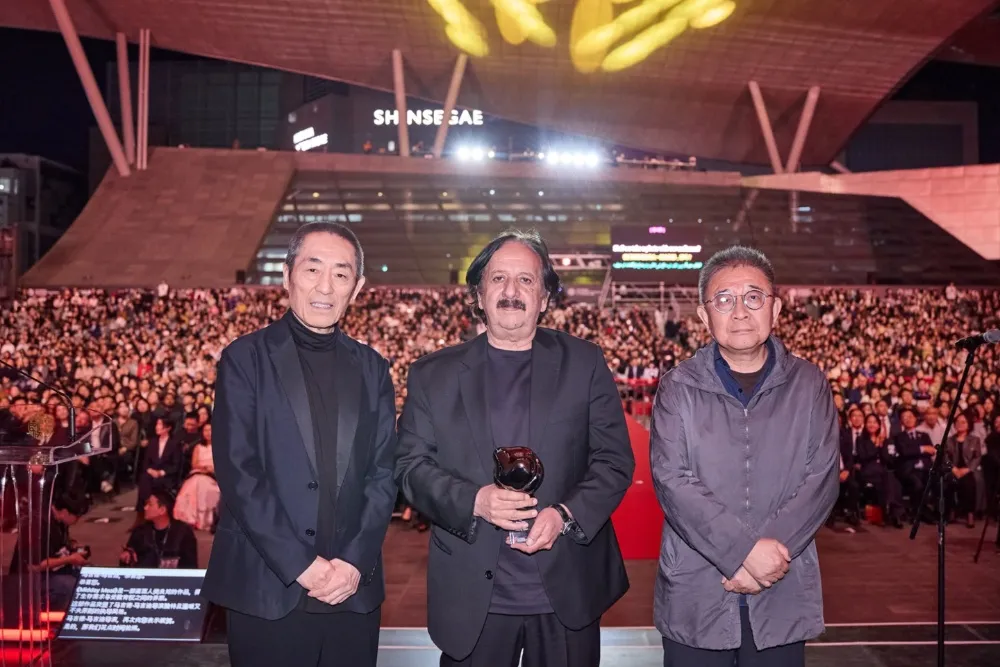
The Busan International Film Festival closed its 31st edition with its strongest film attendance in more than a decade, even as disputes surrounding a Korean box office hit and an anti-war awards speech placed politics at the center of the Oct. 6–15 event.
Festival screenings recorded 200,043 admissions, the highest total since 2015. Overall attendance reached 277,027 when talks, outdoor events and side programs were included — roughly 40,000 above last year’s milestone 30th edition. Organizers attributed the increase to a new opening date and an expanded screening lineup.
Community BIFF, the audience-programmed section in Nampo-dong, attracted 29,511 visitors, more than 1.7 times its previous figure. BIFF Everywhere also brought films to a record 18 locations, including Buddhist temples, traditional markets and a National Assembly building in Seoul.
Political dispute disrupts festival appearances
The controversy surrounding Hur Jin-ho’s thriller “The Assassin(s)” overshadowed the opening week. The film, which opened Sept. 23 and topped Korea’s admissions chart, concerns the Aug. 15, 1974 shooting of first lady Yuk Young-soo, wife of then-President Park Chung-hee. Conservative politicians and online critics accused the movie of distorting history.
On Oct. 1, BIFF canceled “Actors House: Lee Min-ho,” a planned career conversation with one of the film’s stars. The following day, production company Hive Media Corp. withdrew the cast and crew from every festival appearance, including the opening ceremony and an outdoor stage greeting, citing audience and attendee safety. That decision followed a conservative group’s announcement of daily protests outside lead actor Yoo Hae-jin’s home.
Asked about the dispute, jury president Zhang Yimou said he had not seen the film but defended respect for a creator’s vision. Fellow juror July Jung, director of “Next Sohee” and “Dora,” said her “heart feels so cold as a filmmaker.”
Around 20 filmmakers, including Chung Ji-young and Lee Myung-se, later held a Busan press conference urging politicians to stop using the film as a political weapon and allow audiences to judge it. They also criticized the opposition People Power Party after its 109 lawmakers asked the Singapore International Film Festival to withdraw the movie. Singapore retained “The Assassin(s)” as its Oct. 21 opening title.
“Midday Meal” takes Busan’s top prize
Politics surfaced again when Majidi’s “Midday Meal,” about a rural schoolteacher, received the Busan Award for best film. After accepting the trophy from Zhang, the Iranian director spoke against the war in Iran and discussed a February U.S. military strike on a school in Minab that killed 156 civilians, including 120 schoolchildren.
Majidi dedicated the honor to the Iranian people, saying, “They will stand firm to the end and fight to get their independence back.” He added: “I wish for a future with no war.”
This was Busan’s first edition since FIAPF recognized it as an A-list festival and the second year of its 13-title Asian competition. The victory allows “Midday Meal” to enter the Oscars’ international feature race without going through a national selection.
Eddie Cahyono’s Indonesian drama “Ibuku” won the special jury prize, while Lee Yun Chan was named best director for Taiwan’s “To Be Ordinary.” Best actor was shared by Zhou Xun for “The First Taste of Loneliness” and Himeno Kashun for “Satoko Always.” Li Danfeng received the artistic contribution award for sound direction on “The First Taste of Loneliness.”
The event’s newly elevated status was reflected on its red carpet. Michelle Yeoh returned after a 15-year absence and was named Asian Filmmaker of the Year. Ann Hui received the Camellia Award, while former festival chair Kim Dong-ho collected the Korean Cinema Award. Fan Bingbing, Charlotte Gainsbourg and Alfonso Cuarón also attended opening night, with Cuarón making his first official trip to Korea.
Market grows as financing pressure intensifies
The Asian Contents & Film Market ran Oct. 10–13 at BEXCO and welcomed 30,484 visitors, an increase of 1.6%. Registrations rose 4.3% to 3,158 participants representing 1,266 companies across 58 countries. Its 339 exhibitors marked a 17% rise, including 49 first-time exhibitors and debut pavilions from Czech and Slovak participants and Cambodia.
ACFM director Ellen Y.D. Kim told Variety that funding remains the market’s biggest obstacle, with national support staying at the same level for two consecutive years despite rapid growth in the event’s size and role.
Industry groups nevertheless pursued new partnerships. The Producers Guild of Korea and Indonesia’s APROFI formed the Asian Producers Alliance alongside producer organizations from the Philippines, Taiwan and Hong Kong. The coalition is intended to support co-productions and policy collaboration.
On Oct. 12, Solaire Partners and Japan’s Questry signed a memorandum of understanding to create a KRW100 billion ($74.6 million) Korea–Japan content fund. A new Investor Summit also assembled 20 companies, while Cinema by Brand connected three film projects with brand backing.
Technology was another major talking point. Netflix senior director of APAC production Lee Sung Q said the streamer has used AI in some form on around 300 titles. Director Kang Yoon-sung estimated that AI could save 30% to 40% of a feature’s budget, but warned that the technology can remove the debate and shared experience central to filmmaking. Both Kang and Lee emphasized that human involvement remains essential to conveying emotion.
ShowBiz Take
Busan’s decade-high film turnout and expanding market show an event growing in audience reach, international participation and industry influence. Yet this edition also demonstrated the pressures accompanying that profile: political campaigns can disrupt talent appearances, financing remains difficult for independent projects, and AI’s cost-saving potential is advancing faster than agreement over its creative value.
The festival’s new A-list standing, “Midday Meal’s” direct route toward the international feature race and the formation of new cross-border financing and producer partnerships ensure that the 31st edition will be measured not only by its record crowds, but by what its deals, debates and award winners do next.