
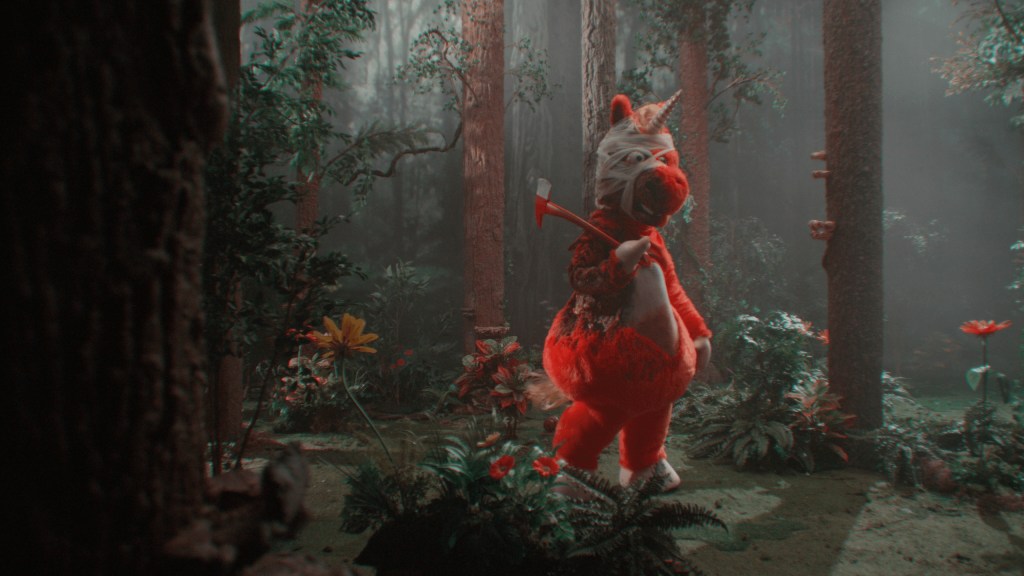
“Buddy,” the off-kilter horror-comedy from filmmaker Casper Kelly, broke through the weekend’s specialty box office with an unexpectedly strong showing, landing at No. 6 on the domestic chart and giving Roadside Attractions and Saban Films a new high-water mark for a release of its kind.
The result is the sort of late-weekend surprise that theater owners and specialty distributors still chase: a movie without the marketing muscle of a major studio campaign managing to elbow its way into the national conversation. For Roadside and Saban, the performance is especially notable because it demonstrates that a carefully positioned genre title can still generate theatrical urgency in a market where smaller films often struggle to separate themselves from streaming noise.
Kelly, whose work has built a cult following by twisting familiar formats into surreal, unsettling comedy, arrived with a film that was never expected to play like a conventional mainstream horror release. That may have been the point. “Buddy” leaned into its oddness, selling itself as a strange theatrical event rather than a safe, easily categorized offering. Audiences responded strongly enough to push it into the weekend’s upper tier, ahead of several higher-profile specialty titles and holdovers.
While the broader box office continues to be driven by franchise fare, family films and established horror brands, “Buddy” offers a reminder that the middle lane is not entirely closed. Specialty distributors have spent the past several years recalibrating expectations as adult dramas, prestige awards titles and art-house imports have become harder sells theatrically. Genre, however, remains one of the few dependable ways to mobilize younger moviegoers and create word-of-mouth heat quickly.
That makes the “Buddy” debut more than a quirky footnote. Horror-comedy can be difficult to sell because it asks audiences to accept two tones at once, and it often relies on precise marketing to communicate whether viewers are getting a midnight movie, a broad comedy, a gore-forward scare picture or something stranger. Roadside and Saban appear to have benefited from presenting the film as a distinctive piece of counterprogramming rather than sanding down its edges.
The No. 6 finish also arrives at a time when distributors are looking for proof that smaller theatrical bets can still pay off. Marketing costs have risen, release calendars are crowded and platforms have trained audiences to wait for at-home availability. But specialty success stories continue to emerge when a film has a clearly defined audience and a reason to be seen in a room with other people. “Buddy” seems to have tapped into that appetite for communal discovery.
For Roadside Attractions, which has long operated in the space between prestige-minded adult fare and commercial specialty releases, the film’s breakout adds momentum to a theatrical strategy built on selectivity. The company has frequently found success by backing films that major studios might consider difficult to slot. Saban, meanwhile, has been active in genre and independent acquisitions, making “Buddy” a useful signal that theatrical upside still exists for the right acquisition when the positioning is sharp.
The weekend also underlines how horror remains one of the most durable categories in the independent marketplace. Unlike many dramas that require reviews, awards attention or recognizable stars to reach beyond core audiences, horror can move quickly on concept, atmosphere and online chatter. When comedy is added successfully, it can broaden the audience while giving fans something to quote, clip and debate.
Kelly’s profile likely helped. His previous projects have circulated widely among viewers who favor the bizarre, the formally inventive and the darkly comic. That built-in curiosity may not resemble traditional star power, but in the current marketplace, a filmmaker with a loyal internet-era following can be just as valuable as a familiar face on the poster. “Buddy” appears to have converted that curiosity into ticket sales.
The film’s performance may also encourage buyers to look more aggressively at unconventional genre material. Independent distributors have sometimes treated theatrical as a limited prestige platform before a more important digital or streaming window. A result like this complicates that thinking. If a movie can generate a top 10 domestic placement and establish a distributor record, the theatrical window becomes part of the value proposition rather than a symbolic stop on the way to home viewing.
Of course, the next test will be staying power. Specialty films that open above expectations can fade quickly if the initial audience represents most of the demand. But horror and comedy both have a useful advantage: they can travel through reaction. If audiences leave “Buddy” talking about the experience, the movie has a better chance of holding screens and expanding its footprint.
For exhibitors, the breakout is welcome news. Theaters need a steady flow of films that appeal to different pockets of the audience, particularly between tentpoles. A surprise like “Buddy” fills seats, diversifies the weekend lineup and gives smaller venues a conversation starter at a time when programming variety is increasingly important.
The specialty sector will be watching closely to see whether “Buddy” is a one-week curiosity or the beginning of a longer run. Either way, its opening has already made a point: eccentric genre films can still cut through when distributors embrace what makes them unusual.
What Happens Next
Roadside Attractions and Saban are expected to use the strong opening as leverage for continued playdates, with word of mouth determining how widely “Buddy” can grow in the coming weeks. If the film holds well, it could become a model for how distributors handle oddball horror-comedies: targeted, theatrical-first and unapologetically weird.